

How does your brain hold on to a memory, and how can you help it? Meet working memory and long-term memory, see why sleep helps, and try some memory tricks. Free STEM lesson for Grade 2 and up.
Beginner · STEM · Curiosity Questions
Materials: Paper, a pencil and 10 small everyday objects, like a spoon, a sock and a toy car. Grown-ups: pick things too big to swallow if little ones are nearby. A grown-up nearby and about 10 minutes.
Tips: Read the What and How parts aloud together. Try each memory trick as you read. Stop while it is still fun.
Before we explain, wonder together:
- Can you remember 3 things you ate yesterday?
- Why is a phone number split into groups?
- Do you remember things better after a good sleep?
There are no wrong guesses. Notice first, then explore.
Ask → Explore → Apply: We ask those questions. We explore how memory works, why sleep helps and some memory tricks. Then we apply it with a quiz-yourself game and Memory X.
Memory
Memory at a glance
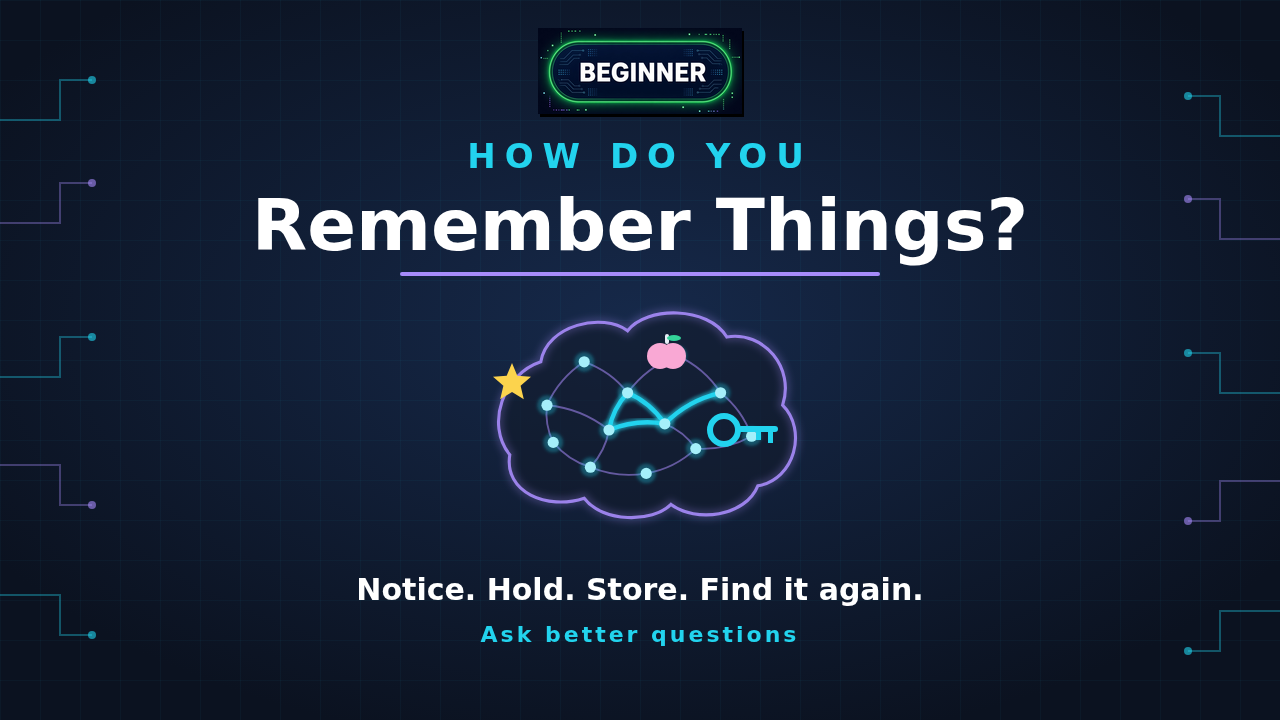
Four steps: Notice → Hold → Store → Find again
Working memory: Holds a few things for a few seconds
Long-term memory: Keeps things for days or even years
Best helpers: quiz yourself, repeat over days, sleep.
Fun extras: chunks, stories, pictures.

Memory means keeping something in your brain and finding it again later.
Your brain has tiny cells called neurons. They pass messages to each other.
Making a memory has steps. First you notice something. Then you hold it for a moment, and your brain can store it to find again later.
When you learn something, a group of brain cells connects. Using that memory again makes those connections stronger.
Scientists at the Queensland Brain Institute in Australia say a part of the brain called the hippocampus (hip-oh-CAMP-us) is important for memory. It helps make new memories.

Here is how two kinds of memory work together.
Working memory is like a small sticky note. It holds only a few things, for just a few seconds, while you use them.
Long-term memory can keep things for days or even years. Each time you use a memory, its brain connections get stronger, so it is easier to find again.
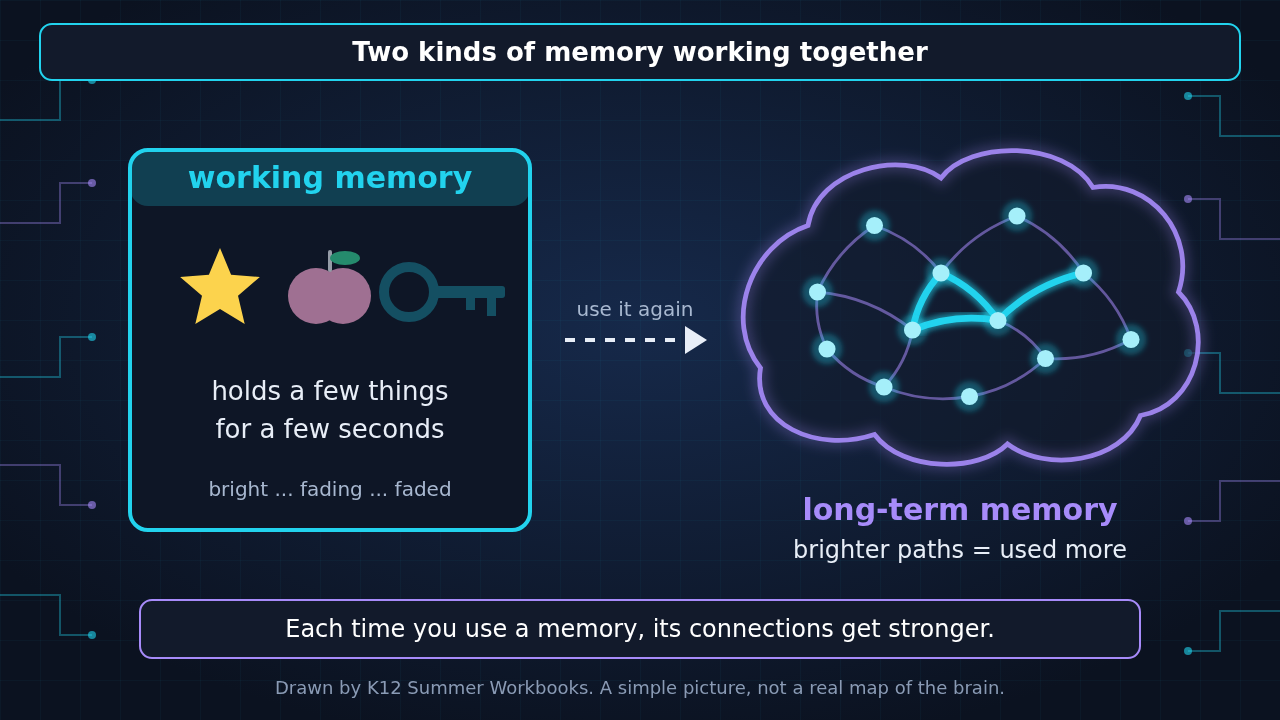
Working memory holds a few things for a moment. Long-term memory is a web of connections that grow stronger with use.
How does something stick in long-term memory? Use it again. Practice it now, and then again on another day.
Practice spread out over days is called spaced practice. Many studies found it helps people remember for longer than practicing all at once.
Why does sleep matter? Sleep helps the brain strengthen and sort the day’s new memories.
Scientists at the Queensland Brain Institute say that while you sleep, the hippocampus replays recent events, like a quick rerun. Sleep scientists who wrote “Why Sleep?” for the kids’ science journal Frontiers for Young Minds explain it too.
Why learn memory helpers? Working memory is small. Some helpers let you hold more at once, and some help you find a memory later.
Fun fact: Phone numbers are split into groups, like 555-0123, so they are easier to remember. Making small groups is called chunking.
Goal: Try the best helper first, then three fun extras. Then play Memory X, our free memory game.
Start with the best helper.
Quiz yourself: look at the 10 objects for 1 minute, cover them, and write down all you remember. Check, then try again on another day.
Next, try three fun extras. See which ones you like best.
- Chunking. Read 5 8 2 9 1 7 and cover it, then read it as 582-917 and cover it again. Which was easier to say back?
- Story. Link cat, rocket, sock, pizza and moon into a silly story, like a cat in one sock flying a rocket to the moon for pizza. Then cover the words and tell the story back.
- Picture walk. Picture your bedroom and, in your mind, put 5 things in 5 different spots around it. Later, walk past the spots again in your mind and see what is there.
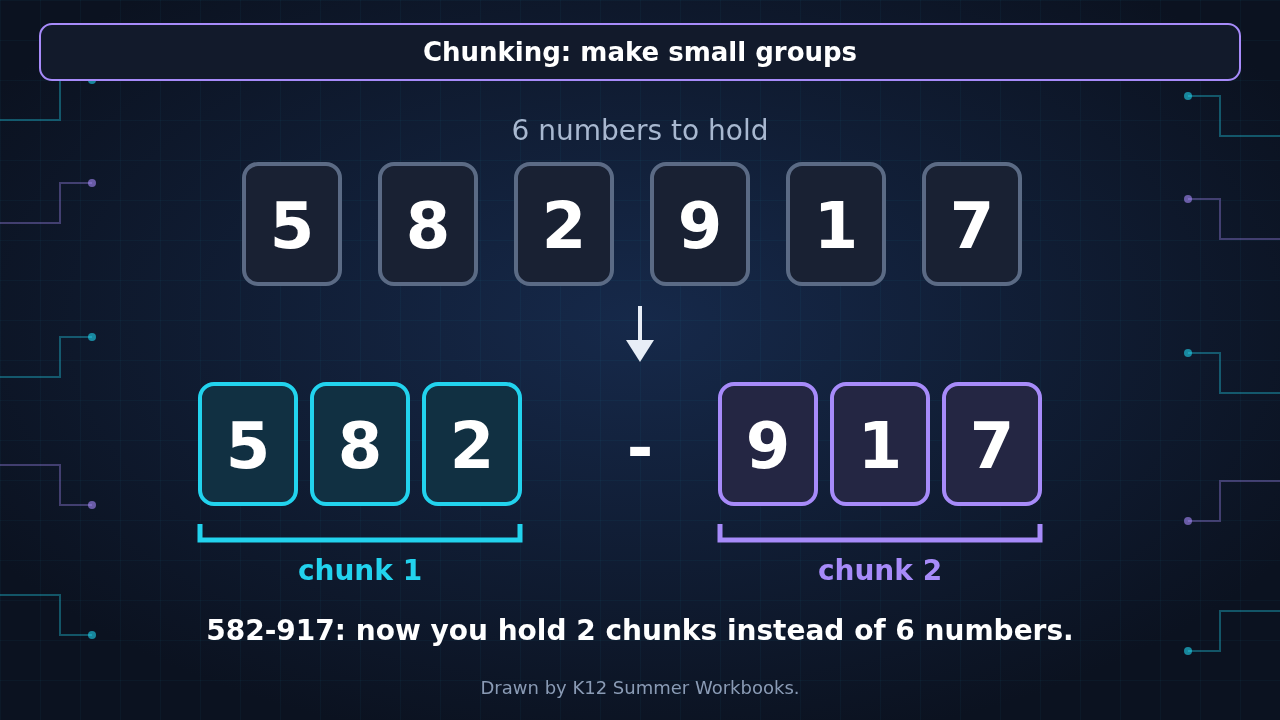
Six numbers become two chunks.
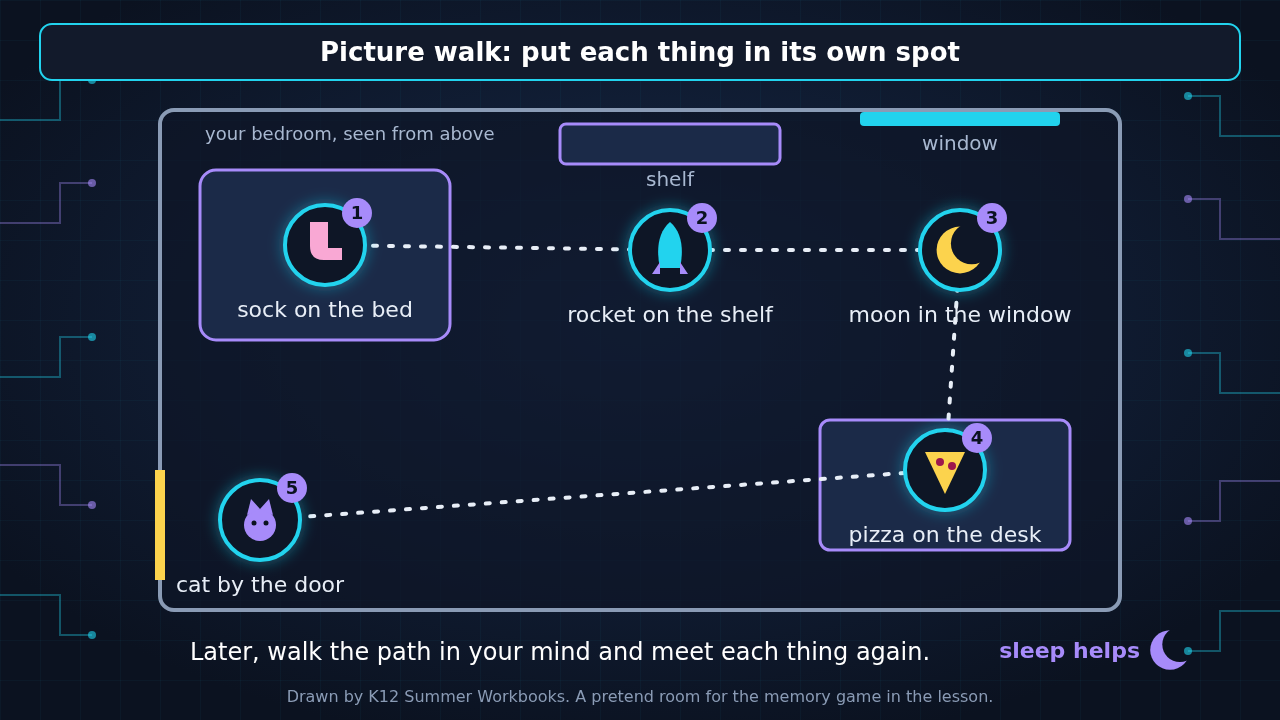
A picture walk: put each thing in its own spot, then walk past the spots again in your mind.
- Watch. The pads light up one at a time. Each pad has its own shape: star, moon, heart or square.
- Repeat. Tap the pads in the same order. On a keyboard, press 1, 2, 3 or 4.
- Chunk it. Try it in pairs: star-moon, star-star.
- Need another look? Tap Show again. There is no clock, so take your time.
- Missed one? That is OK, and there is no game over. The game gives you a shorter one, or lets you see the same one again.
Check your thinking: The pads light up star, moon, star, star, heart, square. In pairs, that is star-moon, star-star, heart-square. Now you hold 3 chunks instead of 6 shapes.
Talk about it: Which helper worked best for you? Why do you think so?

Use these helpers for spelling words, math facts or a new friend’s name.
Quiz yourself instead of just reading it again. Then review it on another day, and again a few days later.
Get a good night’s sleep after you learn something new.
What next? Play Memory X again on another day. See if you can beat your longest pattern.
When you come back on another day, it says “You came back! You earned a Practice Again badge.”
Keep exploring
Next step: Play Memory X. Find more free apps in the Practice Zone.
Related lessons:
- How Do You Learn to Type?: practice the home row a little each day.
- What Is AI?: how computers learn from examples.
- What Is Multiplication?: facts to practice with your new memory helpers.
More free lessons: All lessons, Free STEM samples and the Practice Zone.
Grown-up corner
- Sleep. The American Academy of Sleep Medicine recommends 9 to 12 hours of sleep per 24 hours for children 6 to 12. If you’re worried about your child’s sleep, talk to their doctor.
- Sleep and memory. A 2010 review by Diekelmann and Born in Nature Reviews Neuroscience describes how sleep helps the brain strengthen newly learned information.
- How much working memory holds is debated. Miller (1956) described about 7 plus or minus 2 items, and Cowan (2001) argues for about 4 chunks in short-term memory. Children hold fewer, and capacity grows through the school years (Gathercole and colleagues, 2004), so we say “a few things.”
- Which helpers help most. Dunlosky et al. (2013) rated distributed (spaced) practice and practice testing 'high utility', and the keyword mnemonic and imagery use for text learning 'low utility'. They did not rate story chaining, chunking, or the picture-walk trick from this lesson.
- A learning aid. This is a learning aid, not a test of memory or attention. Talk to your child’s doctor or teacher about any concerns.
- No rushing. Memory X has no game over, no answer timer and no sound until you turn it on. After a miss, it says “That was a tricky one! Let’s try a shorter one” and gives a shorter pattern. At the shortest length (3), it says “Nice try! Let’s watch it again.” and replays the same pattern after a short pause (or right away with the Show again button). After each pattern, the next one starts by itself after a short pause; tap Pause to wait.
- Progress. Memory X: progress stays on this device, and there is no sign-up. Clearing the browser’s site data, or using another device, starts over.
- Platform. Memory X runs on the Grok Build platform. Like any website, its host receives your device’s IP address when the page opens. The page also loads a script from grok.com, which sends your device’s IP address to grok.com, and grok.com may set cookies. grok.com is a separate service, and its own privacy policy applies. Full details: https://k12summerworkbooks.com/privacy-apps. Opens in a new tab.
- Screen time. Keep sessions short. Adult supervision is recommended for screen time.
Supplemental. This free lesson and Memory X are a learning aid for home or summer learning. They are not a school curriculum.
Word bank
- Memory — Keeping something in your brain and finding it again later.
- Neuron — A kind of brain cell. Neurons pass messages to each other.
- Hippocampus — A part of the brain that helps make new memories.
- Working memory — A small sticky note in your mind. It holds a few things for a few seconds.
- Long-term memory — Memory that can keep things for days or even years.
- Spaced practice — Practice spread out over different days.
- Quiz yourself — Cover what you learned and try to say or write it back.
- Chunk — A small group of things you remember as one, like 582.
- Picture walk — Putting things in spots around a room in your mind, then walking past them again.
Sources: Queensland Brain Institute: Types of memory; Queensland Brain Institute: How are memories formed?; Queensland Brain Institute: Where are memories stored?; Manoach and Stickgold (2013), Why Sleep?, Frontiers for Young Minds; Paruthi et al. (2016), AASM pediatric sleep recommendations, J Clin Sleep Med; Diekelmann and Born (2010), The memory function of sleep, Nat Rev Neurosci; Miller (1956), Psychological Review; Cowan (2001), Behavioral and Brain Sciences; Gathercole et al. (2004), Developmental Psychology; Cepeda et al. (2006), Distributed practice, Psychological Bulletin; Dunlosky et al. (2013), Improving Students’ Learning, Psychological Science in the Public Interest.
Made by K12 Summer Workbooks. Text and pictures are original.