


The Moon is an average of 238,855 miles (384,400 kilometers) from Earth. That is about 30 Earths. Build a scale model to see it.
Beginner · STEM · Curiosity Questions
Materials: Two small balls, about 1 inch and 1/4 inch wide. String, scissors and a ruler. A table and a grown-up to help.
Tips: Read the What and How parts aloud together. Ask “What do you notice?” before you explain.
Build the string model at the end. This is the first of two Moon lessons.

Before we explain, wonder together:
- The Moon looks close in pictures. How far away is it really?
- How many Earths could you fit between Earth and the Moon?
There are no wrong guesses. Notice first, then explore.
Ask → Explore → Apply: We ask those questions. We explore the Moon’s distance and orbit. Then we apply it with a ball-and-string model.
The Moon’s distance
The Moon at a glance
Average distance: 238,855 miles (384,400 kilometers)
In Earths: About 30 Earths fit in between
Closest and farthest: 225,309 to 251,903 miles
Moon’s width: A little over a quarter of Earth’s width
Light takes: About 1.3 seconds to cross the gap
The Moon is far away. About 30 Earths would fit in the space between us.

The Moon is the big rock that circles Earth. We see it in the sky.
How far away is it? We measure the distance in miles or kilometers.
A mile is a long way. You can walk one mile in about 20 minutes.
A kilometer is a little shorter than a mile. It takes about 12 minutes to walk.
The Moon is an average of 238,855 miles from Earth. That is 384,400 kilometers.
An average is a middle number. We will see why we need one.
NASA says that is about 30 Earths. So 30 planets the size of Earth would fit in between.
The Moon is smaller than Earth. It is a little more than a quarter as wide.
Picture Earth as a nickel. The Moon would be a coffee bean, NASA says.

Look at the scale picture. It shows Earth and the Moon the right size and the right distance apart.
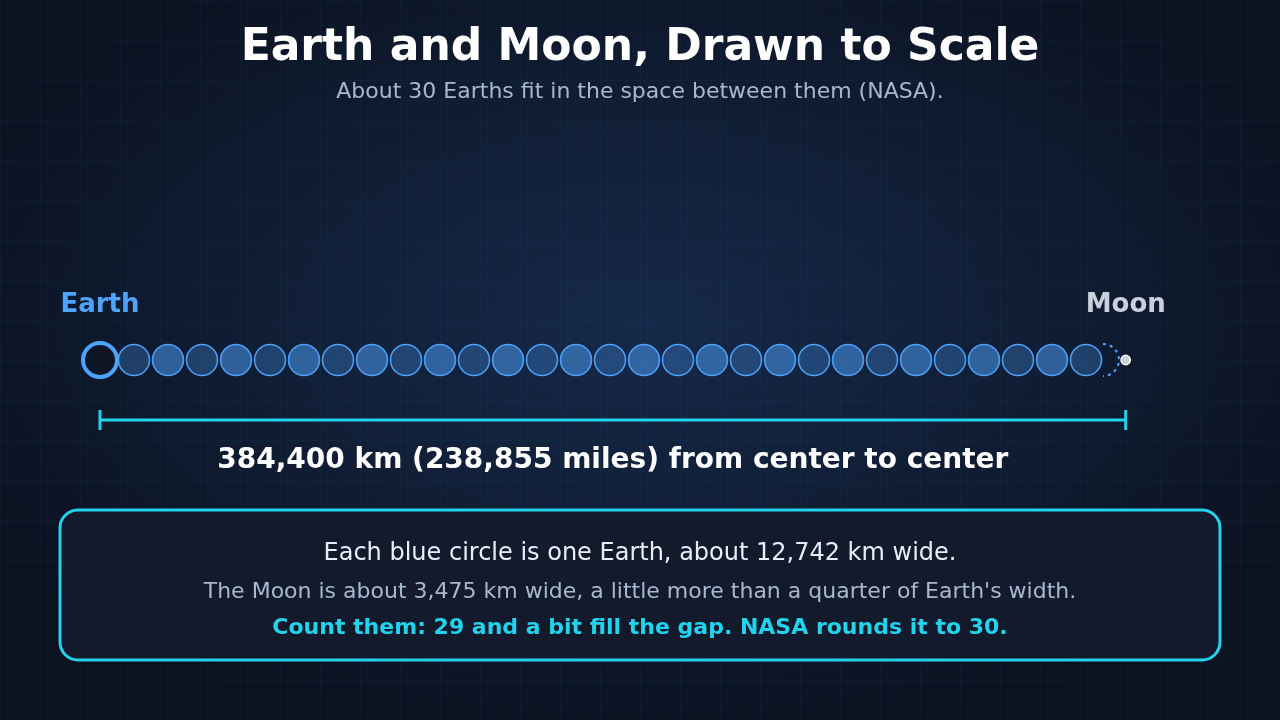
About 30 Earths fit between Earth and the Moon (NASA). The sizes and gap here are to scale.
That is a lot of empty space. In most drawings, the Moon is much too close.
Now look at the orbit picture. An orbit is the path one object takes around another.
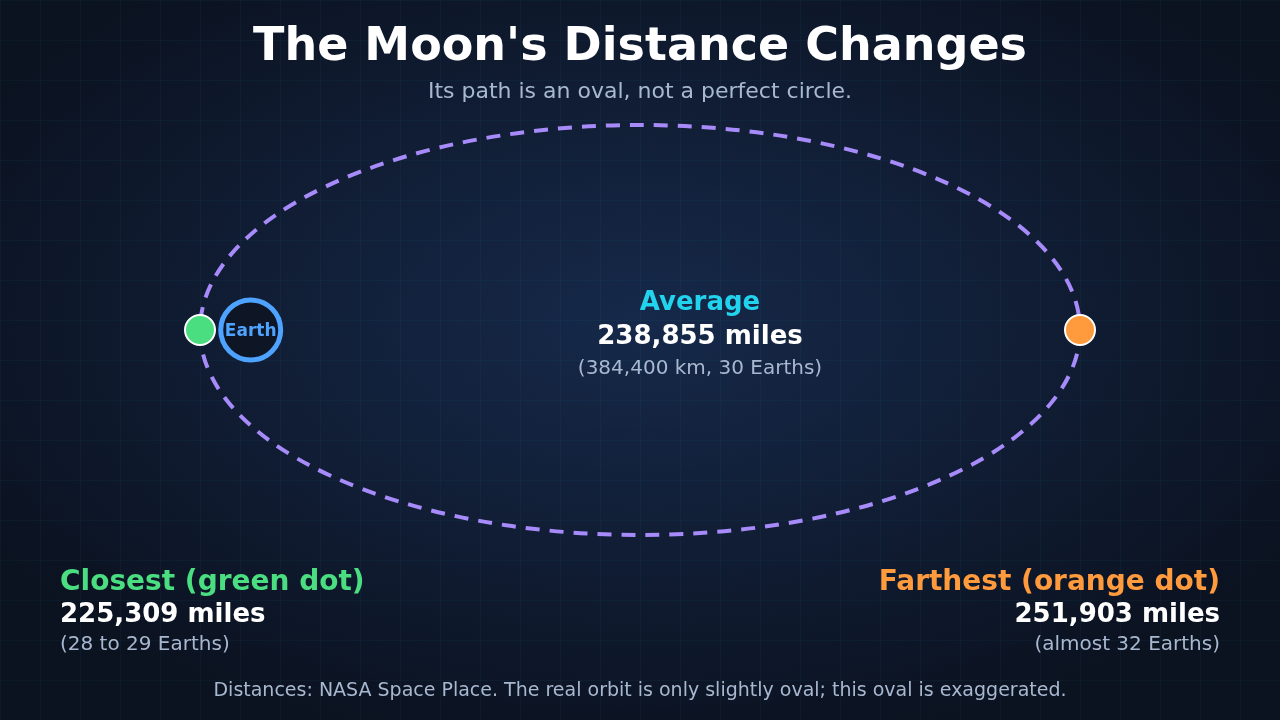
The Moon’s orbit is a little oval, so the distance changes. This drawing exaggerates the oval.
The Moon’s orbit is a little oval. So its distance changes.
NASA says the Moon is closest at 225,309 miles. It is farthest at 251,903 miles.
The average, 238,855 miles, is in the middle. That is why scientists give an average.
The picture draws the oval much too fat. The real orbit is only a little bit oval.

Why does the distance matter? Because it tells us how far light and rockets must go.
Light is the fastest thing we know. NASA says moonlight takes about 1.3 seconds to reach us.
A rocket is much slower. How long does a trip take? Find out in How Long Does It Take to Get to the Moon?.
Fun fact: The Moon is slowly moving away from Earth. NASA says it moves about 3.8 centimeters (1.5 inches) farther every year.

Goal: Build a scale model. That is a small copy with the same proportions. You need two balls, string, scissors and a ruler.
- Pick Earth. Find a ball about 1 inch wide, like a large marble.
- Pick the Moon. Find a ball 1/4 inch wide, like a pea or a bead.
- Cut the string. Make it 30 inches long. That is 2 and a half feet, or 76 centimeters.
- Connect. Tape Earth to one end and the Moon to the other.
- Stretch it. Pull the string tight on a table. That is the real gap, made small.
- Go big. Try a bigger Earth. Use the table in the picture.
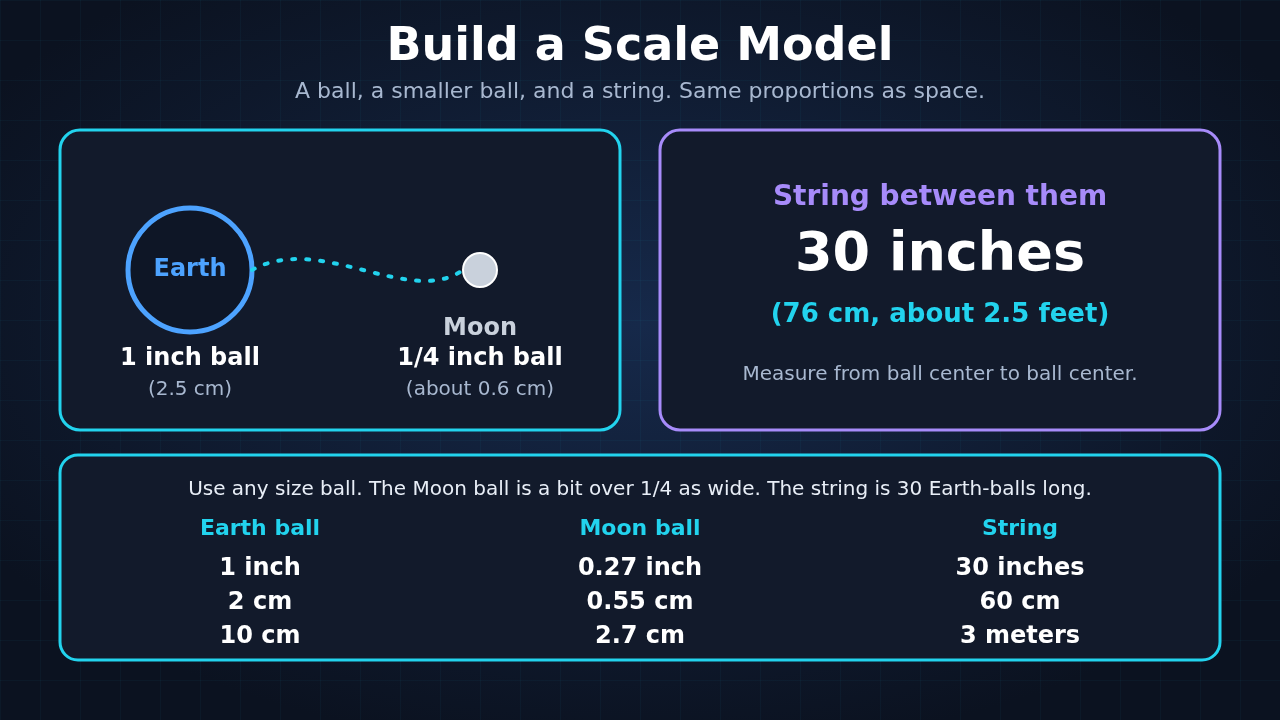
A scale model. Make the string 30 times as long as the Earth ball is wide.
Check your thinking: Your Earth ball is 1 inch wide. Thirty of them in a row make 30 inches. That matches the string.
So about 30 Earths fit between them. A bigger Earth needs a longer string.
Talk about it: Which surprised you more: the Moon’s size or its distance?

You can use this idea any time you need to picture something huge.
A scale model turns far-away places into something you can hold.
Next time you see the Moon, remember the string. It is about 30 Earths away.
What next? Can you walk to the Moon? Find out in How Long Does It Take to Get to the Moon?.
Keep exploring
Next lesson: How Long Does It Take to Get to the Moon?. We use this distance to find out how long a trip takes.
Related lessons:
- How Long Does It Take to Get to the Moon?: use the distance to find a trip time.
- Why Is the Sky Blue?: why the sky is blue.
- What Is a Scam Call?: stay calm and spot the signs.
More free lessons: All lessons, Free STEM samples and the Practice Zone.
For advanced learners
Ready for more? These are deeper facts from the sources we used. Read them with a grown-up.
Think deeper:
- NASA says about 30 Earths fit between Earth and the Moon. Our scale picture shows 29 Earths and a part. Why might the two be different?
- The NASA Fact Sheet says the Moon moves away 3.8 cm per year. The Moon Facts page says “about an inch.” Which number do we quote?
- Space Place says the closest distance is 28 to 29 Earths and the farthest almost 32. Why do you think the number changes?
Which distance? NASA Space Place and NASA’s Moon Facts page both give the average as 238,855 miles (384,400 km). NASA’s Moon Fact Sheet gives the same 384,400 km as the semimajor axis of the orbit (0.3844 million km), with a mean perigee of 363,300 km and a mean apogee of 405,500 km.
Space Place gives one particular closest and farthest, 225,309 and 251,903 miles, which we convert to about 362,600 and 405,400 km. NASA’s Supermoons page gives about 226,000 miles (363,300 km) and about 251,000 miles (405,500 km), and says the distances to apogee and perigee vary by event.
So the sources give slightly different closest and farthest numbers, and each source is correct for what it measures. We used the Space Place figures because it is NASA’s kid page for this exact question.
30 Earths: the math. Earth is about 12,742 km wide (2 x 6,371.0 km, NASA Fact Sheet radii). 384,400 ÷ 12,742 = 30.17 Earths, measured center to center.
The gap between the two surfaces is 384,400 minus Earth’s radius (6,371.0) minus the Moon’s radius (1,737.4), which is about 29.5 Earths. NASA says “30” for both, and our scale picture shows 29 Earths and a part.
Space Place says the closest distance is 28 to 29 Earths and the farthest almost 32.
Size. The Fact Sheet gives a Moon mean radius of 1,737.4 km and an Earth mean radius of 6,371.0 km, a ratio of 0.2727. NASA’s Moon Facts page says the Moon’s radius is about 1,740 km, less than a third of Earth’s width.
We say “a little over a quarter.”
Moving away. The Fact Sheet says the Moon recedes at 3.8 cm per year. The Moon Facts page says “about an inch.”
3.8 cm is about 1.5 inches. We quote the Fact Sheet value.
Scale model. With an Earth ball 1 inch wide, the Moon ball is 0.27 inch wide (we say about 1/4 inch) and the string is 30.17 inches (we say 30). This is our own calculation from the NASA numbers above.
Round balls and string will not be exact. That is fine for a model.
Light time. NASA Glenn’s page “Seeing the Earth, Moon, and Sun to Scale” says the Moon is about 1.3 light-seconds away (240,000 miles).
Supplemental. This free lesson is a STEM aid for home or summer learning. It does not replace a school curriculum.
Word bank
- Moon — The big rock that circles Earth.
- Distance — How far it is from one place to another.
- Mile — A unit of distance. You can walk one in about 20 minutes.
- Kilometer — A unit of distance a little shorter than a mile.
- Average — A middle number that stands for many numbers.
- Orbit — The path one object takes around another.
- Scale model — A small copy that keeps the right proportions.
Sources: NASA Space Place: How Far Away Is the Moon?; NASA Science: Moon Facts; NASA NSSDC: Moon Fact Sheet; NASA Science: Supermoons; NASA Glenn: Seeing the Earth, Moon, and Sun to Scale.
Made by K12 Summer Workbooks. Text and pictures are original.