


A scam call is a phone call where someone lies to get your money or private information. Learn the signs and what to do, calmly.
Beginner · Safety · Curiosity Questions
Materials: Paper, a pencil, and a grown-up to read with you. You do not need a phone.
Tips: Read the What and How parts aloud together. Stay calm and curious. Nothing here is meant to worry you, and nobody needs to be afraid.
Practice the steps like a fire drill. This is general safety information.
Before we explain, wonder together:
- A phone rings. The screen shows a name you do not know. What could you do?
- How could you tell if a caller is telling the truth?
There are no wrong guesses. Notice first, then explore.
Ask → Explore → Apply: We ask those questions. We explore the signs of a scam call. Then we apply it with a spot-the-signs game and a family plan.
Meet the scam call
Scam calls at a glance
What it is: A phone call that tricks you
What the caller wants: Your money or your private information
Common signs: Pressure, secrets, gift cards and codes
Your plan: Hang up. Tell someone you trust.
Who can help: A parent or another grown-up you trust
Stay calm. A scam call is the caller’s trick.
It is never your mistake. You are not in trouble.
A scam call is a trick by phone. Hang up and tell someone you trust.

A scam is a trick to get your money or private information.
A scam call is a scam that comes by phone.
Private information is facts only you and your family should know. Passwords and card numbers are two examples.
The caller may pretend to be someone you know.
They might say they are from a bank, a store, or the government.
They might even pretend to be a family member who needs help.
The caller may sound very friendly. Or they may sound upset and in a hurry.
You do not need to be afraid. You just need a plan.

Scam calls often share the same four signs. Look at the picture.
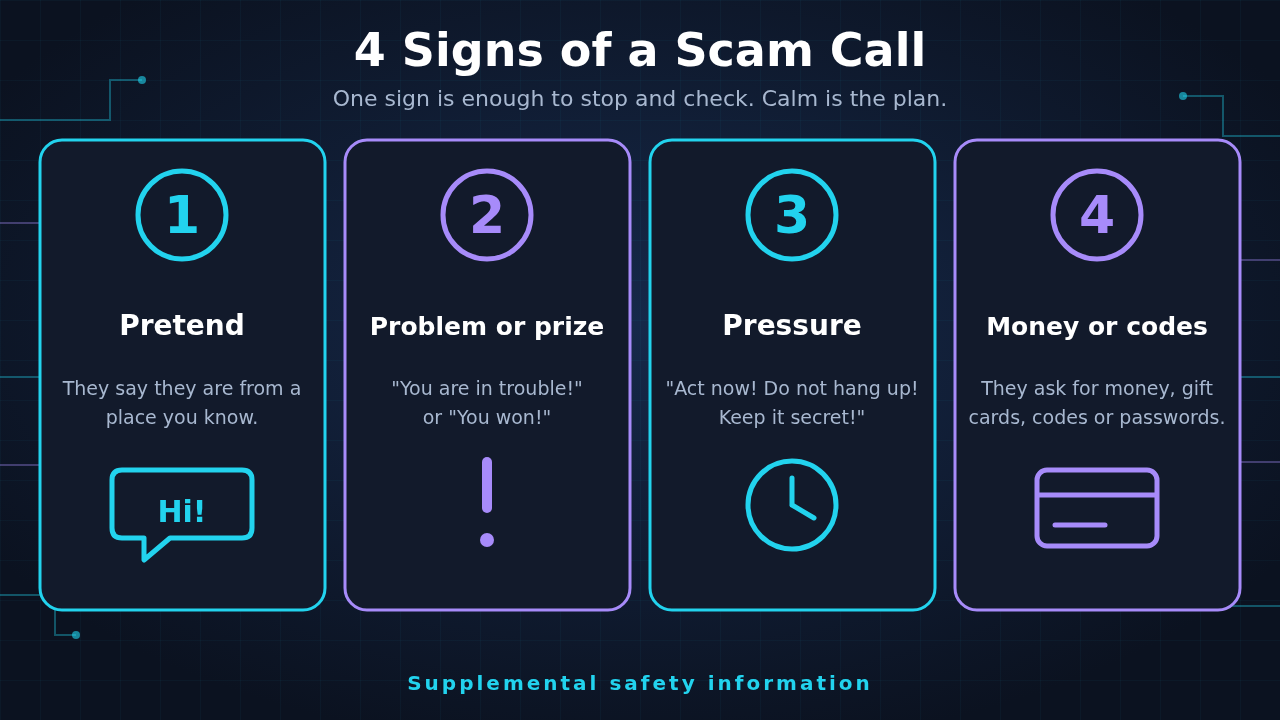
Four signs of a scam call. One sign is enough to stop and check.
Sign 1: They pretend. The caller says they are from a place you know.
Sign 2: A problem or a prize. They say you are in trouble. Or they say you won something.
Sign 3: Pressure. They say to act right now. They may say to keep it a secret.
Sign 4: Money or codes. They ask for money, passwords or codes. They may ask for a gift card.
A gift card is a card with money on it, made for a gift. Only scammers ask you to pay with one.
A real caller gives you time. You can always say, “I will call you back.”
Here is a tricky part. The name on a phone screen, called caller ID, can be faked.
This faking is called spoofing. The caller changes what shows on your screen.
So a local number or a real company name is not proof.
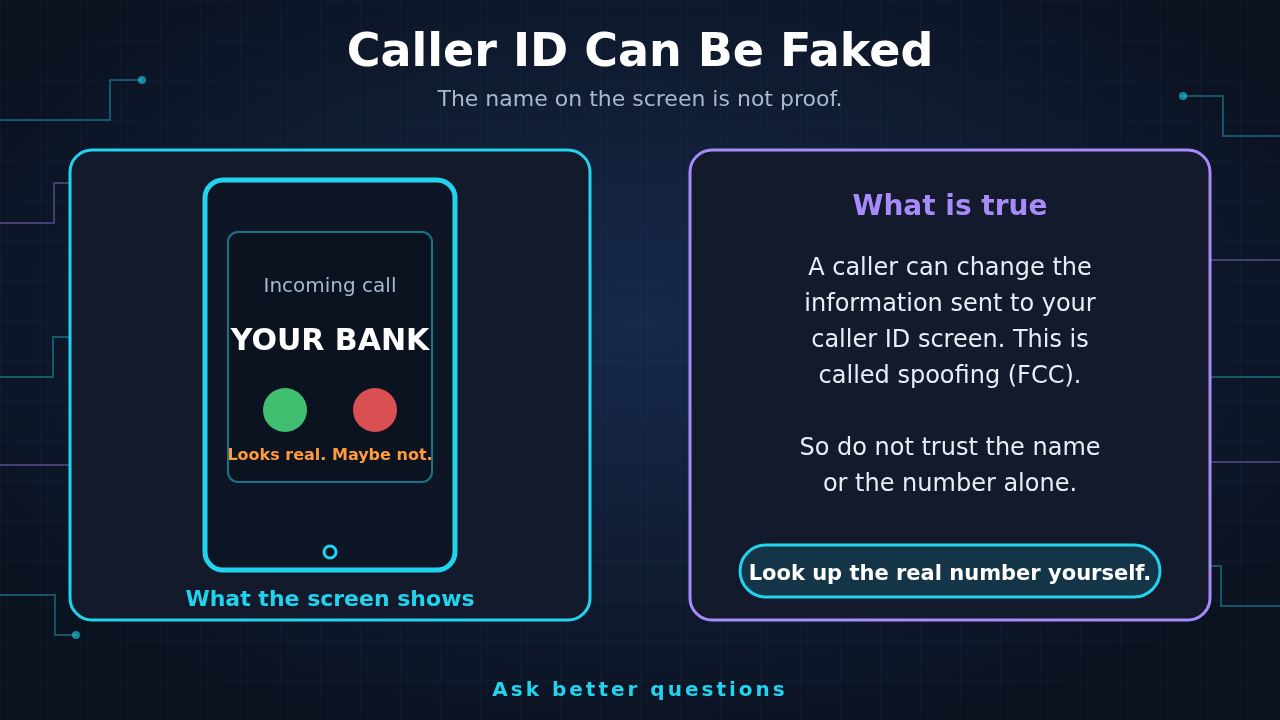
The name on the screen can be faked.
Now for your plan. Look at the steps picture.
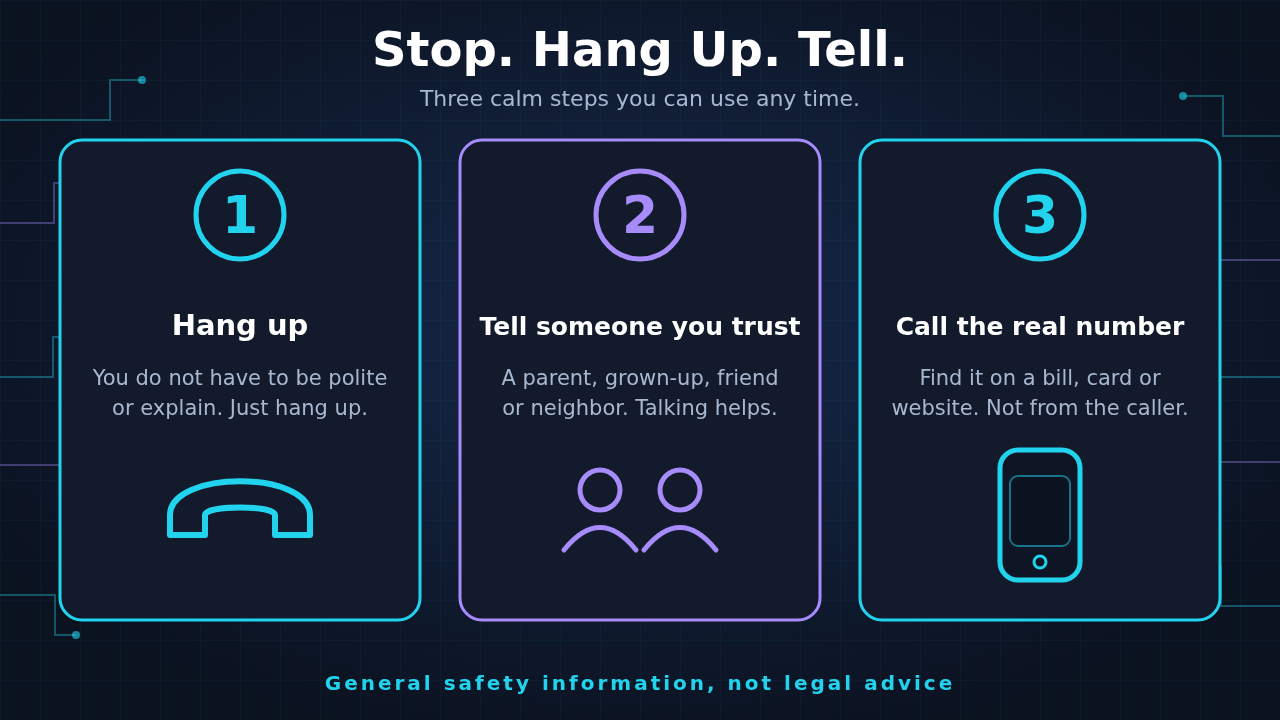
Your plan: hang up, tell someone, call the real number.
Hang up. You do not have to be polite or explain.
Tell someone you trust. That can be a parent, a grown-up, a friend or a neighbor.
Call the real number yourself. Find it on a bill, a card or the real website.
Do not call back a number the caller gave you.
If a recording says to press a button, just hang up.

Why do scammers do this? They want money or private information.
They rush you so you cannot think. They also want you to keep it secret.
That is why slowing down works so well. Here are three good habits.
- Slow down. Real callers give you time to think.
- Check. Look up the real number yourself.
- Talk. Tell someone you trust. Talking helps you see the trick.
Fun fact: Real police and government offices do not call to threaten you. The FTC says so.

Goal: Practice spotting the signs. You need paper and a pencil, and a grown-up to read with you.
- Read. A grown-up reads each pretend call out loud. These calls are made up.
- Spot. For each call, write the sign numbers (1 to 4) that you hear.
- Decide. Is it a scam call or a normal call? Say why.
- Practice. Say it out loud: “I will hang up and call the real number.”
Pretend call A: “Hello! This is your bank. There is a problem with your account. Tell me the code we just sent you. Do it right now.”
Pretend call B: “Hi, it is your cousin. I need help. Please keep this a secret. Buy gift cards and read me the numbers.”
Pretend call C: “Congratulations! You won a trip! First, you must pay a small fee with a gift card.”
Pretend call D: “Hi, this is Ben’s mom. Practice ends at 5 today. Can you tell Ben? No rush.”
Check your thinking: Call A has signs 1, 2, 3 and 4. Call B has signs 1, 2, 3 and 4. Call C has signs 2 and 4.
Call D is a normal call. It has no pressure, no secrets and no money.
Make a family plan. Talk with a grown-up and pick your plan together:
- Pick a code word that only your family knows. Do not post it online.
- Agree: if a caller asks for money or codes, hang up.
- Call back only at a number you know.
- Pick a grown-up you will always tell.
Another idea: ask a question only the real person could answer.
Talk about it: Why do you think scammers like to rush people? What helps when you feel rushed?

When should you be extra careful?
- When a call rushes you.
- When someone asks for money, gift cards, codes or passwords.
- When a caller says to keep a secret.
Texts and emails can use the same tricks. Use the same plan: stop, check, tell.
A phone is a useful tool. With a plan, you can stay calm.
What next? Teach someone else the four signs. Teaching helps you remember.
Keep exploring
Series: Free lessons. Explore more: All lessons
Related lessons:
- What Is AI?: computers can learn to copy voices.
- Why Is the Sky Blue?: a science mystery you can see every day.
- How Far Is the Moon?: a space distance you can build with a string.
More free lessons: All lessons, Free STEM samples and the Practice Zone.
Grown-up corner
- Where to report. The FTC takes scam reports at ReportFraud.ftc.gov. The FCC takes complaints about spoofing and unwanted calls at fcc.gov/complaints.
- The FCC guide also lists the National Do Not Call Registry (donotcall.gov or 1-888-382-1222). For spam texts, the FCC says most carriers let you forward them to 7726.
- If someone already paid or shared information. The FTC says to act quickly. For gift cards, it says to report to the gift card company right away (no matter how long ago it happened), keep the card and receipt, and tell the FTC.
- If you only want to report a call, the FTC points to DoNotCall.gov. This lesson cannot give advice for a specific case.
- Four signs. The FTC lists four signs: scammers pretend to be from an organization you know, say there is a problem or a prize, pressure you to act now, and tell you to pay in a specific way. It adds that real businesses give you time and no real business or agency tells you to buy a gift card to pay them.
- Caller ID. The FCC says spoofing is when a caller falsifies the information sent to your caller ID display.
- Scammers may show a local number (neighbor spoofing) or a company or agency you trust. The FCC says spoofing is not always illegal (for example, an office showing its main number), but it is against FCC rules when done to defraud, cause harm or get something of value.
- Where sources differ. The FCC says not to answer calls from unknown numbers and never to call back an unfamiliar number. The FTC stresses blocking unwanted calls, not trusting caller ID and not calling a number the caller gave you.
- For a call about a family emergency, the FTC says to hang up and call the person back on a number you know, or ask a question only the real person could answer. The Illinois Attorney General and the Electronic Frontier Foundation (EFF) suggest a family code word chosen in advance, not shared outside the family and not based on public information. Families can choose the rules that fit them.
- Voice cloning. The FTC (2023) says a scammer can use AI to copy a loved one’s voice from a short audio clip, so do not trust the voice alone.
- Call the person back on a number you know. If you cannot reach them, call another family member or friend.
- Scope. This is general safety information for families, not legal advice. Most of it applies to texts and emails too.
Supplemental. This free lesson is a STEM aid for home or summer learning. It does not replace a school curriculum.
Word bank
- Scam — A trick to get your money or private information.
- Scam call — A scam that comes by phone.
- Private information — Facts only you and your family should know.
- Gift card — A card with money on it, made for a gift.
- Caller ID — The name or number a phone shows for a call.
- Spoofing — Changing the name or number a caller ID shows.
- Code word — A secret word that only your family knows.
Sources: FTC: How To Avoid a Scam; FTC: Phone Scams; FTC: Avoiding and Reporting Gift Card Scams; FTC: Scammers Use Fake Emergencies To Steal Your Money; FTC: Scammers use AI to enhance their family emergency schemes (2023); FCC: Caller ID Spoofing; FCC: Stop Unwanted Robocalls and Texts; FCC: Robocalls, Texts and Spoofing (PDF); Illinois Attorney General: consumer alert on AI voice scams; EFF: Create a Family Password.
Made by K12 Summer Workbooks. Text and pictures are original.