


Beginner · STEM · Curiosity Questions
Materials: 10–20 small household objects (coins, buttons, dry pasta, blocks or socks), two bowls or cups, paper and pencil. Optional: an egg carton and a paper strip for a number line.
Tips: Read the What and How parts aloud together. Ask “What do you notice?” before you explain.
Let the learner move the objects. Pause after each picture and say it out loud: “3 plus 4 equals 7.”

Before we explain, wonder together:
- You have 3 apples and a friend gives you 4 more. How could you find the total without starting the count over?
- Does 3 + 4 give the same answer as 4 + 3? How could you test it?
There are no wrong guesses. Notice first — then explore.
Ask → Explore → Apply: We ask those questions, explore with joining, hops, and tens, then apply with objects from home and a quick practice round.

Addition is a way to join groups and find out how many there are in all.
3 + 4 means a group of 3 joins a group of 4. Say “3 plus 4.”
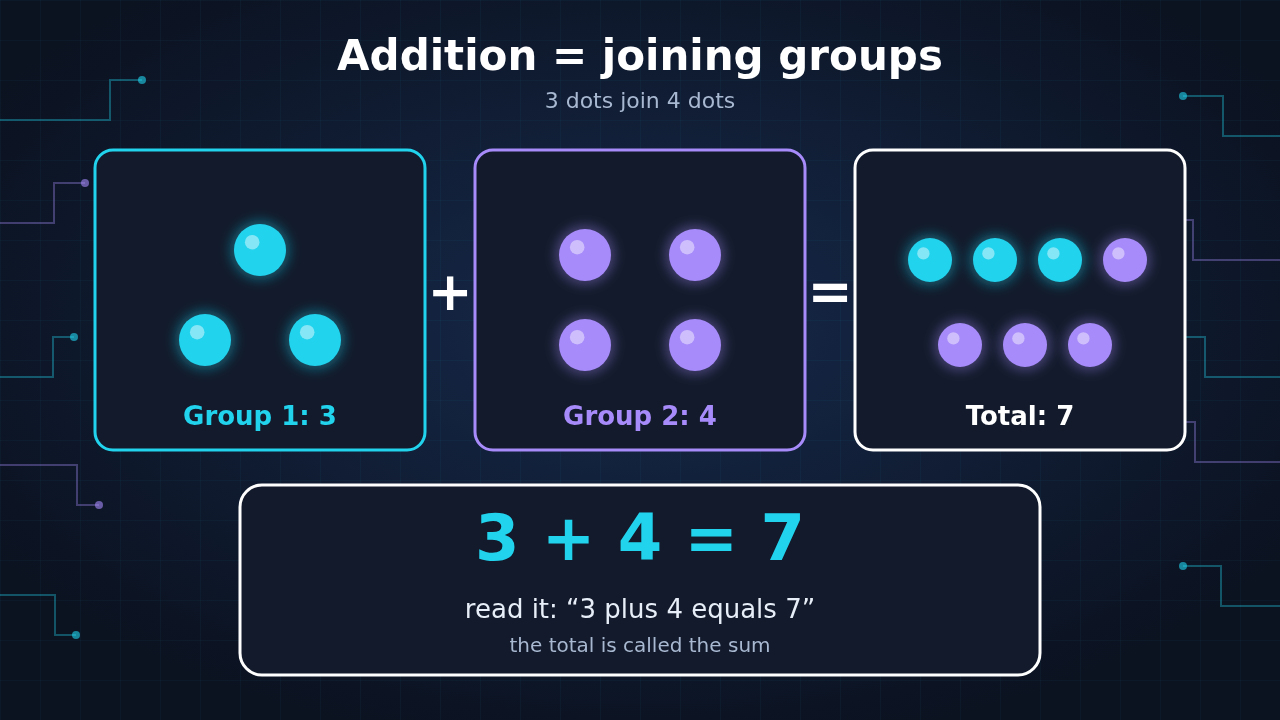
Count them all: 1, 2, 3, 4, 5, 6, 7. So 3 + 4 = 7. The total has a name: the sum.
The numbers you add are called addends. In 3 + 4 = 7, the addends are 3 and 4, and the sum is 7.
In one sentence: Addition tells you the total when you put groups together.

There are four handy ways to see addition. Each one helps you find a sum faster than counting everything again.
1. Join and count. You just met this one: put the groups together and count the total.
2. Count on with a number line.
Start at the first number, then hop to the right. Start at 3 and make 4 hops.
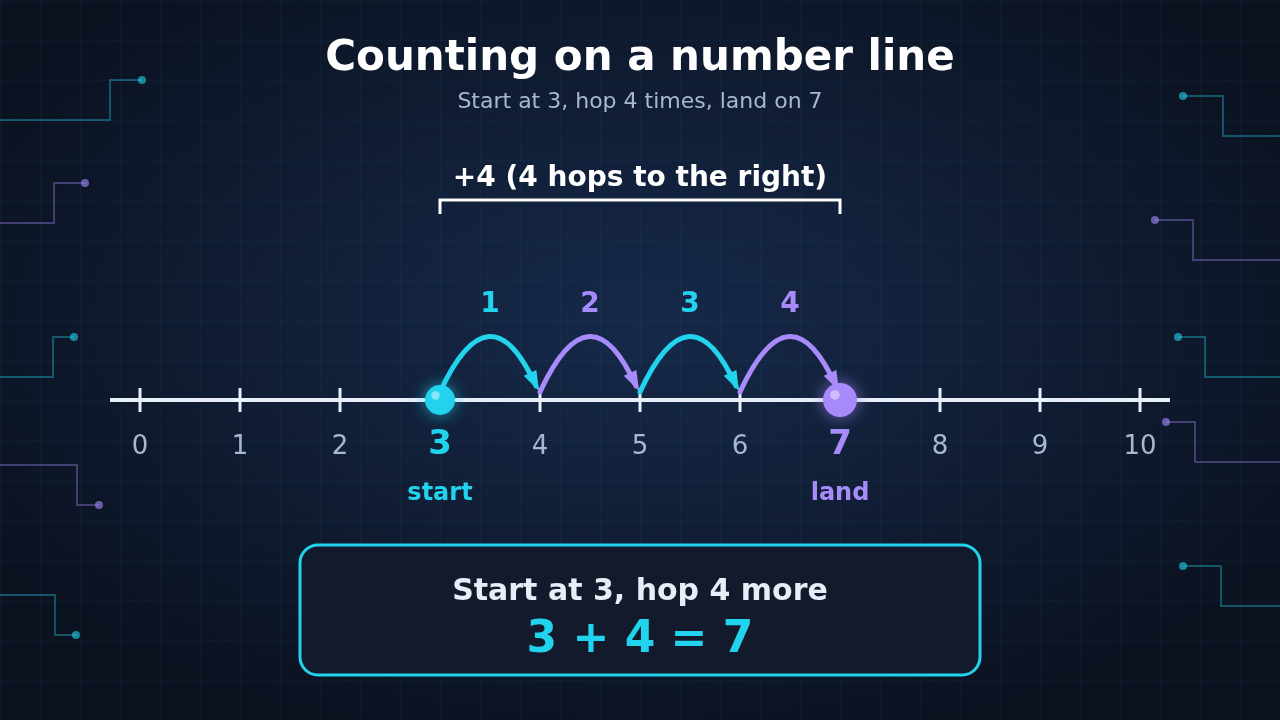
You land on 7. You did not have to count the first 3 again: you started there.
3. Make 10. Ten is an easy number to work with.
To add 8 + 7, use a ten frame, a box with room for 10 dots. Move 2 from the 7 to fill the frame.
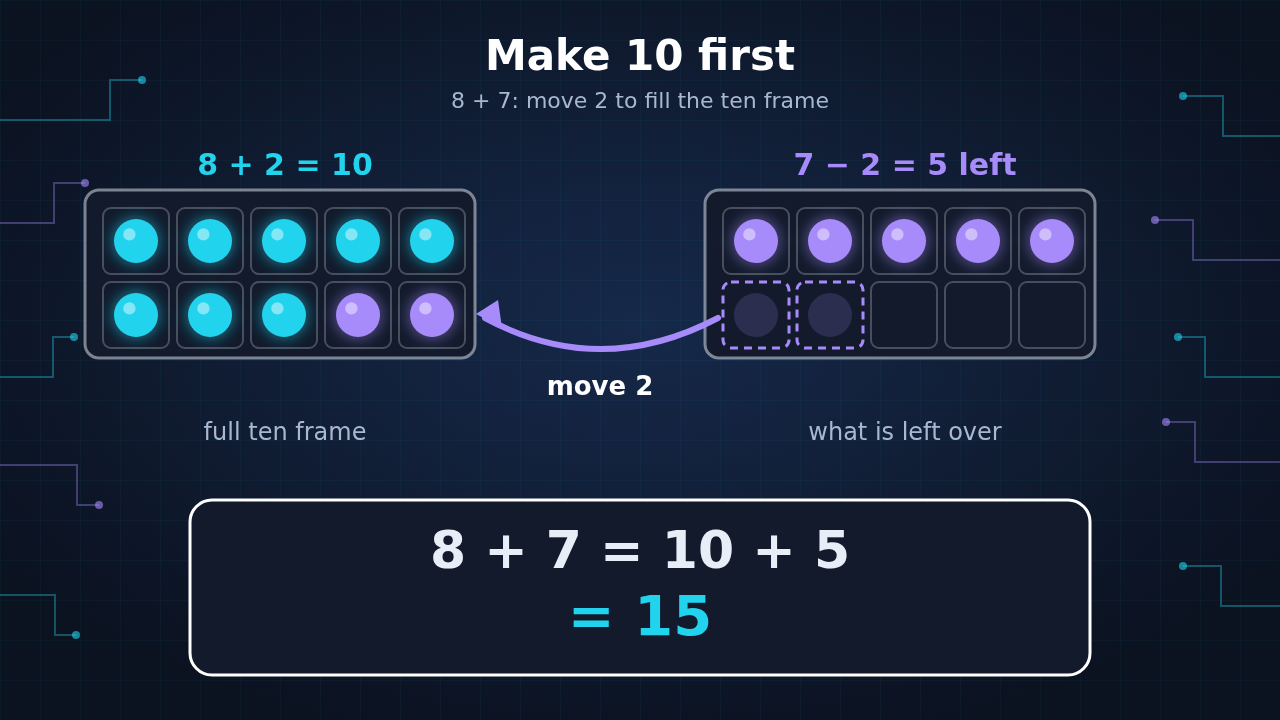
Now it is 10 + 5 = 15. So 8 + 7 = 15.
Doubles help, too. 6 + 6 = 12. So 6 + 7 is just one more: 13.
4. The flip.
Swap the order of the groups. Now it is 4 plus 3.
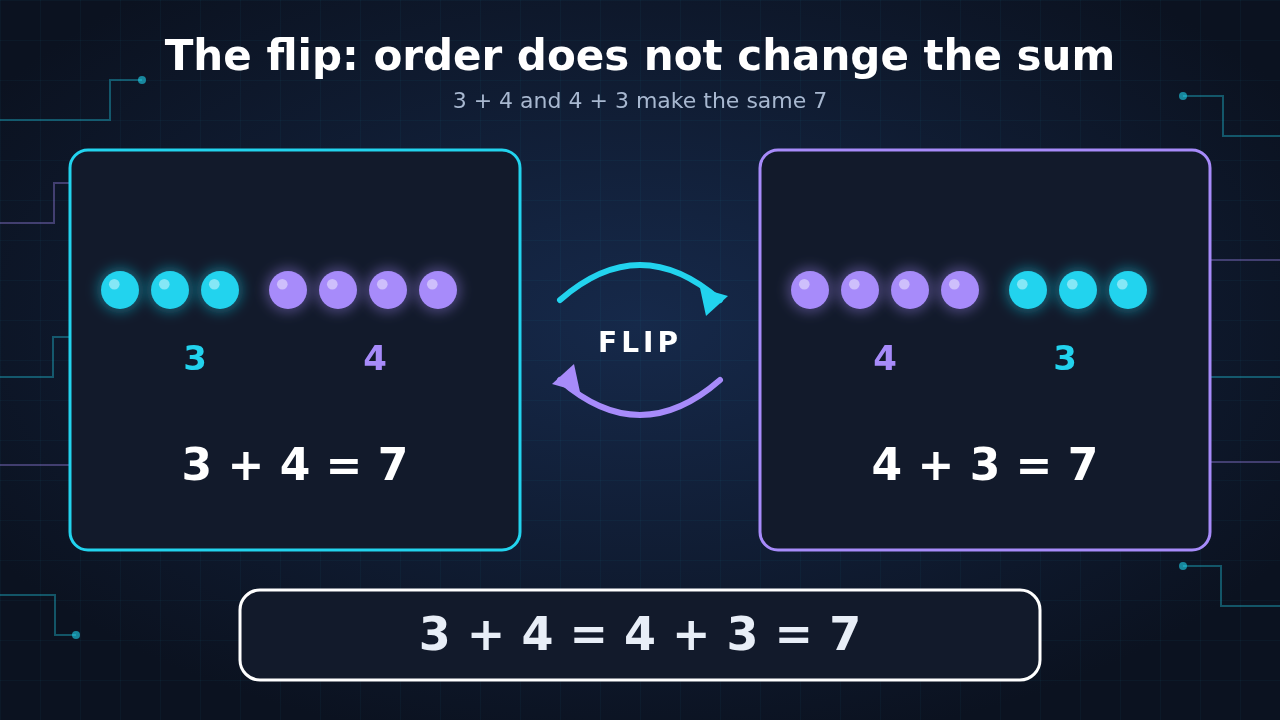
Same 7 dots. So 3 + 4 = 4 + 3. Mathematicians call this the commutative property: when you add, the order does not change the sum.
That is handy. If one order feels hard, flip it. 2 + 9 can become 9 + 2: start at 9 and count on 2.
Careful: the flip works for addition, not for every operation. 5 − 2 is not the same as 2 − 5.
Bigger numbers: add by parts. Split each number into tens and ones, add the tens, add the ones, then put the parts together.
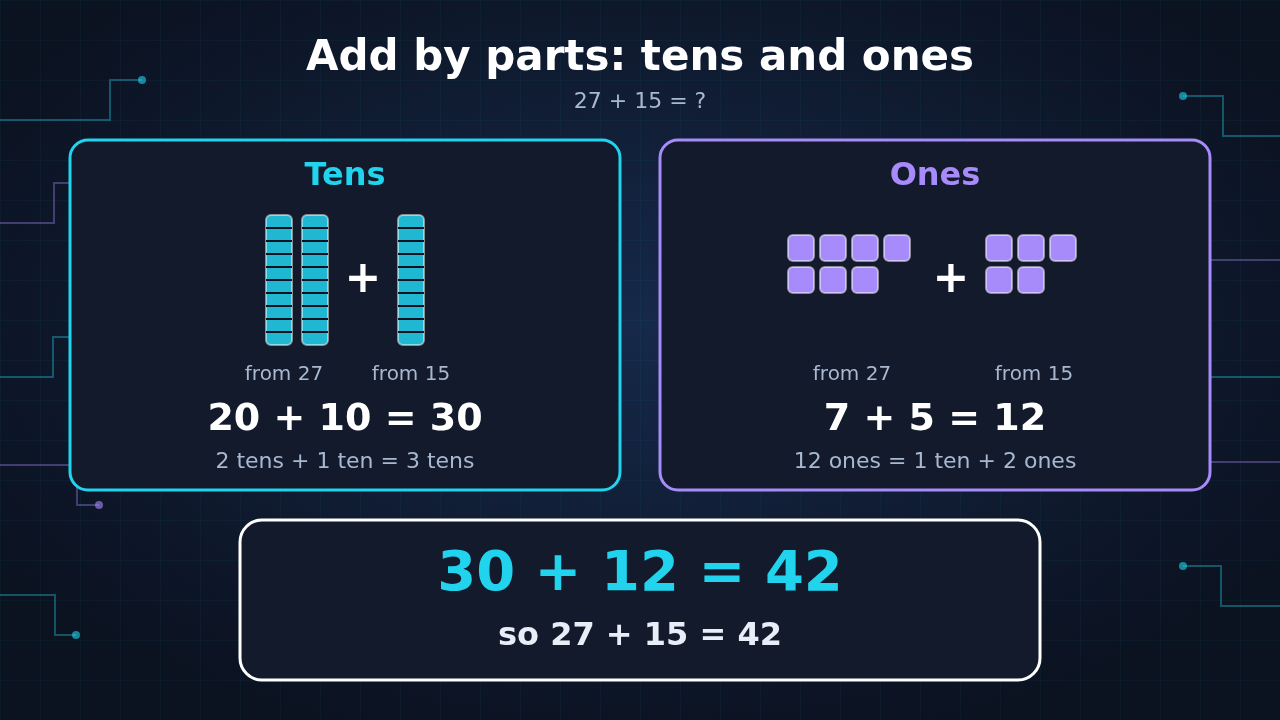
27 + 15: the tens are 20 + 10 = 30. The ones are 7 + 5 = 12. Then 30 + 12 = 42.

Join, Hop, Make 10 (build it, flip it, count it)
Goal: Find a sum four different ways with objects you already have.
Steps:
- Collect about 20 small objects and two bowls or cups.
- Join: Put 3 objects in one bowl and 4 in the other. Pour them together and count. Say “3 plus 4 equals 7.”
- Flip: Now pour the 4-bowl first, then the 3-bowl. Is the total still 7?
- Hop: Draw a number line from 0 to 15 on paper. Put a button on 5, then hop it 6 spaces to the right. Where does it land?
- Make 10: Draw a box with 2 rows of 5 squares, or use an egg carton with 10 cups. Put in 8 objects. Set 7 objects beside it.
- Move 2 over to fill the 10. How many are left over? Say “10 plus 5 equals 15.”
- Challenge: How many ways can you split 10 objects into two groups? (Try 1 and 9, 2 and 8, and so on.)
Success check: You can show 3 + 4 by joining and by hopping, show 8 + 7 by making 10, and say why 4 + 3 is also 7.
Talk about it: Which way helped you find 8 + 7 fastest? What happens when you add 0 to a group? (Hint: nothing changes!)

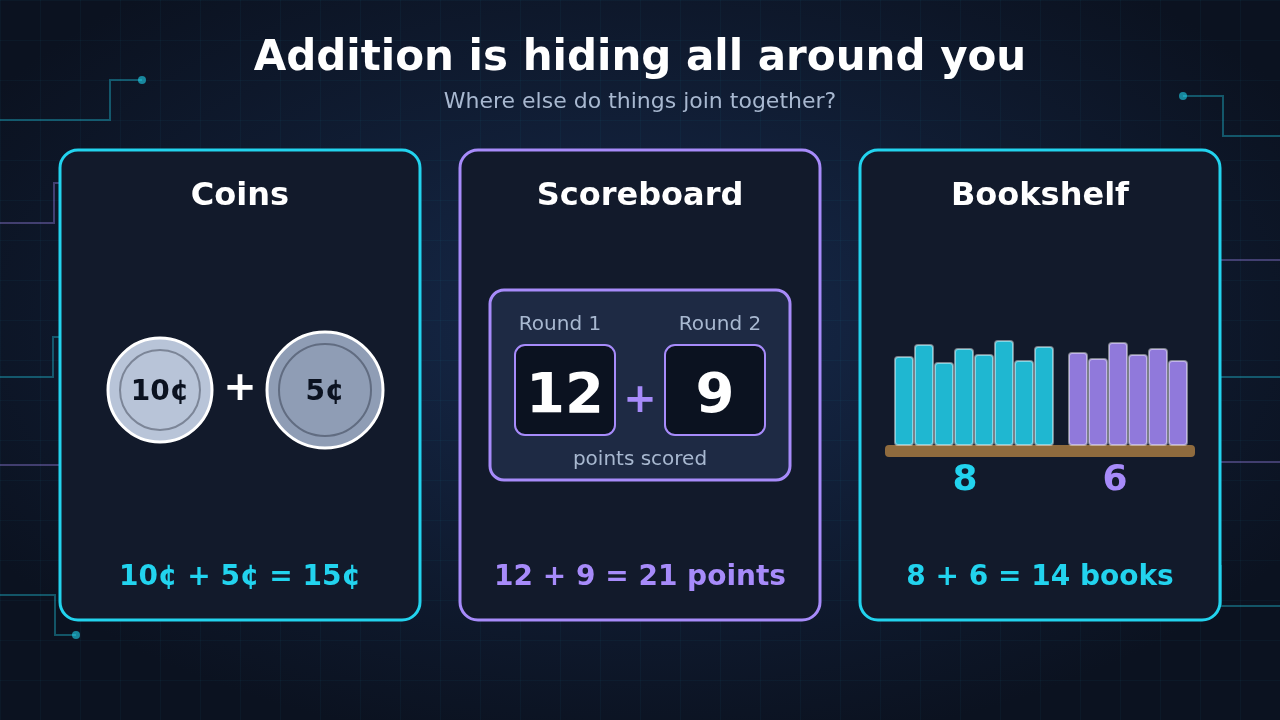
Real-life example: You have a dime and a nickel. That is 10¢ + 5¢ = 15¢. Add a second nickel and you have 20¢.
Addition saves time. You do not have to count every coin from the beginning each time you get a new one. You start from what you have and count on.
You use it when you shop, keep score, share, and plan. It is also the base for subtraction, multiplication, and later math.

Look for things that join together around you:
- Money: a 25¢ coin and a 10¢ coin make 35¢.
- Games: add your points from each round to get a total score.
- Snacks and chores: 6 crackers now plus 5 more later is 6 + 5 = 11.
When to use this lesson: On a rainy day, during summer math time, or any time you are counting how many in all.
Check your thinking
Talk together. Explain your thinking out loud.
- What does 3 + 4 mean?
- Start at 6 on a number line and hop 5 to the right. Where do you land?
- How could you make 10 first to solve 9 + 6?
- If 8 + 5 = 13, what is 5 + 8? How do you know?
- Add by parts: what is 34 + 25?
- Where in your home can you use addition?
Answers for grown-ups:
(1) A group of 3 joins a group of 4, and the total is 7.
(2) 6 + 5 = 11, so you land on 11.
(3) Move 1 from the 6 to the 9: 9 + 6 = 10 + 5 = 15.
(4) 13, because the flip does not change the sum.
(5) Tens: 30 + 20 = 50. Ones: 4 + 5 = 9. Then 50 + 9 = 59.
(6) Answers will vary: coins, snacks, game scores, toys, steps.
Facts to 20
An addition fact is one pair like 8 + 7 = 15.
The facts to 20 use numbers from 0 to 10 on each side, from 0 + 0 up to 10 + 10. Each side has 11 choices, so there are 11 × 11 = 121 facts in all.
The flip gives you a head start. Once you know 3 + 4, then 4 + 3 feels familiar. Count the pairs without caring about order and there are only 66 different ones to learn.
As you practice, the number of facts you know grows. Strategies like counting on, making 10, and doubles help you build them.
ASK → EXPLORE → APPLY
APPLY IT: Addition X
Pick your numbers. Play 10 cards.
Which sums felt easy? Which felt tricky?
Type the answer. Choose a quick round of 10 cards or a longer round of 20. Pick the numbers you want to practice.
Tips for grown-ups: Progress stays on this device. The app does not send your progress to us. Try one 10-card round a day.
Word bank
- Addition — Joining groups to find the total.
- Addend — A number you add. In 3 + 4, the addends are 3 and 4.
- Sum — The answer to an addition problem. The sum of 3 + 4 is 7.
- Plus (+) — The sign that means join or add.
- Equals (=) — The sign that means “is the same as.”
- Number line — A line with numbers in order. Hop right to add.
- Ten frame — A box with 10 spaces, used to see how numbers make 10.
- Doubles — Adding a number to itself, like 6 + 6 = 12.
- Tens and ones — The two parts of a number like 27: 2 tens and 7 ones.
- Fact — One addition pair with its sum, like 8 + 7 = 15.
- Commutative property (the flip) — Adding in a different order gives the same sum: 3 + 4 = 4 + 3.
Supplemental STEM aid for home or summer learning — not a school curriculum replacement. Adult supervision for materials.