


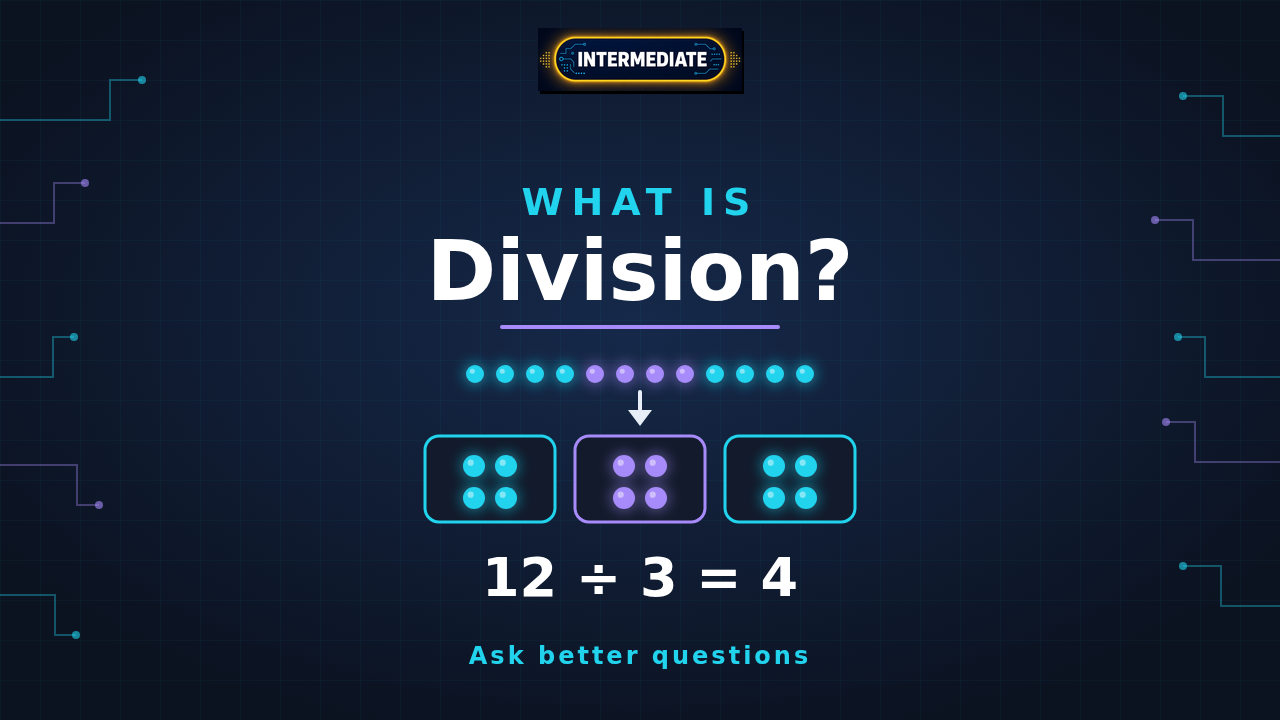
Intermediate · STEM · Curiosity Questions
Materials: 12–24 small household objects (coins, buttons, dry pasta, blocks or socks), paper and pencil. Optional: paper plates or bowls, a muffin tin or egg carton.
Tips: Read the What and How parts aloud together. Ask “What do you notice?” before you explain.
Let the learner move the objects. Say each picture out loud: “12 shared into 3 groups.”
Start with multiplication: Division undoes multiplication, so it helps to know a few times tables first. New to them? Read What Is Multiplication? and come back.

Before we explain, wonder together:
- 12 cookies, 3 friends, and everyone must get the same. How many cookies does each friend get?
- Is 12 ÷ 3 the same as 3 ÷ 12? How could you test it?
There are no wrong guesses. Notice first — then explore.
Ask → Explore → Apply: We ask those questions, explore with sharing, groups, rows, and jumps, then apply with objects from home and a quick practice round.

Division splits a total into equal parts. Every part ends up the same size.
12 ÷ 3 asks: if 12 cookies are shared equally among 3 friends, how many does each friend get? Say “12 divided by 3.”
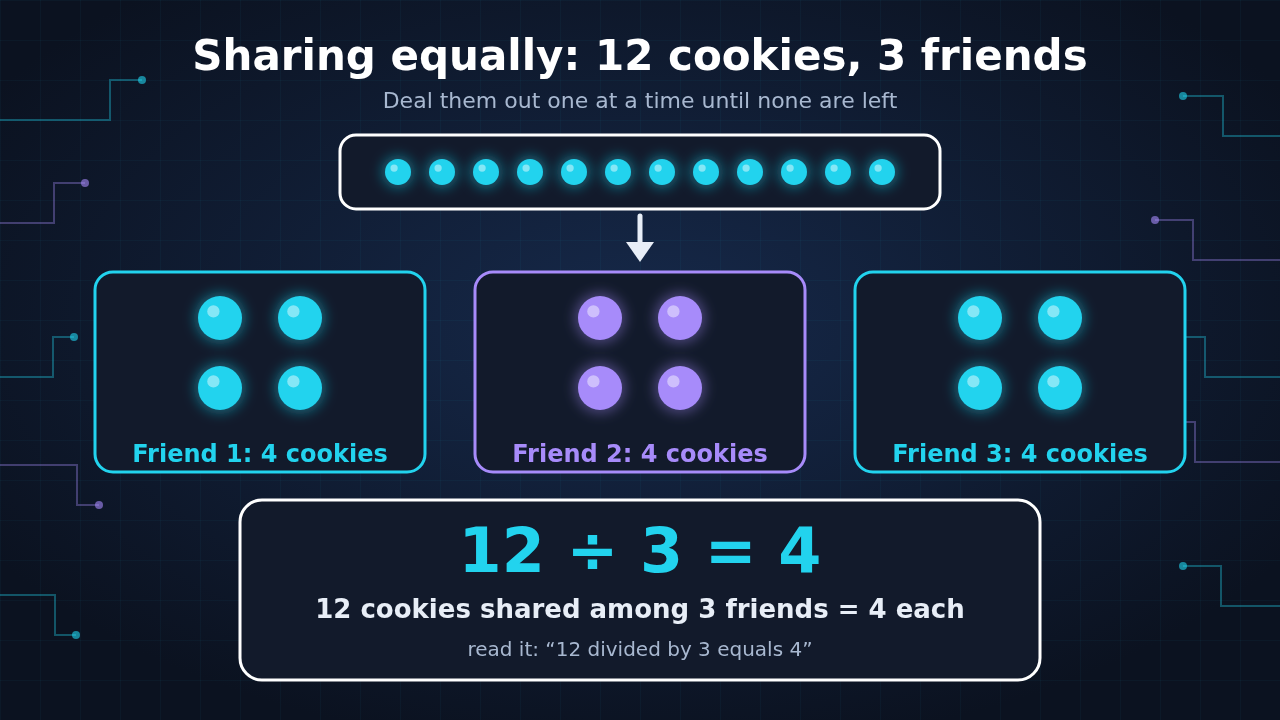
Deal them out one at a time, like cards. Each friend gets 4. So 12 ÷ 3 = 4.
Division has two helpers: sharing (how many in each group?) and grouping (how many groups?). Both give the same answer here.
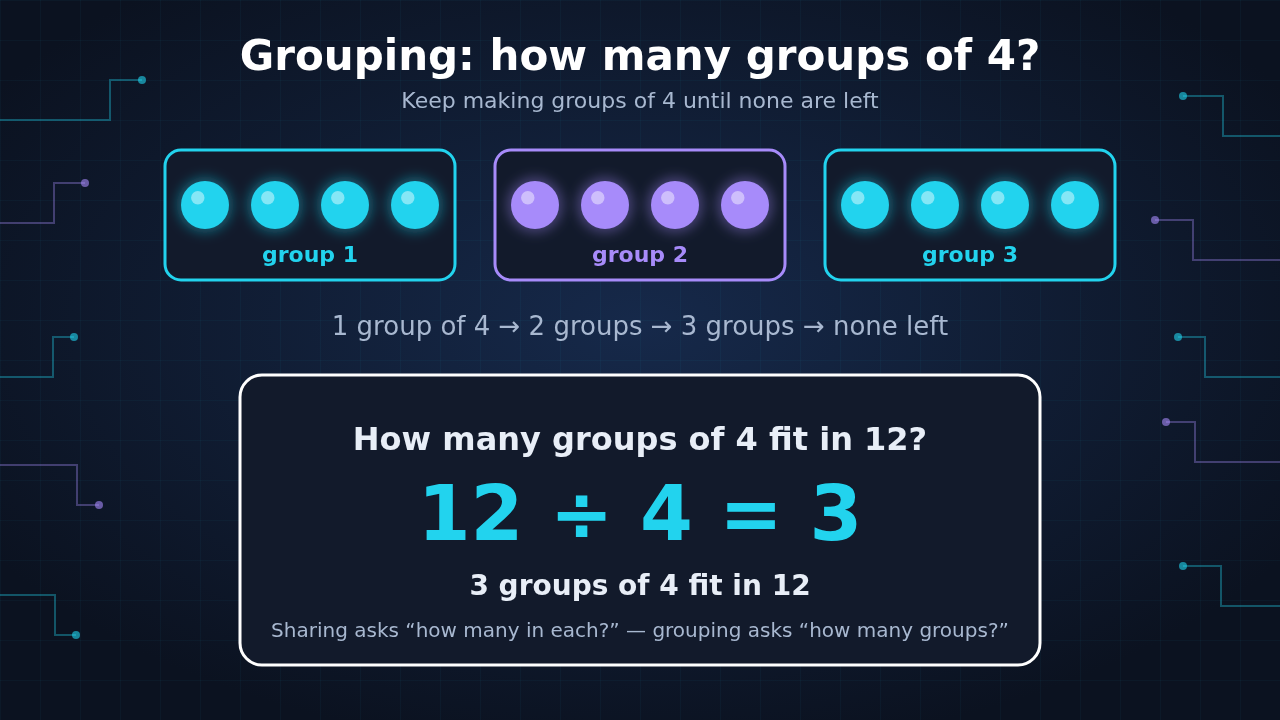
Now ask a different question: how many groups of 4 fit in 12? Make a group of 4, then another, then another.
None are left. That is 3 groups, so 12 ÷ 4 = 3.
In one sentence: Division tells you the size of each equal share, or how many equal groups you can make.

Here are more ways to see division. Each one shows the same 12.
1. Arrays. Line the 12 objects up in 3 rows of 4, then split them.
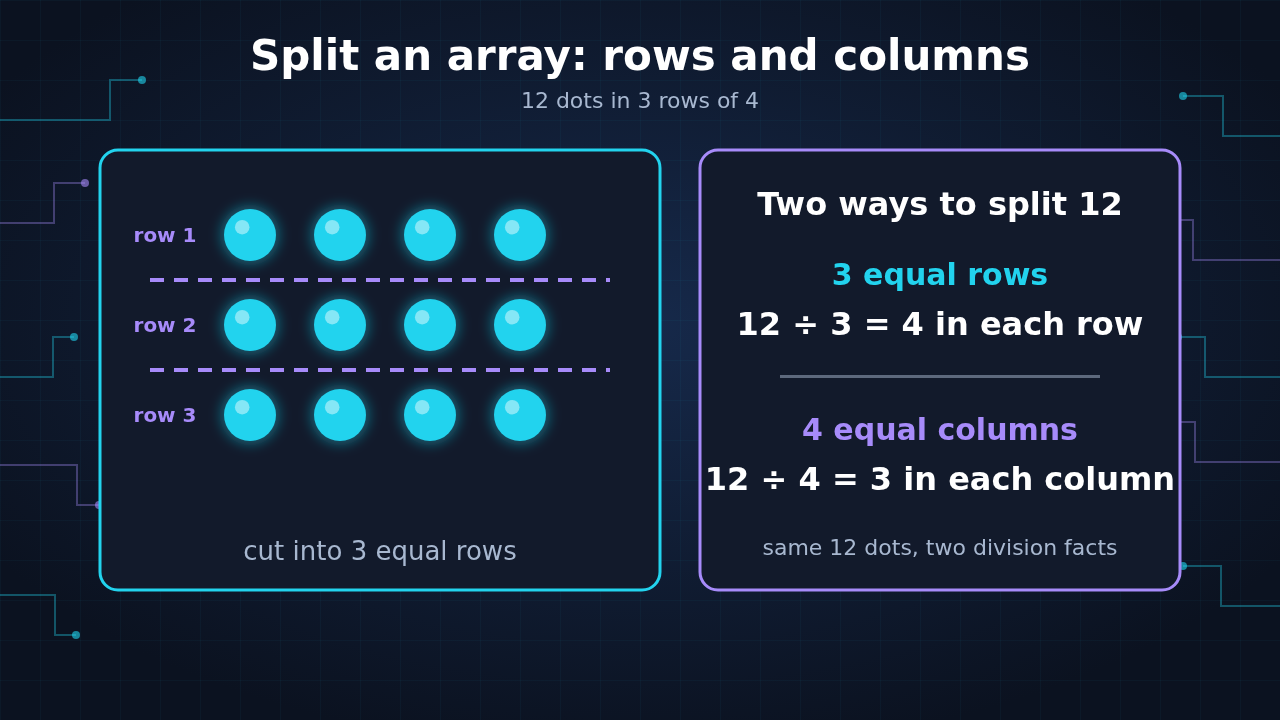
Cut into 3 equal rows: 4 in each row, so 12 ÷ 3 = 4. Cut into 4 equal columns: 3 in each column, so 12 ÷ 4 = 3.
2. Number line. Start at 12 and jump back 3 each time until you reach 0.
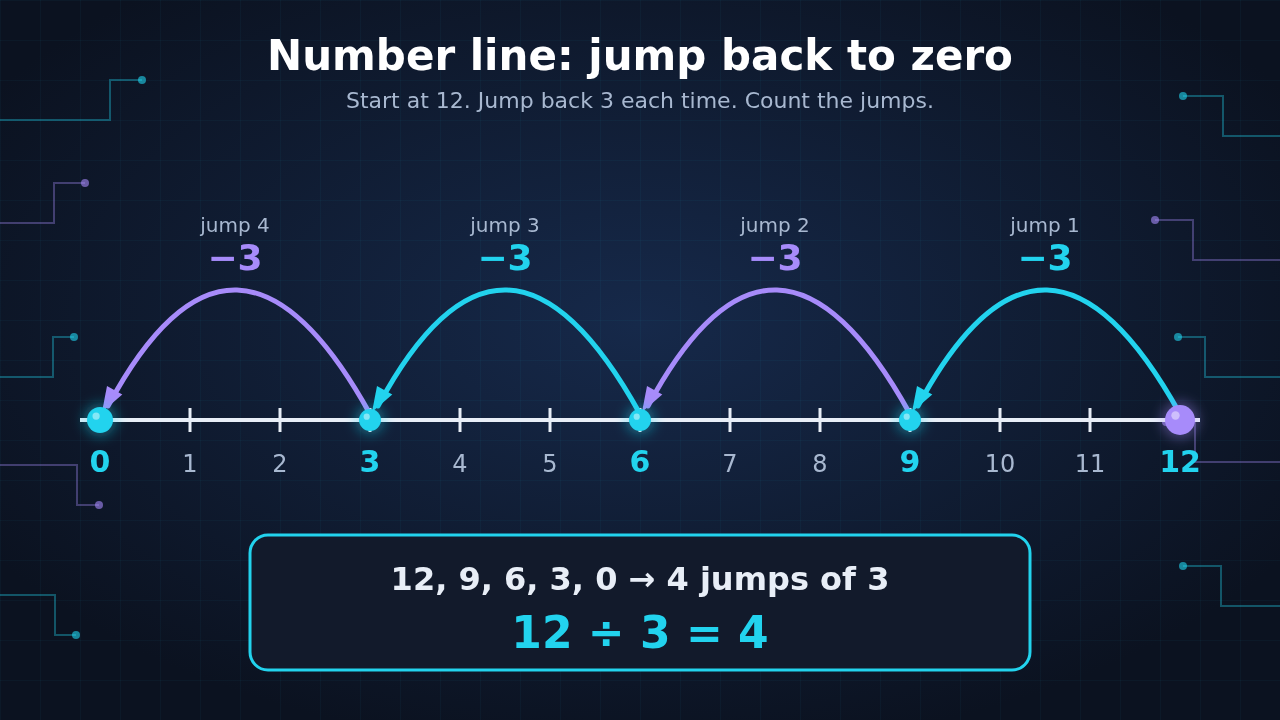
12, 9, 6, 3, 0. That is 4 jumps, so 12 ÷ 3 = 4. You can also skip count up: 3, 6, 9, 12 is 4 jumps of 3.
3. Division undoes multiplication. Division and multiplication are inverse operations: one undoes the other.
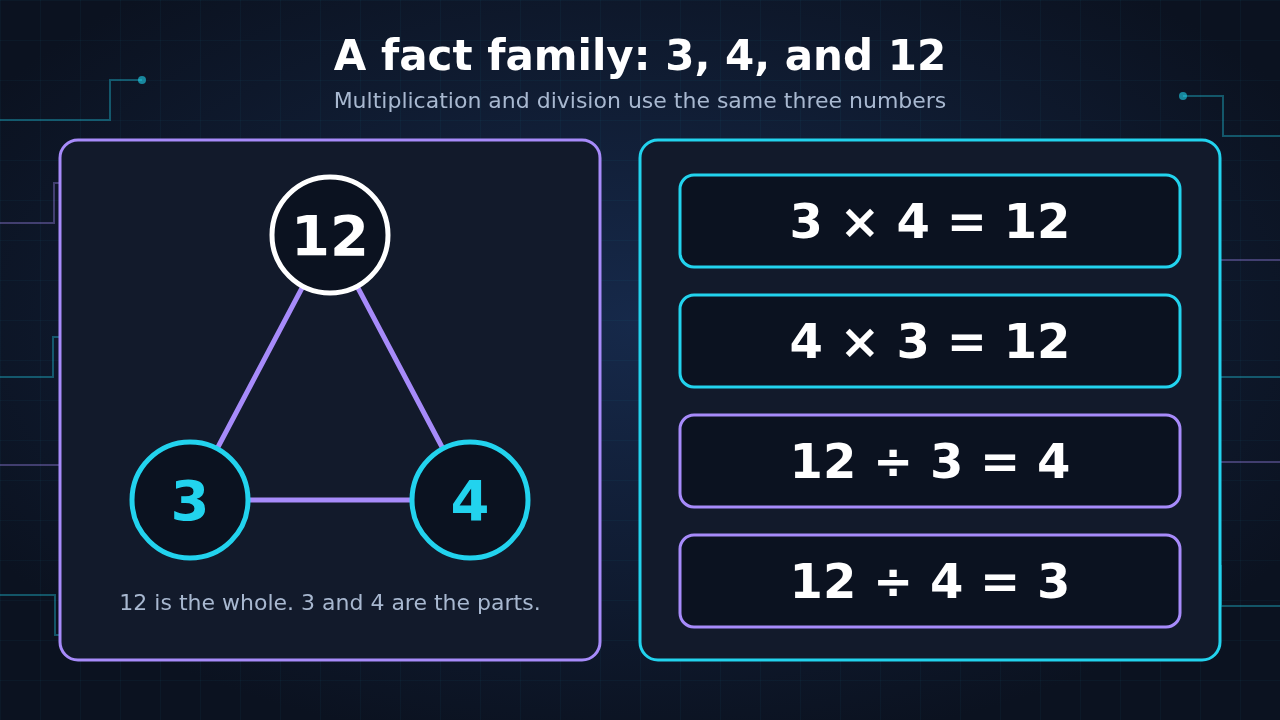
Because 3 × 4 = 12, we know 12 ÷ 3 = 4. The numbers 3, 4, and 12 make a fact family of four facts. To solve 12 ÷ 3, ask: “3 times what makes 12?”
Remainders. What if 13 cookies are shared among 3 friends?
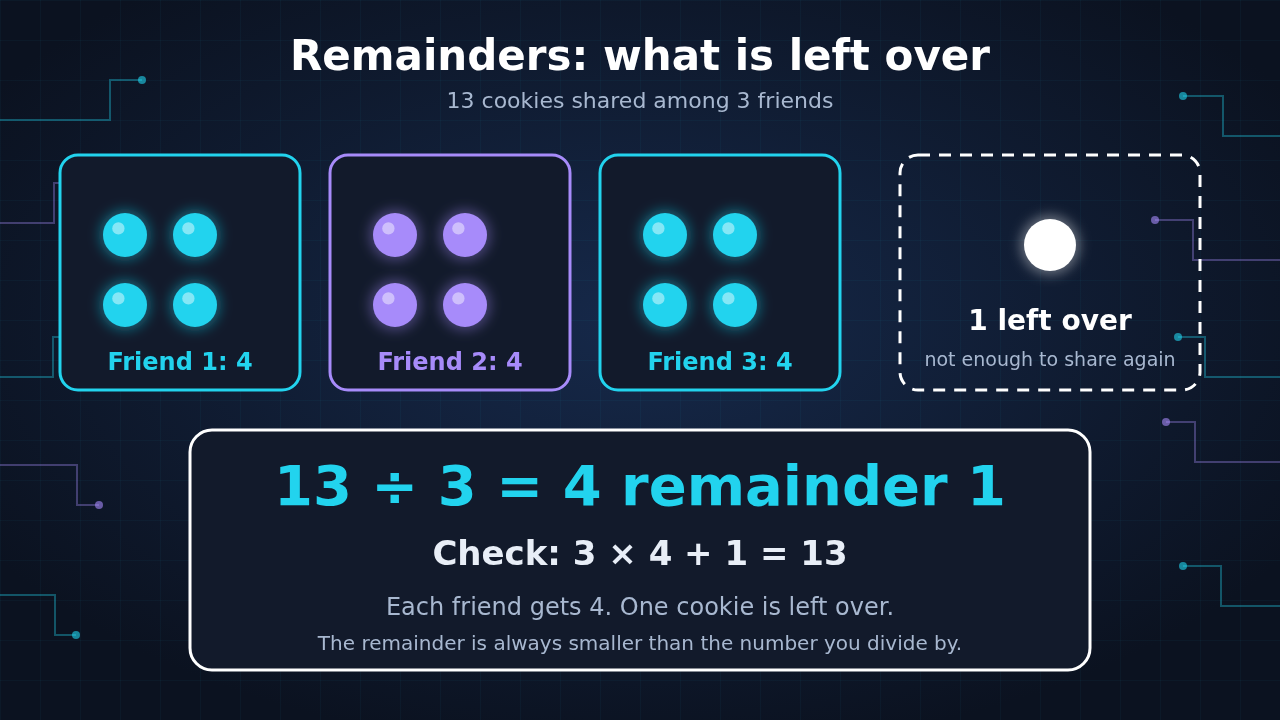
Each friend gets 4, and 1 cookie is left over. We write 13 ÷ 3 = 4 remainder 1. Check it: 3 × 4 + 1 = 13.
Order matters. 12 ÷ 3 = 4, but 3 ÷ 12 is not 4.
You cannot give 3 cookies to 12 friends and have a whole cookie each. Unlike multiplication, division has no flip.
Special cases:
- Dividing by 1 keeps the number the same. 12 ÷ 1 = 12, because 1 friend gets all 12.
- Dividing a number by itself gives 1. 12 ÷ 12 = 1, because 12 cookies make 1 group of 12.
- Dividing by 0 does not work. You cannot share things among zero groups.

Share It, Group It, Check It
Goal: Show 12 ÷ 3 and 12 ÷ 4 with objects you already have, then check with multiplication.
Steps:
- Collect 12 small objects and 3 plates, bowls, or circles of string.
- Share: Deal the objects onto the 3 plates, one at a time. Count one plate. Say “12 shared among 3 is 4 each.”
- Group: Push all 12 together again. Make groups of 4.
- How many groups? Say “12 into groups of 4 is 3 groups.”
- Check: Say the matching multiplication fact: 3 × 4 = 12.
- Remainder: Add 1 more object (13 in all) and share among 3 plates again. What is left over?
- Challenge: Try 12 ÷ 1, 12 ÷ 12, and 12 ÷ 6. Which ones surprised you?
Success check: You can show 12 ÷ 3 by sharing and by grouping, then say the multiplication fact that checks it.
Talk about it: When is it easier to think “how many in each?” and when is it easier to think “how many groups?” What happens with 5 objects shared among 2 plates?

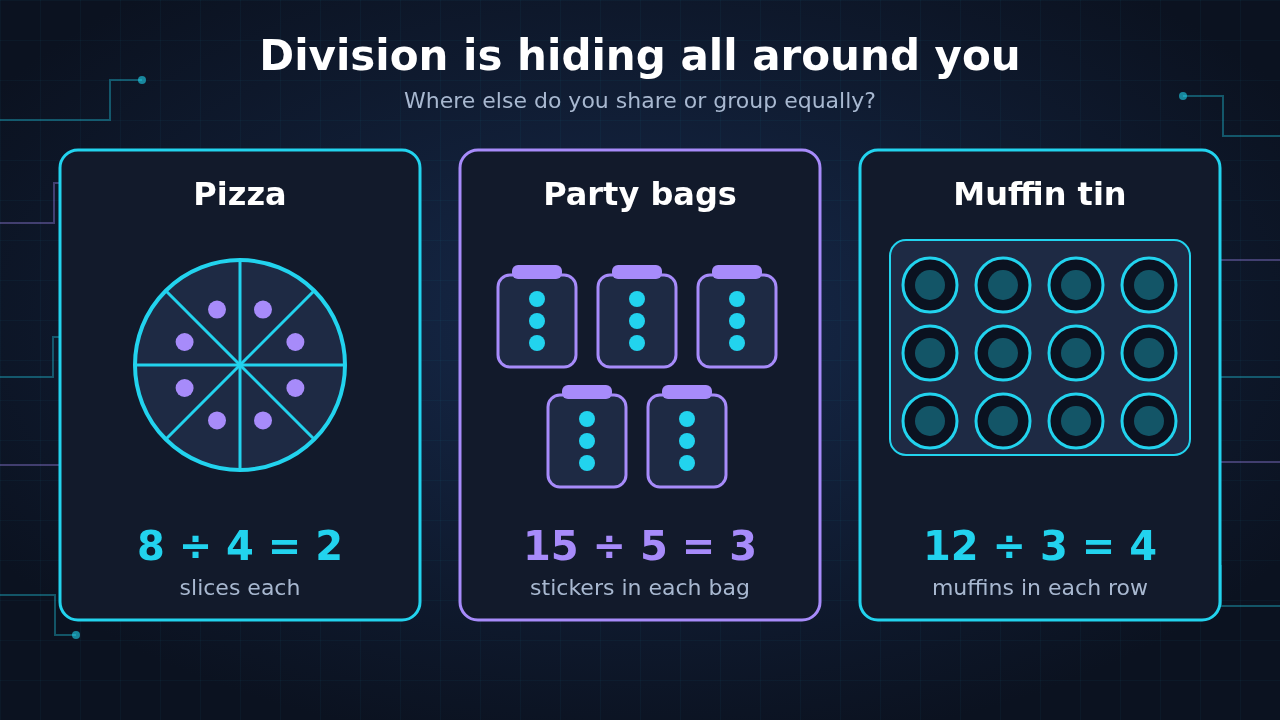
Real-life example: A pizza has 8 slices and 4 people want the same amount. 8 ÷ 4 = 2 slices each.
Have 15 stickers for 5 party bags? 15 ÷ 5 = 3 stickers in each bag.
Division keeps things fair. It helps you share, pack, plan, and split a bill without guessing. It also leads to later math, like fractions and finding averages.

Look for fair sharing and equal groups around you:
- Snack time: 12 crackers shared among 4 people is 12 ÷ 4 = 3 each.
- Packing: 20 pencils in boxes of 5 is 20 ÷ 5 = 4 boxes.
- Teams and seats: 24 players on 4 teams is 24 ÷ 4 = 6 on each team.
When to use this lesson: At a snack table, while packing or tidying up, or any time something needs to be shared fairly.
Check your thinking
Talk together. Explain your thinking out loud.
- What does 12 ÷ 3 mean? Say it two ways: sharing and grouping.
- Write the multiplication fact that matches 20 ÷ 4.
- 15 cookies are shared equally among 5 friends. How many does each friend get?
- Start at 18 and jump back by 6 until you reach 0. How many jumps? What division fact is that?
- Is 12 ÷ 3 the same as 3 ÷ 12? How do you know?
- 14 objects are shared among 4 plates. How many on each plate, and how many are left over?
- If 7 × 8 = 56, what are two division facts you also know?
Answers for grown-ups:
(1) 12 shared among 3 groups is 4 in each group; or 12 split into groups of 3 makes 4 groups.
(2) 4 × 5 = 20 (or 5 × 4 = 20), so 20 ÷ 4 = 5.
(3) 15 ÷ 5 = 3.
(4) 18, 12, 6, 0 is 3 jumps, so 18 ÷ 6 = 3.
(5) No. 12 ÷ 3 = 4, but 3 ÷ 12 is not 4: 3 objects cannot give 12 groups a whole object each. Order matters in division.
(6) 3 on each plate and 2 left over: 14 ÷ 4 = 3 remainder 2, check 4 × 3 + 2 = 14.
(7) 56 ÷ 8 = 7 and 56 ÷ 7 = 8.
Division facts up to 144
A division fact is one pair like 56 ÷ 8 = 7.
Every division fact comes from a multiplication fact. 7 × 8 = 56, so 56 ÷ 8 = 7 and 56 ÷ 7 = 8.
The times tables go up to 12 × 12 = 144. Dividing by 1 through 12 gives the matching division facts, and the biggest one is 144 ÷ 12 = 12.
As you practice, you can count how many division facts you know out of 144. A fact you know from multiplication gives you a head start on its division partners.
ASK → EXPLORE → APPLY
APPLY IT: Division X
Pick your tables. Play 10 cards.
Which facts felt easy? Which felt tricky?
Tips for grown-ups: Progress stays on this device. The app does not send your progress to us. Try one 10-card round a day.
Word bank
- Division — Splitting a total into equal groups or equal shares.
- Dividend — The number being divided. In 12 ÷ 3, it is 12.
- Divisor — The number you divide by. In 12 ÷ 3, it is 3.
- Quotient — The answer to a division problem. The quotient of 12 ÷ 3 is 4.
- Equal groups — Groups that each have the same number of things.
- Array — Objects lined up in rows and columns.
- Inverse operations — Operations that undo each other, like multiplication and division.
- Fact family — Related facts that use the same three numbers, like 3 × 4 = 12 and 12 ÷ 3 = 4.
- Remainder — What is left over when a total cannot be shared or grouped evenly.
- Fact — One division pair with its answer, like 56 ÷ 8 = 7.
Supplemental STEM aid for home or summer learning — not a school curriculum replacement. Adult supervision for materials.