


Beginner · STEM · Curiosity Questions
Materials: 12–24 small household objects (coins, buttons, dry pasta, blocks or socks), paper and pencil. Optional: paper plates or bowls, an egg carton or muffin tin.
Tips: Read the What and How parts aloud together. Ask “What do you notice?” before you explain.
Let the learner move the objects. Pause after each picture and say it out loud: “3 groups of 4.”

Before we explain, wonder together:
- Three plates each hold 4 cookies. How could you find the total without counting every cookie?
- Is 3 × 4 the same as 4 × 3? How could you test it?
There are no wrong guesses. Notice first — then explore.
Ask → Explore → Apply: We ask those questions, explore with groups, rows, and jumps, then apply with objects from home and a quick practice round.

Multiplication is a fast way to count equal groups. Every group has the same number of things.
3 × 4 means 3 groups of 4. Say “3 times 4.”
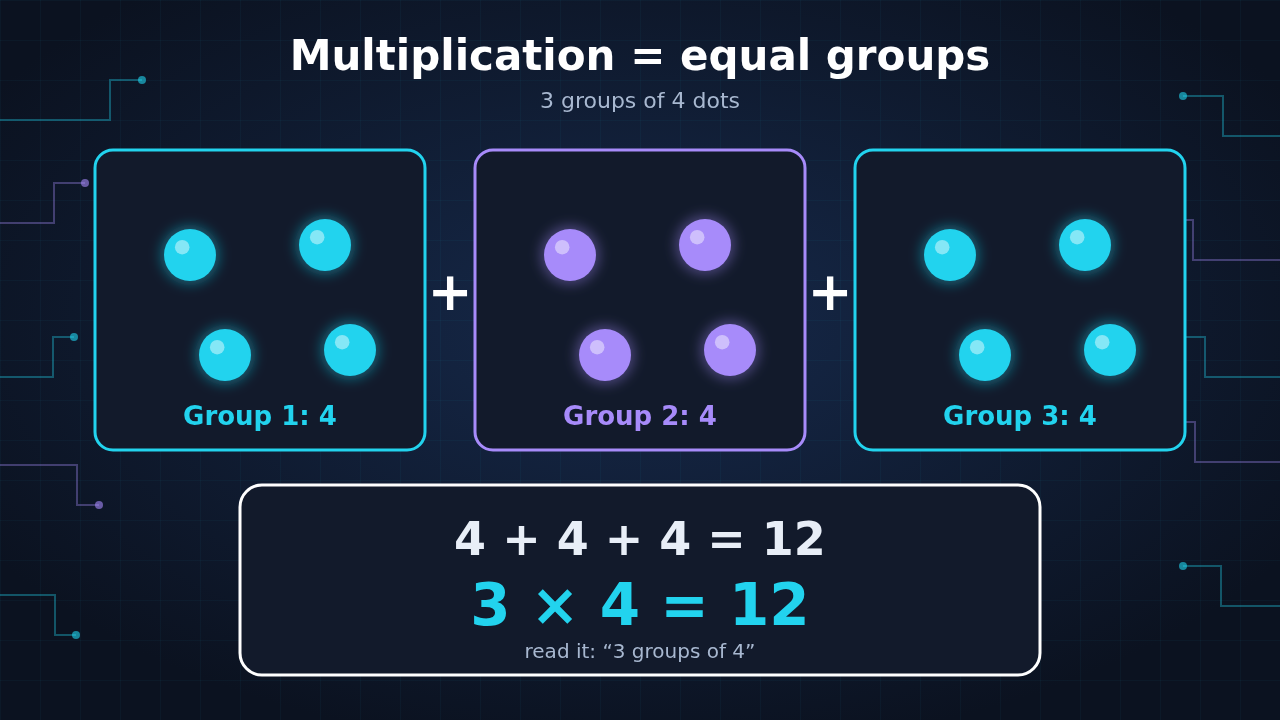
Count them: 4 + 4 + 4 = 12. So 3 × 4 = 12.
Multiplication is a shortcut for adding the same number again and again.
In one sentence: Multiplication tells you the total when you have equal groups.

There are three handy ways to see multiplication. Each one shows the same 12.
1. Groups. You just met these: 3 groups of 4.
2. Arrays. An array lines objects up in rows (side to side) and columns (up and down).
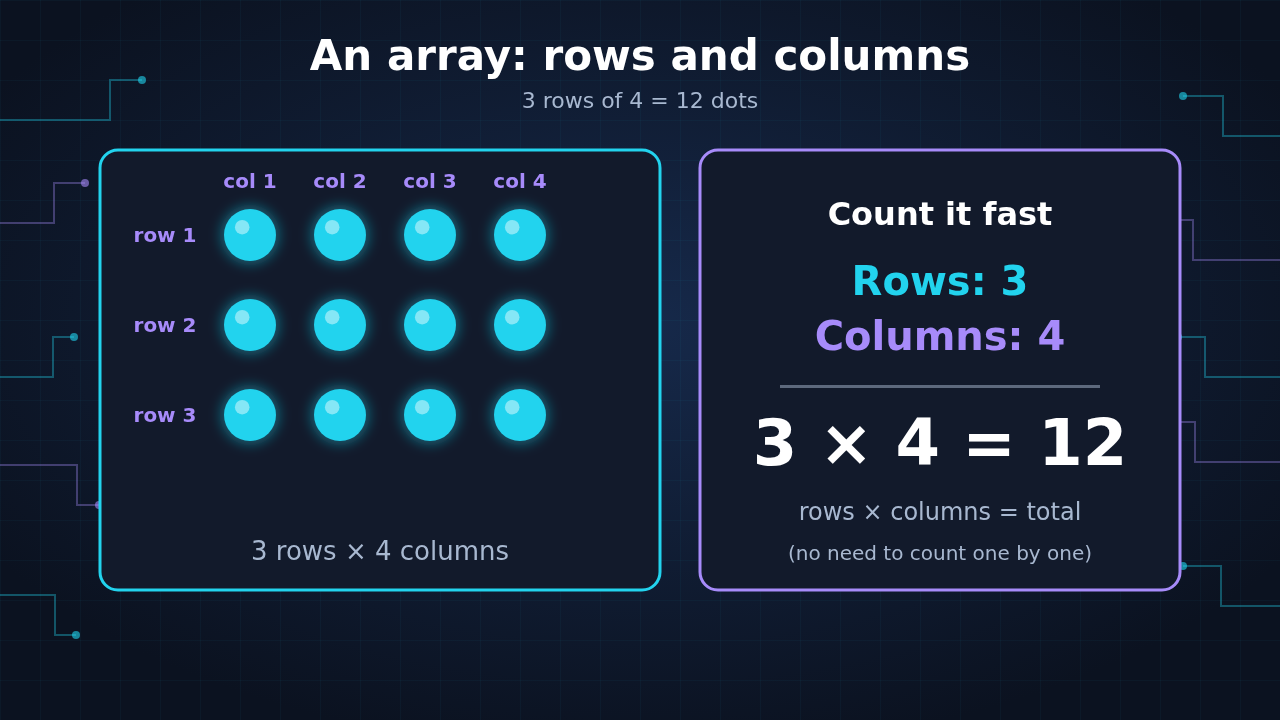
3 rows with 4 in each row. Rows × columns = total, so 3 × 4 = 12. No one-by-one counting needed.
3. Skip counting.
Jump along a number line. Start at 0 and make 3 jumps of 4.
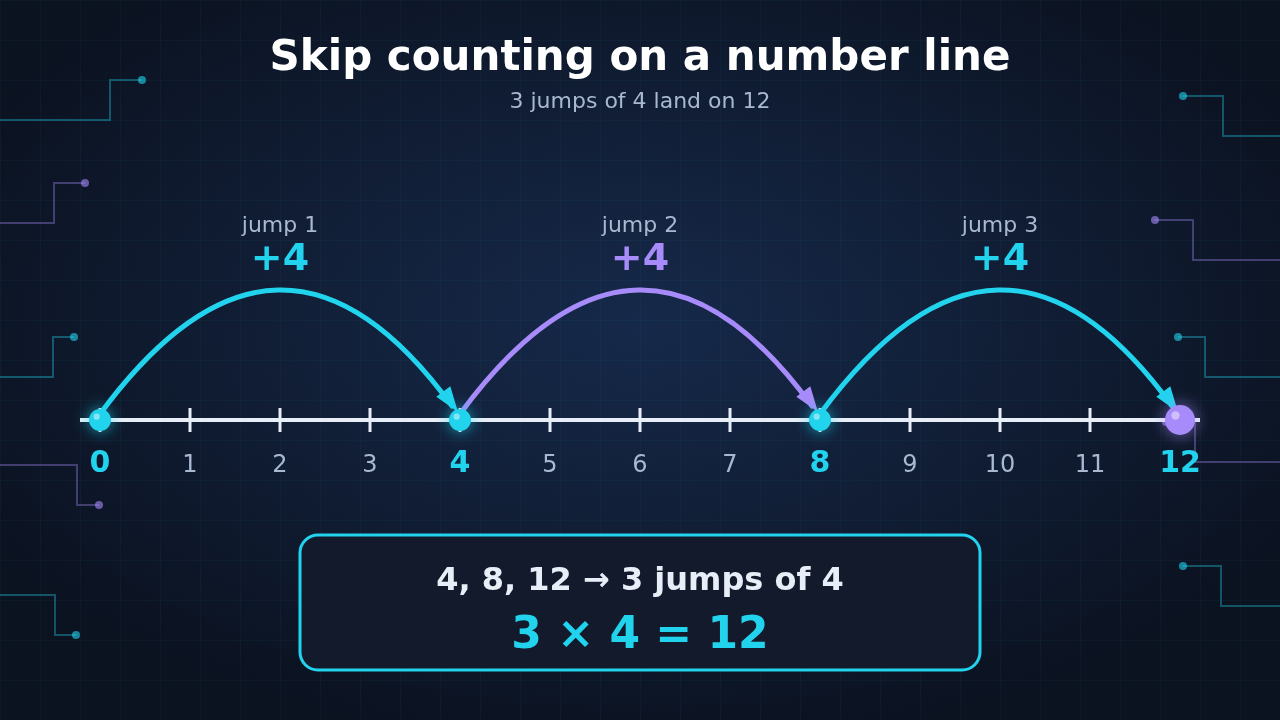
You land on 4, then 8, then 12. That is 3 × 4 = 12 again.
The flip. Turn the array on its side. Now it has 4 rows of 3.
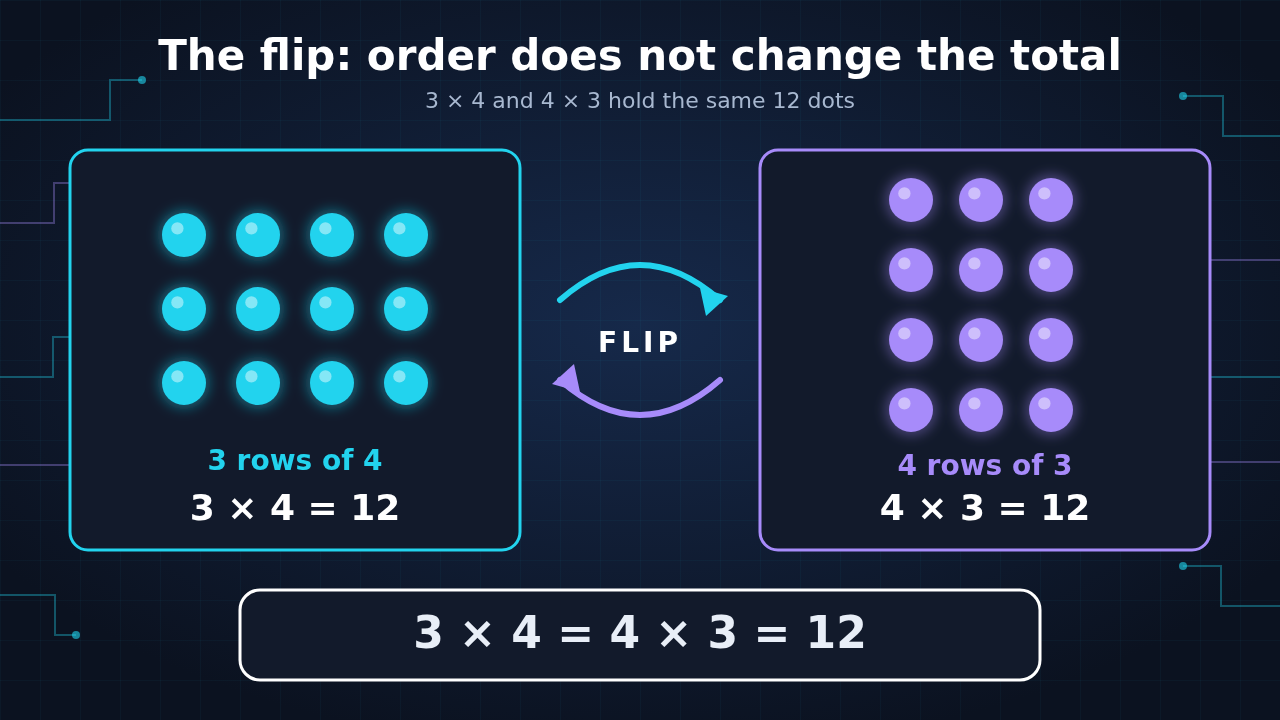
Same 12 dots. So 3 × 4 = 4 × 3. Mathematicians call this the commutative property: for multiplication, the order does not change the total.
Careful: the flip works for multiplication, not for every operation. 5 − 2 is not the same as 2 − 5.

Array Builder (build it, flip it, count it)
Goal: Show 3 × 4 three ways with objects you already have.
Steps:
- Collect 12 small objects.
- Groups: Make 3 groups of 4. Use plates, bowls, or circles of string. Say “3 groups of 4.”
- Array: Slide the objects into 3 rows of 4. Say “3 rows, 4 in each row.”
- Skip count: Touch each row and count 4, 8, 12.
- Flip: Turn the paper or walk around the table. Now it is 4 rows of 3. Is it still 12?
- Challenge: How many different arrays can you make with exactly 12 objects? (Try 2 rows and 6 rows, too.)
Success check: You can show 3 × 4 as groups, as an array, and as 3 jumps of 4, then say why 4 × 3 is also 12.
Talk about it: Which way helped you see the 12 fastest? What happens when you try 5 objects? (Hint: 5 can only be 1 row of 5 or 5 rows of 1.)

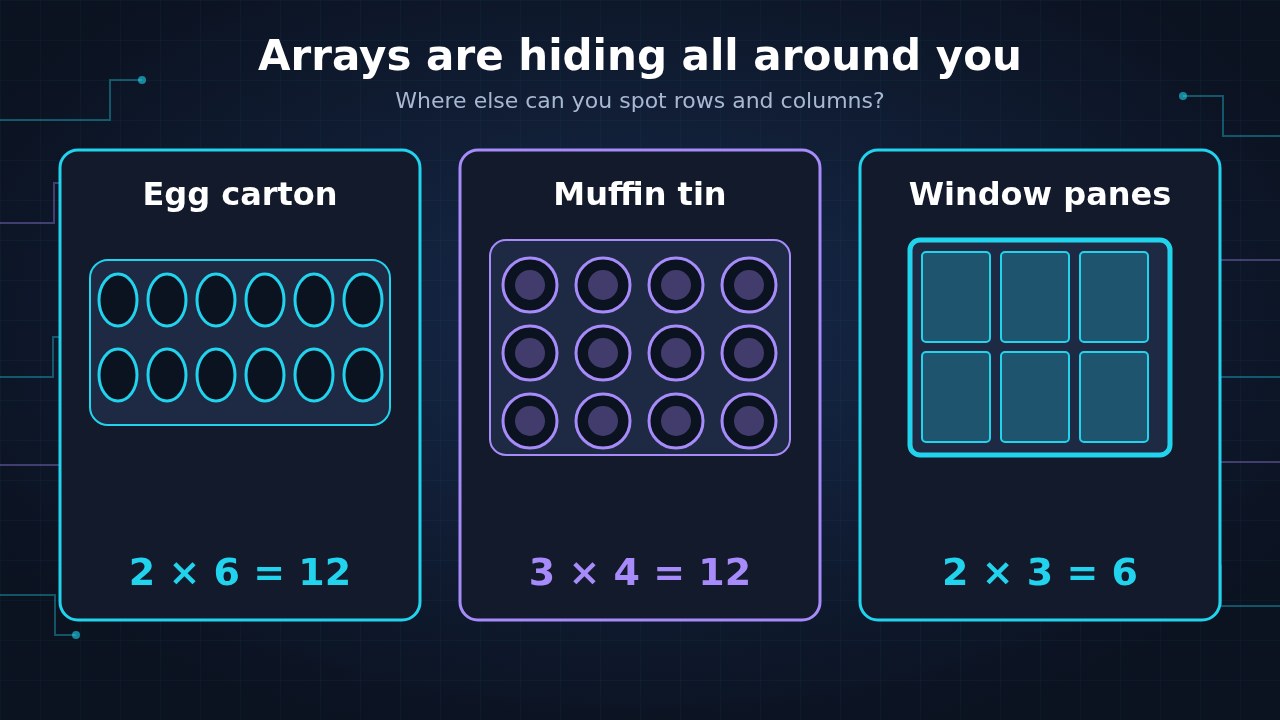
Real-life example: A muffin tin has 3 rows of 4 cups. You can bake 3 × 4 = 12 muffins in one batch.
Need 36 muffins for a party? That is 3 batches of 12. 3 × 12 = 36.
Multiplication saves time. Counting 36 muffins one by one is slow. Equal groups let you see the total fast.
You will use it when you shop, cook, build, and share. It also powers later math, like finding the area of a rectangle.

Look for equal groups and neat rows around you:
- Egg carton: 2 rows of 6 is 2 × 6 = 12 eggs.
- Snack packs: 4 packs with 6 crackers in each is 4 × 6 = 24 crackers.
- Floor tiles, windows, or chairs: count the rows, count the columns, then multiply.
When to use this lesson: On a rainy day, during summer math time, or any time you spot a neat set of rows at home.
Check your thinking
Talk together. Explain your thinking out loud.
- What does 3 × 4 mean?
- Write 3 × 4 as an adding problem.
- An array has 2 rows and 5 columns. How many objects are in it?
- Start at 0 and make 4 jumps of 5. Where do you land?
- If 6 × 3 = 18, what is 3 × 6? How do you know?
- Where in your home can you find an array?
Answers for grown-ups:
(1) 3 groups of 4.
(2) 4 + 4 + 4 = 12.
(3) 2 × 5 = 10.
(4) 5, 10, 15, 20, so you land on 20 (4 × 5 = 20).
(5) 18, because the flip does not change the total.
(6) Answers will vary: egg carton, muffin tin, window, tiles, shelf.
Facts known out of 144
A multiplication fact is one pair like 7 × 8 = 56.
The times tables go from 1 to 12. Each table has 12 facts.
12 × 12 = 144. So there are 144 facts in all.
As you practice, the number of facts you know grows. You also get a head start: once you know 3 × 4, the flip makes 4 × 3 feel familiar.
ASK → EXPLORE → APPLY
APPLY IT: Multiplication X
Pick the tables you are learning. Play 10 cards.
Which facts felt easy? Which felt tricky?
Type the answer. Choose a quick round of 10 cards or a longer round of 20. Choose any tables from 1 to 12.
Tips for grown-ups: Progress stays on this device. The app does not send your progress to us. Try one 10-card round a day.
Word bank
- Multiplication — A fast way to find the total of equal groups.
- Equal groups — Groups that each have the same number of things.
- Array — Objects lined up in rows and columns.
- Row — A line that goes side to side.
- Column — A line that goes up and down.
- Skip counting — Counting by the same jump each time, like 4, 8, 12.
- Product — The answer to a multiplication problem. The product of 3 × 4 is 12.
- Fact — One multiplication pair with its answer, like 7 × 8 = 56.
- Commutative property (the flip) — Multiplying in a different order gives the same total: 3 × 4 = 4 × 3.
Supplemental STEM aid for home or summer learning — not a school curriculum replacement. Adult supervision for materials.