


Beginner · STEM · Curiosity Questions
Materials: 10–20 small household objects (coins, buttons, dry pasta, blocks or socks), paper and pencil. Optional: a paper plate or bowl, a strip of paper for a number line.
Tips: Read the What and How parts aloud together. Ask “What do you notice?” before you explain.
Let the learner move the objects: sliding them away makes “take away” real. Say each fact out loud: “7 take away 3 leaves 4.”

Before we explain, wonder together:
- You have 7 crackers and 3 get eaten. How could you find how many are left without starting over?
- If 3 + 4 = 7, what do you already know about 7 − 3?
There are no wrong guesses. Notice first — then explore.
Ask → Explore → Apply: We ask those questions, explore with taking away, hops, and comparing, then apply with objects from home and a quick practice round.

Subtraction finds what is left when you take some away. It also finds how far apart two numbers are.
7 − 3 means start with 7 and take away 3. Say “7 minus 3.”
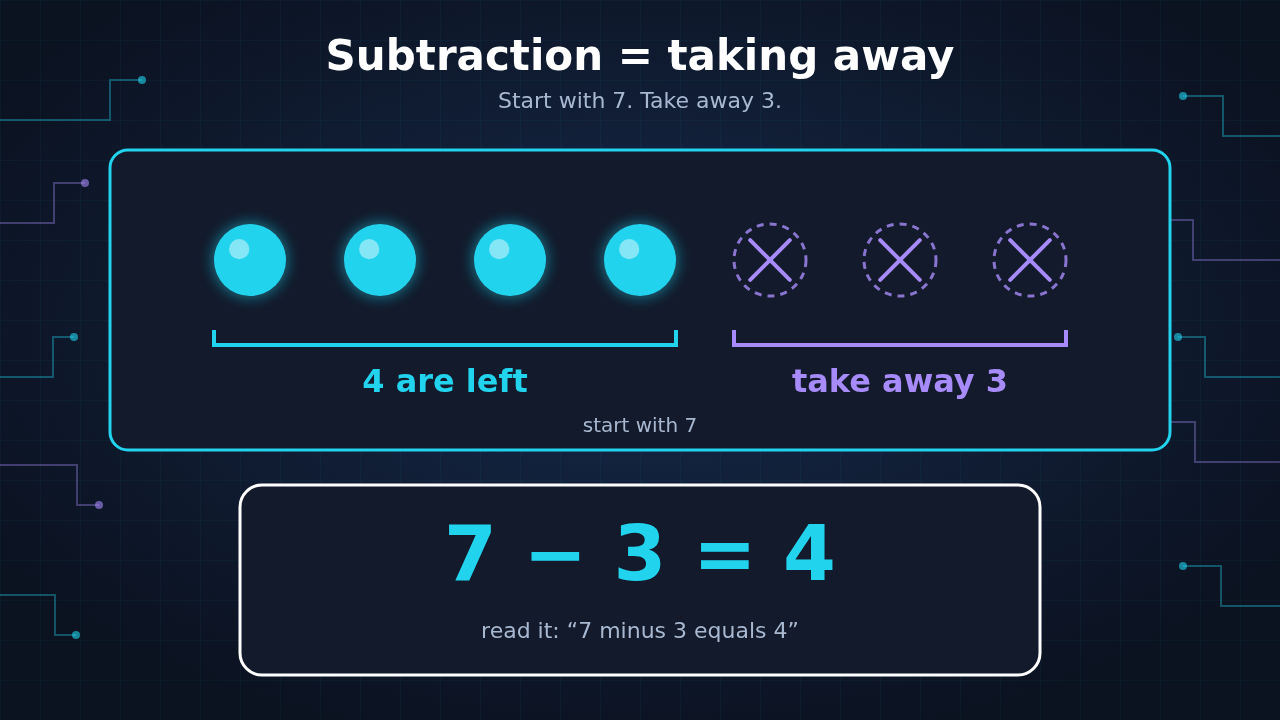
Count what is left: 4. So 7 − 3 = 4. The answer to a subtraction problem is called the difference.
Subtraction tells two stories: what is left after you take away, and how much more one amount is than another.
In one sentence: Subtraction tells you what is left, or the difference between two amounts.

There are four handy ways to see subtraction. Each one finds the same 4.
1. Take away. You just met this one: start with 7, take 3 away, count what is left.
2. Count back.
Start at 7 on a number line. Hop back 3 times, one number at a time.
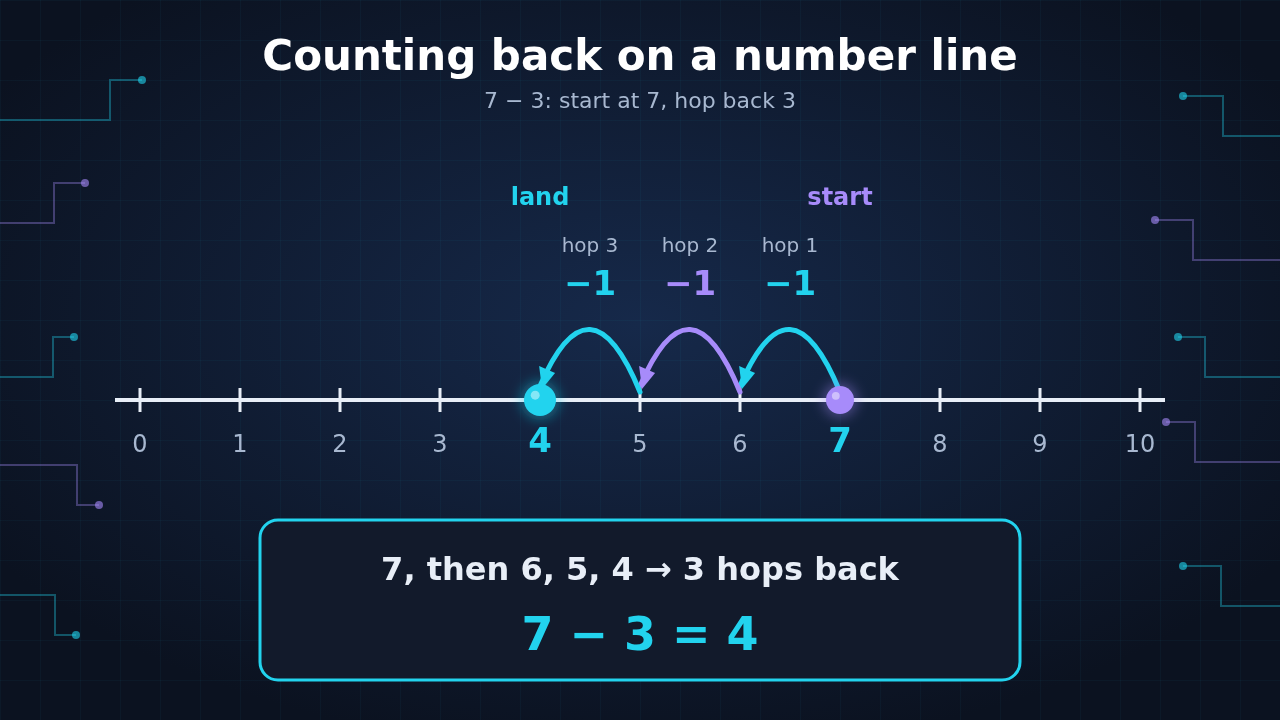
You say 6, 5, 4 and land on 4. Counting back works well when the number you take away is small.
3. Compare.
Build a tower of 7 blocks and a tower of 3 blocks side by side. The extra blocks show the difference.
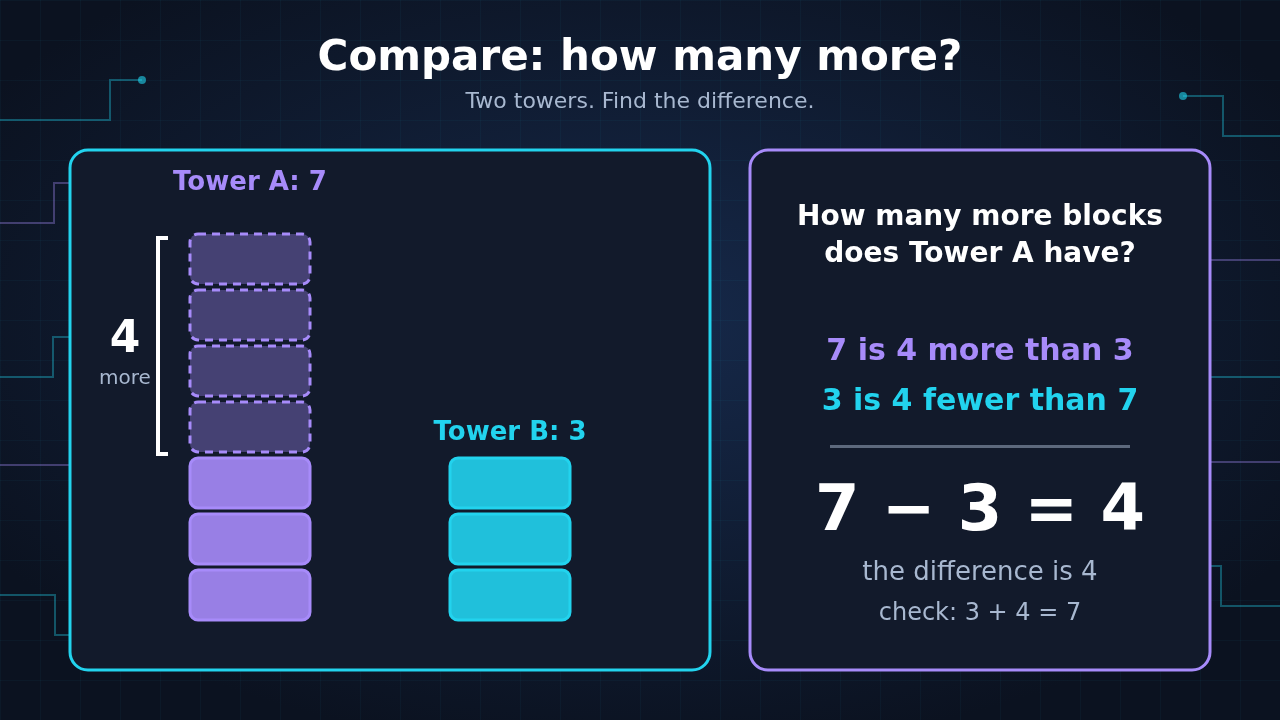
Tower A has 4 more blocks than Tower B. Tower B has 4 fewer than Tower A. Both sentences come from 7 − 3 = 4.
4. Count up.
How far is it from 3 up to 7? Hop up from 3 and count the hops.
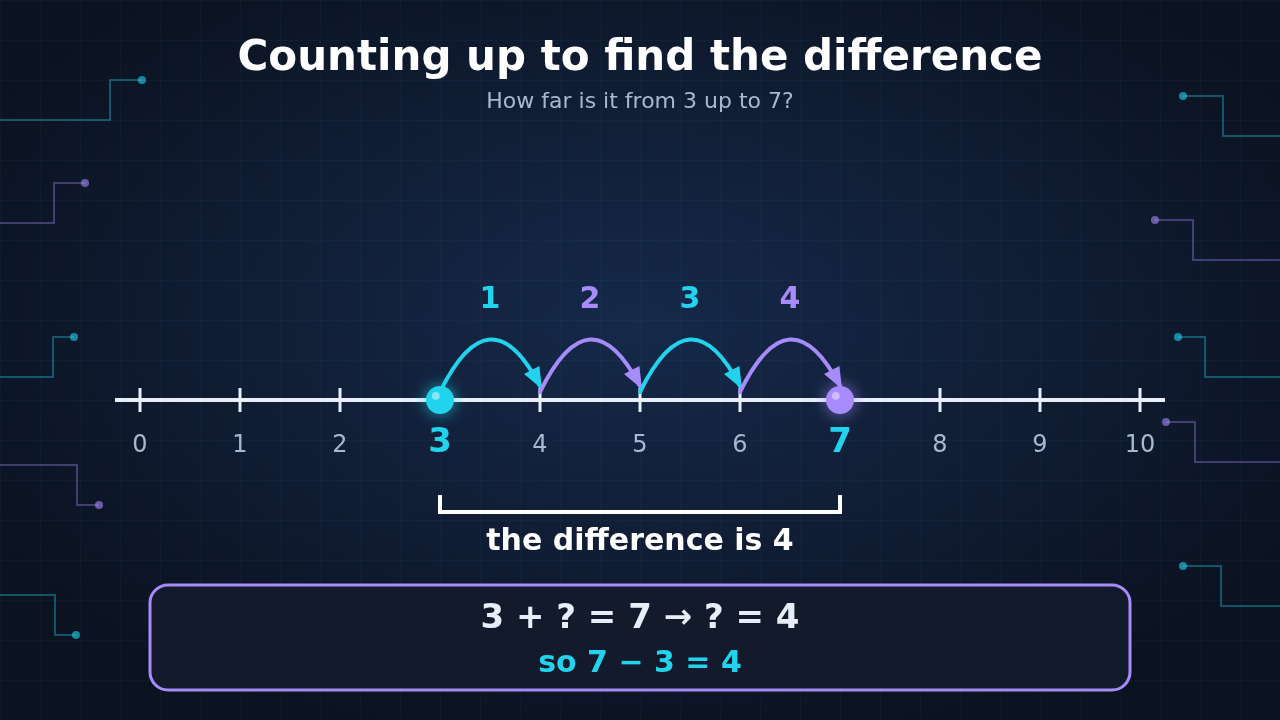
It takes 4 hops, so the difference is 4. Counting up works well when the two numbers are close together, like 15 − 13 (just 2 hops).
Subtraction is a missing-number puzzle. The problem 7 − 3 = ? asks: 3 plus what makes 7? Since 3 + 4 = 7, we know 7 − 3 = 4.
Subtraction undoes addition. Mathematicians call them inverse operations.
Order matters. With addition you can swap: 3 + 4 = 4 + 3. With subtraction you cannot.
7 − 3 = 4, but 3 − 7 is not 4. You cannot take 7 away from only 3 objects. At this level, start with the bigger number.

Take It Away (take away, compare, count back, check)
Goal: Show 7 − 3 four ways with objects you already have.
Steps:
- Collect 10 small objects.
- Take away: Make a pile of 7. Slide 3 away.
- Count what is left. Say “7 take away 3 leaves 4.”
- Compare: Line up 7 objects in one row and 3 in another, side by side. Point to the extras. How many more?
- Count back: Fold a paper strip into a number line from 0 to 10. Put a coin on 7 and hop it back 3 times. Where does it land?
- Check with addition: Put the 4 left objects together with the 3 you took away. Is 3 + 4 equal to 7?
- Challenge: Pick a new start number up to 10 and a number to take away. Write the subtraction and its addition partner. Try 10 − 6.
Success check: You can show 7 − 3 as taking away, as comparing, and as hops back, then check the answer with 3 + 4 = 7.
Talk about it: Which way helped you find 4 fastest? What happens when you take away none (7 − 0) or take away all (7 − 7)? What happens when you try 3 − 7 with objects?

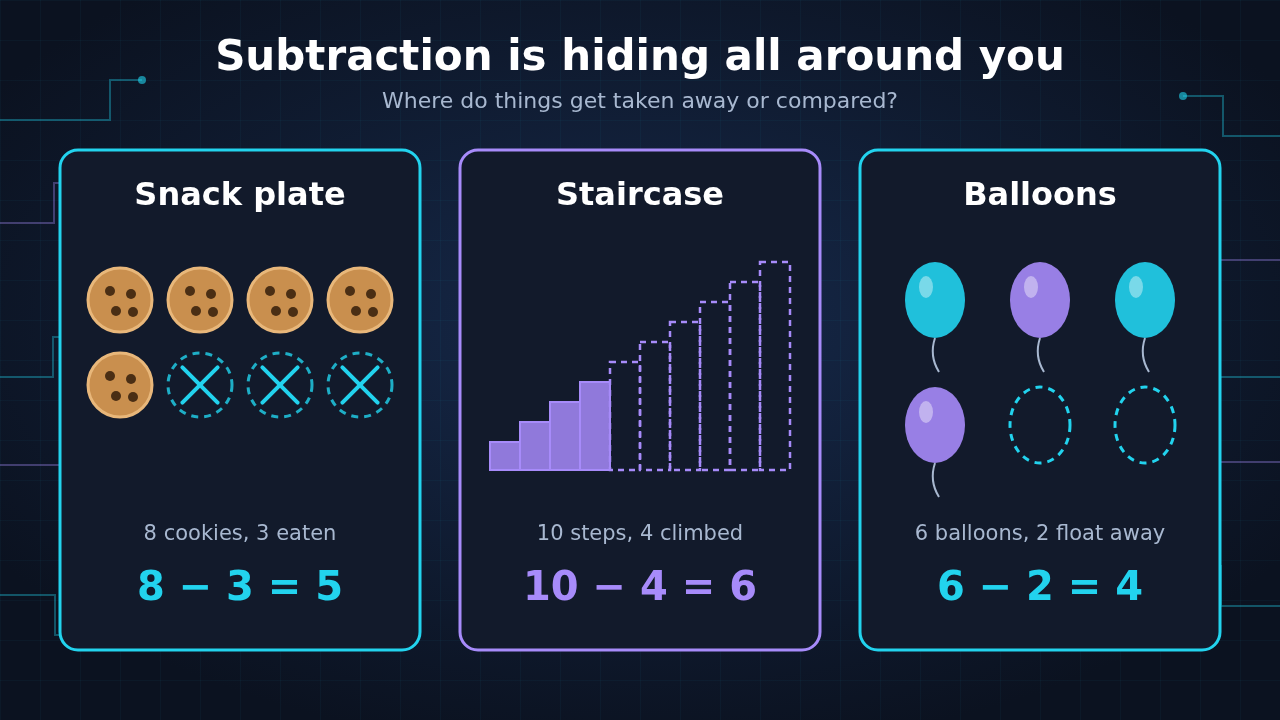
Real-life example: A plate has 8 cookies. You eat 3. That leaves 8 − 3 = 5 cookies.
Want to know how many more? A friend has 12 stickers and you have 9. 12 − 9 = 3, so your friend has 3 more.
Subtraction saves time. Counting everything again after each change is slow. Subtraction tells you what is left, how many more you need, and how far apart two amounts are.
You will use it when you shop, cook, share, and plan your day. It also powers later math, like checking an answer and finding how much longer one length is than another.

Look for things being taken away or compared around you:
- Snacks: 10 grapes and you eat 4 is 10 − 4 = 6 grapes left.
- Stairs: A staircase has 12 steps and you are on step 5. That is 12 − 5 = 7 steps to go.
- Scores or heights: Compare 9 points and 6 points. The difference is 9 − 6 = 3.
When to use this lesson: On a rainy day, during summer math time, or any time you spot something being used up or compared.
Check your thinking
Talk together. Explain your thinking out loud.
- What does 7 − 3 mean?
- Start at 8 and count back 5. Where do you land?
- Tower A has 9 blocks and Tower B has 5. How many more does Tower A have?
- Fill in the blank: 5 + ? = 9. Then write the matching subtraction.
- If 3 + 4 = 7, write the two subtraction facts from the same family.
- Why can you not find 3 − 7 by taking away objects (at this level)?
- Where in your home can you find something being taken away or compared?
Answers for grown-ups:
(1) Start with 7 and take away 3.
(2) 8, then 7, 6, 5, 4, 3, so you land on 3 (8 − 5 = 3).
(3) 9 − 5 = 4 more.
(4) 5 + 4 = 9, so 9 − 5 = 4.
(5) 7 − 3 = 4 and 7 − 4 = 3.
(6) There are only 3 objects, so you cannot take 7 away.
(7) Answers will vary: snacks, stairs, toys, scores, coins.
Fact families: your head start
A subtraction fact is one pair like 7 − 3 = 4.
A fact family is a set of three numbers that go together. Here the family is 3, 4, and 7.
The two small numbers are the parts. The biggest number is the whole.
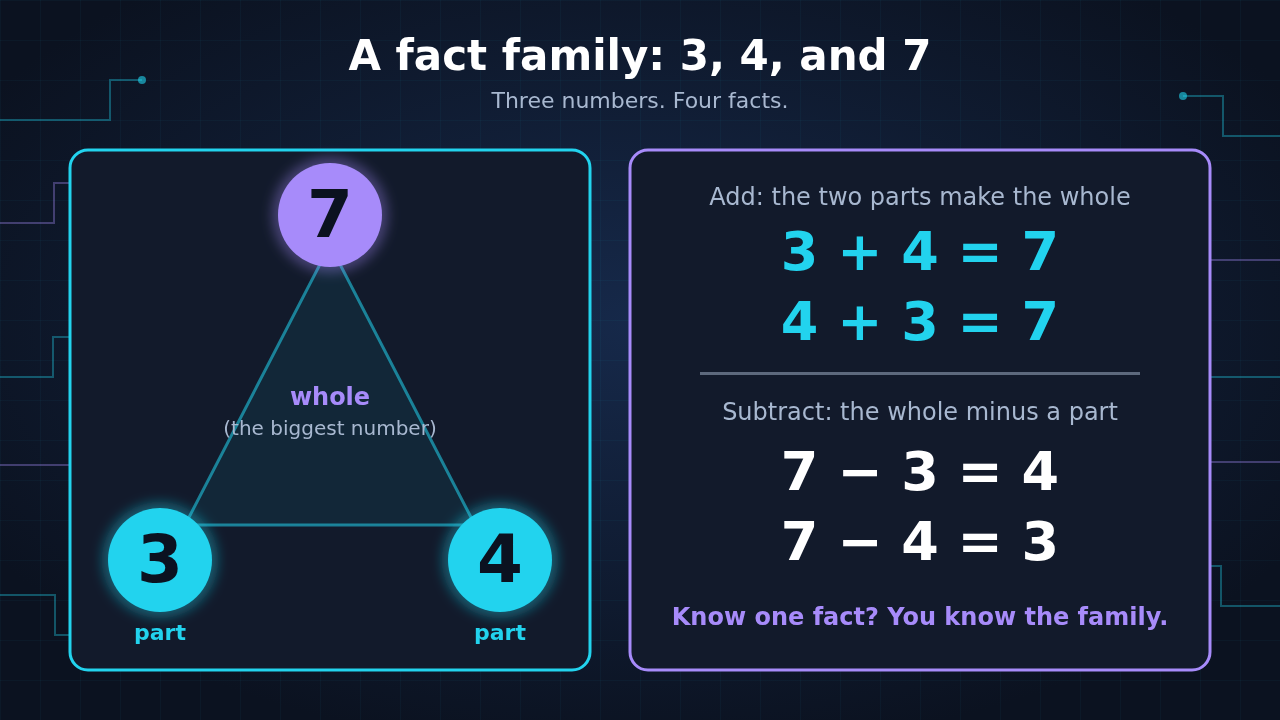
One family gives four facts: 3 + 4 = 7, 4 + 3 = 7, 7 − 3 = 4, and 7 − 4 = 3. In a subtraction fact, the whole always comes first.
Why it helps: If 7 − 3 feels tricky, ask “3 plus what makes 7?” Every addition fact you know gives you a head start on subtraction.
Some families have only two facts. The family 5, 5, and 10 gives 5 + 5 = 10 and 10 − 5 = 5.
As you practice, the number of subtraction facts you know grows. Look for families, not just single facts.
ASK → EXPLORE → APPLY
APPLY IT: Subtraction X
Pick your numbers. Play 10 cards.
Which differences felt easy? Which felt tricky?
Type the answer. Choose a quick round of 10 cards or a longer round of 20.
Tips for grown-ups: Progress stays on this device. The app does not send your progress to us. Try one 10-card round a day.
Word bank
- Subtraction — Finding what is left, or how far apart two numbers are.
- Minus (−) — The symbol for subtracting. Say “7 minus 3.”
- Take away — Remove some from a group and see what is left.
- Difference — The answer to a subtraction problem. The difference of 7 and 3 is 4.
- Count back — Hop down a number line, one number at a time.
- Count up — Hop up from the smaller number to the bigger one to find the difference.
- Compare — Put two amounts side by side to see which is more and by how much.
- Inverse operations — Operations that undo each other, like addition and subtraction.
- Fact family — Three numbers that make two addition facts and two subtraction facts.
- Fact — One subtraction pair with its answer, like 7 − 3 = 4.
Supplemental STEM aid for home or summer learning — not a school curriculum replacement. Adult supervision for materials.