


The sky is blue because air scatters blue light much more than red light. Here is how it works, for kids and grown-ups.
Beginner · STEM · Curiosity Questions
Materials: A tall clear glass, water, a little milk, a flashlight and a dark room. Paper and crayons. A grown-up to help.
Tips: Read the What and How parts aloud together. Ask “What do you notice?” before you explain.
Safety: Do the glass-and-flashlight test with a grown-up. Never look straight at the Sun.

Before we explain, wonder together:
- Sunlight looks white. So where does the blue in the sky come from?
- Why does the sky turn orange and red at sunset?
There are no wrong guesses. Notice first, then explore.
Ask → Explore → Apply: We ask those questions. We explore light and air. Then we apply it with a glass of water and a flashlight.
The blue sky
The blue sky at a glance
Sunlight: Looks white. It is a mix of all the colors.
Blue light: Short waves. Air scatters it much more than red.
Red light: Long waves. It mostly goes straight through.
The big idea: Air bounces blue light all over the sky.
Sunsets: The light travels farther through air.
Look at the sky, not at the Sun. Never look straight at the Sun. It can hurt your eyes.
Air bounces blue light all over the sky. That is why the sky looks blue.

Sunlight looks white. But it is really a mix of all the colors.
A rainbow shows those colors. So does a prism, a special crystal that splits white light.
Light travels in waves. Some waves are short and choppy. Some are long and lazy.
The size of a wave is its wavelength. Blue waves are short. Red waves are long.
Earth is wrapped in air. We call it the atmosphere.
Air is made of tiny bits called molecules.
Sunlight hits air molecules and bounces off in all directions. We call this scatter.
Blue light scatters much more than red, orange or yellow light. So blue light reaches your eyes from all over the sky.

Look at the colors picture. White light goes in. A rainbow comes out.
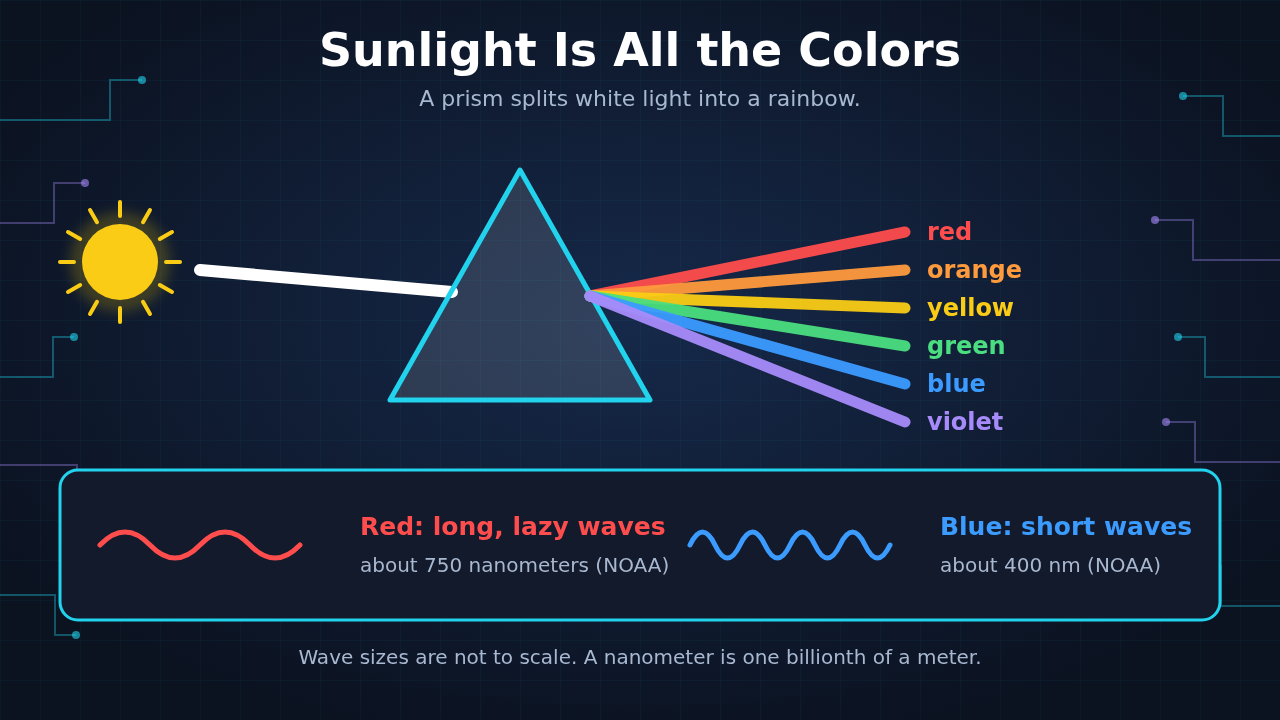
A prism splits white light into colors. Red waves are long. Blue waves are short.
How big are the waves? NOAA says red is about 750 nanometers. Blue is about 400.
A nanometer is one billionth of a meter. These waves are tiny.
Now look at the scatter picture. White sunlight goes into the air.
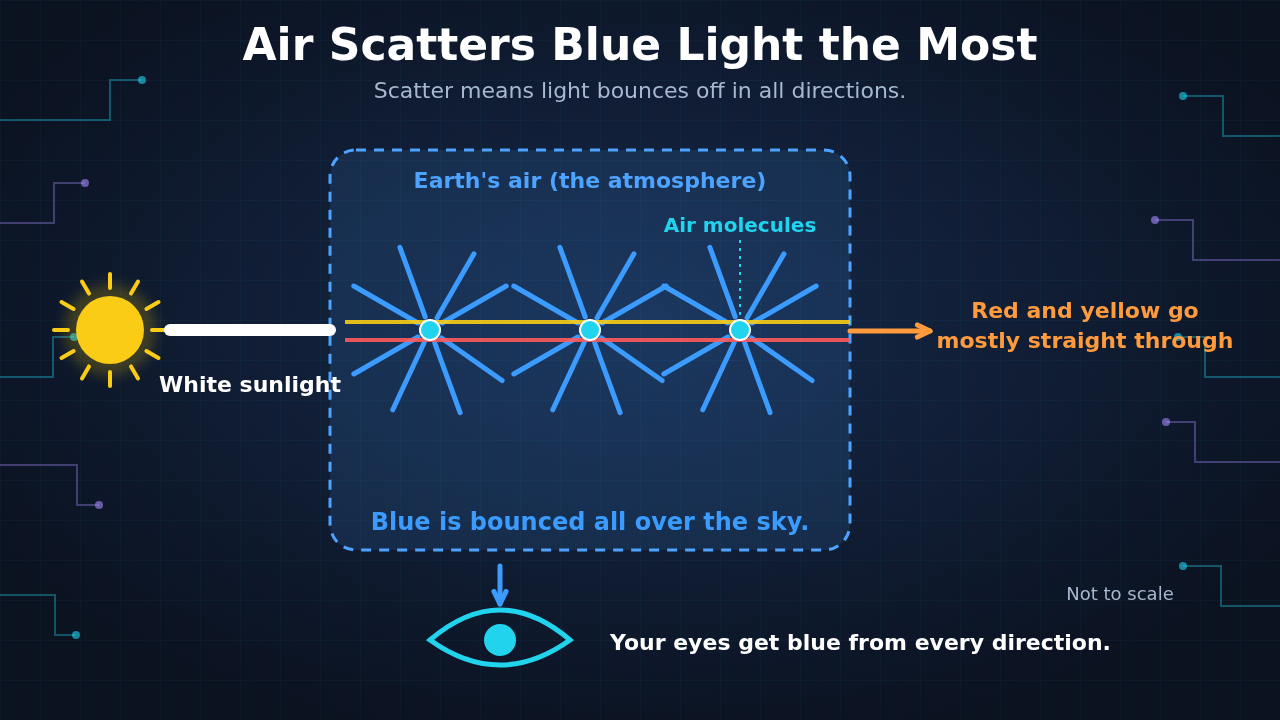
Air molecules bounce blue light in every direction.
The red and yellow parts mostly go straight through.
The blue parts bounce off air molecules. They scatter in every direction.
That blue light comes to your eyes from every part of the sky. So the whole sky looks blue.
What about violet? Violet scatters too. But our eyes see blue better than violet.
High in the air, some violet light is also taken in. That leaves mostly blue.
Near the horizon, the sky looks paler. The light has crossed more air there. The blue has scattered again and again.
Why is the sunset red and orange? At sunset the Sun is low in the sky.
Its light must cross much more air to reach you.
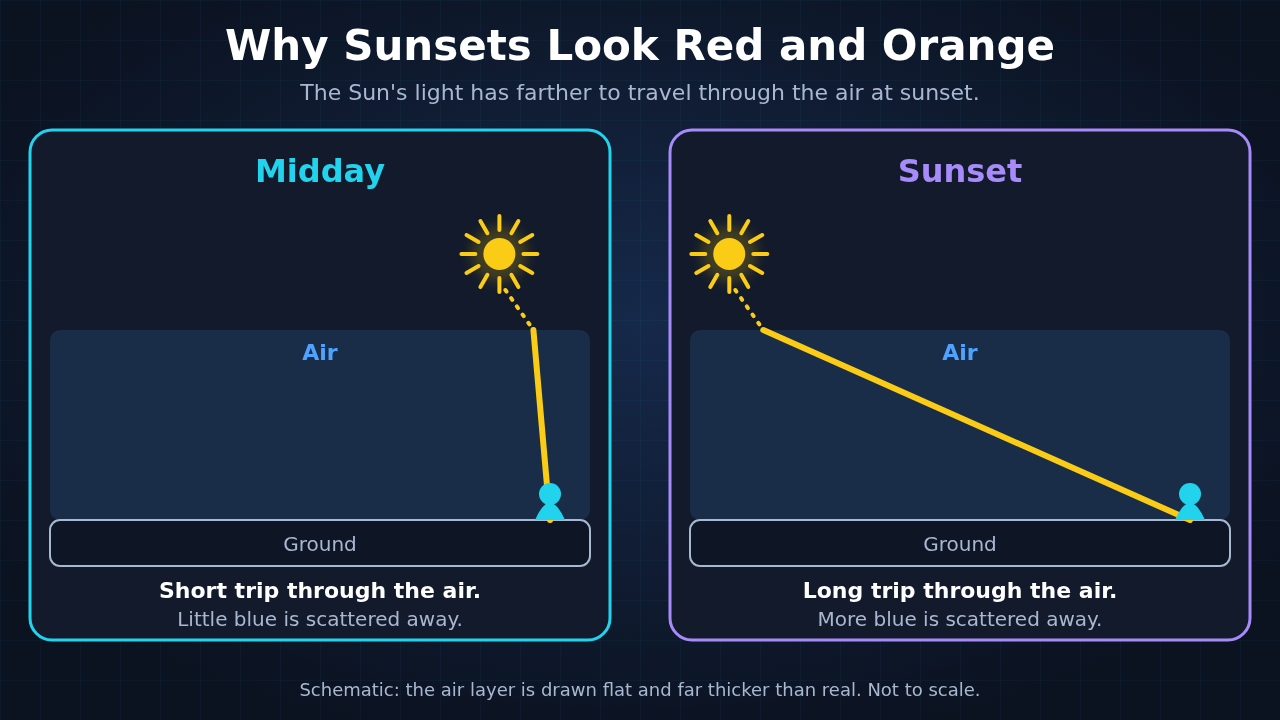
At sunset the light has farther to travel through the air.
More of the blue light is scattered away. The reds and oranges are left.
So the sky near the Sun glows orange and red.
Scattered light is also a clue. A NASA satellite used laser light to map dust and smoke.
Fun fact: A human hair is about 50,000 nanometers thick. Light waves are much smaller than that.

Goal: See scattering with a glass of water and a flashlight. You need a tall clear glass, water, milk, a flashlight, paper and crayons.
- Make it. Fill a tall clear glass with water. Stir in a few drops of milk.
- Shine it. Turn off the lights. Shine a flashlight at the top of the glass.
- Look from the side. Where the light goes through the milky water, it looks a little blue.
- Look at the far end. Hold white paper behind the glass. The light there looks yellow or orange.
- Draw it. Draw the sky at noon and at sunset. Color each one.
Check your thinking: The side looks bluish because tiny bits of milk scatter blue light. The far end looks yellow or orange because the blue was scattered away.
If you add too much milk, the glass looks yellowish. Your noon sky is blue. Your sunset sky is orange and red.
Talk about it: Why do you think the sky near the horizon looks paler?

You can see this every day. Look up on a clear day. The sky is blue.
Look again at sunrise or sunset. The colors change as the Sun gets low.
Remember: look at the sky, not at the Sun.
Who explained it? This kind of scattering is named for Lord Rayleigh, a physicist. NOAA tells the story.
What next? Draw the sky at the same time each day for a week. What do you notice?
Keep exploring
Series: Free lessons. Explore more: All lessons
Related lessons:
- How Far Is the Moon?: look up at the Moon and measure the gap.
- How Long Does It Take to Get to the Moon?: how long a trip to the Moon takes.
- What Is a Scam Call?: stay calm and spot the signs.
More free lessons: All lessons, Free STEM samples and the Practice Zone.
For advanced learners
Ready for more? These are deeper facts from the sources we used. Read them with a grown-up.
Think deeper:
- NESDIS says red waves are about 750 nanometers and blue or violet waves about 400. Which wave is longer?
- Violet scatters too. So why is the sky not violet? Read what the sources say below.
- Why might dust change the colors of a sunset? Look for where the sources agree and where they differ.
Names and numbers. The scattering is called Rayleigh scattering. NOAA’s JetStream page says the air molecules are much smaller than the wavelengths of light, and that blue scatters “about four times stronger” than red.
JetStream also says violet scatters first but very high in the atmosphere, so it is not readily seen. NOAA’s Storm Prediction Center (Corfidi) says pure air scatters violet three to four times more effectively than longer wavelengths.
Wavelengths differ by source: NESDIS says red is about 750 nm and blue or violet about 400 nm; Corfidi gives 0.47 to 0.64 micrometers for violet to red.
Why not violet? The sources stress different reasons. NASA Space Place says only that blue scatters more because its waves are shorter.
NASA Science says violet is scattered more than blue, but the sky looks blue because our eyes are more sensitive to blue. NESDIS says some violet is absorbed high in the atmosphere and our eyes are less sensitive to violet.
UCAR says the sky is blue because our eyes are not very sensitive to violet. Glenn Smith (American Journal of Physics, 2005, reported by Science News) says the measured scattered sunlight is about as intense at violet as at blue, and that our eyes combine violet, blue and green into the sensation of blue.
Sunsets and dust. The sources differ. NESDIS says larger particles of dust, pollution and water vapor scatter more red and yellow and can make the western sky glow red.
NOAA’s Corfidi says low-level dust and haze generally subdue sunset colors, and that clean air gives the brightest ones. NOAA’s Global Monitoring Laboratory says dust and aerosols scatter the longer red wavelengths more efficiently, mostly forward, so a long path through dirty air looks reddish, while a cleaner atmosphere at sunset looks yellowish.
We kept the kid text to what all sources agree on: a longer path through air removes more blue.
The horizon. NASA Space Place says low sunlight has crossed more air, which scatters and re-scatters the blue light many times, and Earth’s surface also reflects and scatters light. It says all this mixes the colors together again, so we see more white and less blue.
NESDIS says the blue is re-scattered so many times that less blue light reaches us.
The glass test. This follows a UCAR Center for Science Education activity. UCAR says the milk particles scatter light the way air does: blue where the light has crossed little water, and yellow, orange or red after it has crossed most of it.
It is a model, not the real sky.
Eye safety. NASA says never to look directly at the Sun without proper solar viewing protection. Regular sunglasses are not enough.
Supplemental. This free lesson is a STEM aid for home or summer learning. It does not replace a school curriculum.
Word bank
- Prism — A special crystal that splits white light into colors.
- Wave — A way light travels: up and down, again and again.
- Wavelength — The size of one wave. Blue is short. Red is long.
- Atmosphere — The layer of air around Earth.
- Molecule — A tiny bit of a gas, much too small to see.
- Scatter — To bounce in many different directions.
- Nanometer — One billionth of a meter.
- Horizon — The line where the sky seems to meet the ground.
Sources: NASA Space Place: Why Is the Sky Blue?; NOAA NESDIS: Why Is the Sky Blue?; NASA Science: Wave Behaviors; NOAA JetStream: The Color of Clouds; NOAA Storm Prediction Center: The Colors of Twilight and Sunset (Corfidi); NOAA Global Monitoring Laboratory: Red sky at night; UCAR Center for Science Education: Blue Skies and Red Sunsets; Science News: Why isn't the sky violet, Daddy?; NASA Science: Eclipse Viewing Safety.
Made by K12 Summer Workbooks. Text and pictures are original.