


Carbon (C) is element 6 on the periodic table, the building block of living things, pencils and diamonds. Facts for kids and grown-ups.
Beginner · STEM · Curiosity Questions
Materials: Paper, a pencil, and 2 or more crayons. Optional: the free Periodic Table X app.
Tips: Read the What and How parts aloud together. Ask “What do you notice?” before you explain. Draw the atom together.
Safety: This lesson is for reading and imagining, not for experiments.
New to the periodic table? Start with What Is the Periodic Table?.

Before we explain, wonder together:
- What do pencils, diamonds and your own body have in common?
- Can a soft pencil tip and a hard diamond be the same stuff?
There are no wrong guesses. Notice first, then explore.
Ask → Explore → Apply: We ask those questions. We explore carbon’s atom and neighbors. Then we apply it with a find-it hunt.
Meet Carbon
Carbon at a glance
Atomic number: 6 (that many protons)
Symbol: C
Atomic mass: 12.011
Group and period: group 14 (a column), period 2 (a row)
Family: Nonmetal
State at room temperature: Solid (in a normal room)
Electron shells (layers): 2 shells, holding 2 and 4 electrons
Carbon is element 6, a nonmetal. It is the building block of all living things.

An element is a pure kind of matter. It is made of only one kind of atom.
Carbon is element 6. It is a nonmetal. A nonmetal is an element that is not a metal.
Carbon is in every living thing: plants, animals and people.
Look inside a carbon atom. It has 6 protons in the center. A proton is a tiny part with a positive charge.
It has 6 electrons moving around the center. An electron is a tiny part with a negative charge.
Pure carbon comes in different forms. Graphite is soft, shiny and gray-black. Diamond is clear and very hard.
Both are pure carbon. Their atoms are linked in different patterns.

Look at the atom picture. Carbon has 6 electrons on 2 shells. A shell is a layer where electrons move.
Shell 1 holds 2 electrons. Shell 2 holds 4.
Two shells means carbon is in period 2. A period is a row on the table.
Carbon has 4 outer electrons. That puts it in group 14. A group is a column on the table.
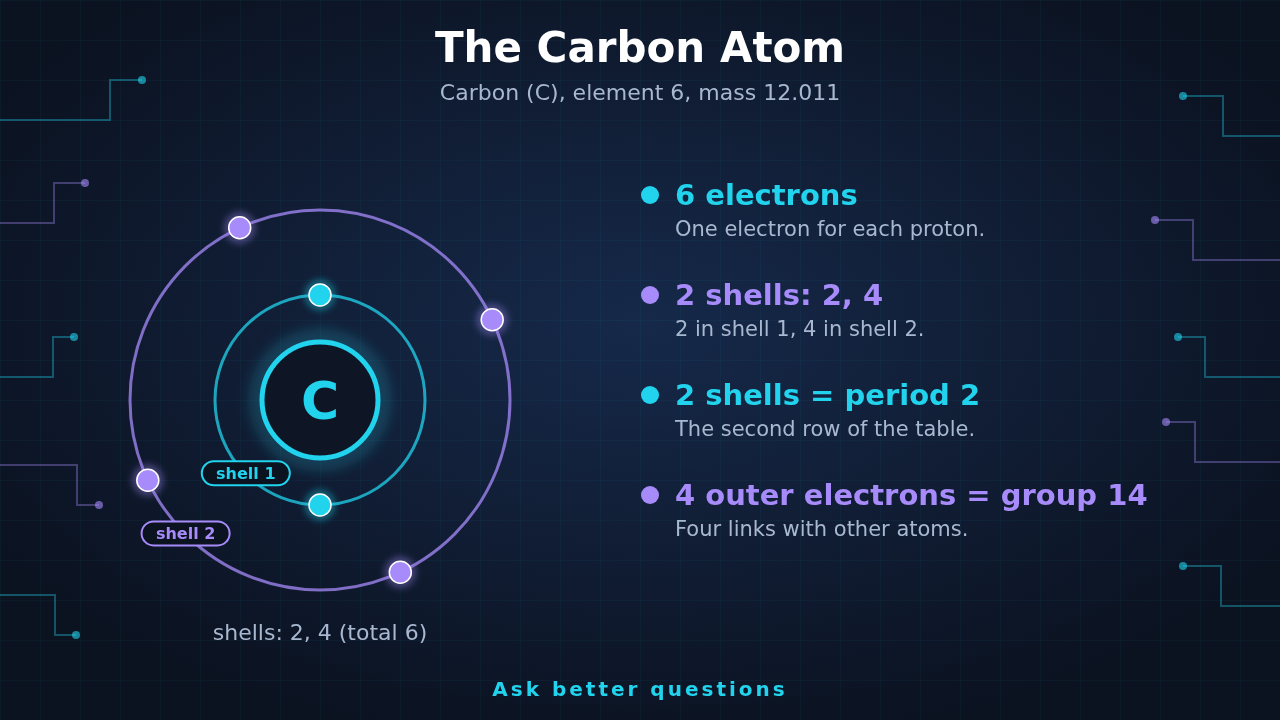
Carbon’s atom: 6 electrons on 2 shells.
Four outer electrons let carbon link with up to 4 other atoms. That is why carbon can build so many different things.
Air has carbon too, joined with oxygen. Together they make carbon dioxide. It has 1 carbon atom and 2 oxygen atoms.
Plants take in carbon dioxide from the air to make food.
Look at the neighbors picture. Elements go in order. Boron comes before carbon, and nitrogen comes after.
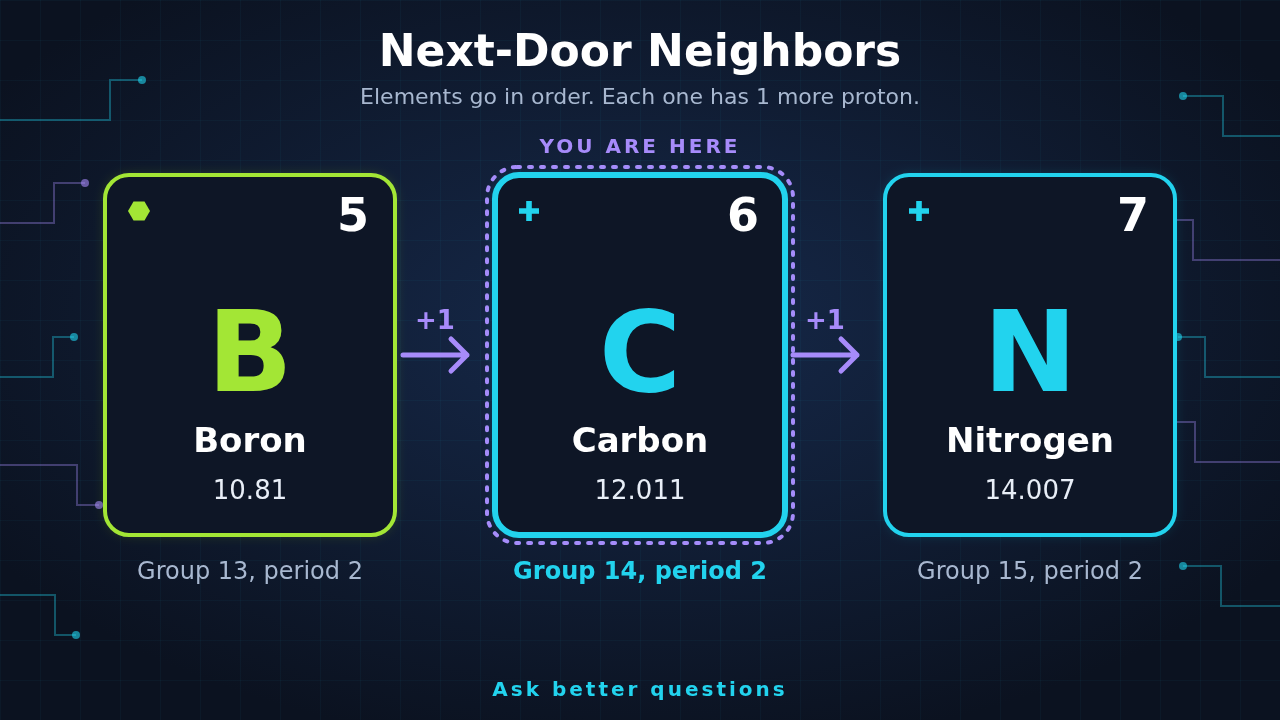
Element 6 sits between its next-door neighbors.

Why does carbon matter? Here are three everyday uses.
- Pencils. Pencil “lead” is graphite mixed with clay. Graphite is a form of carbon.
- Diamonds. Diamonds are made only of carbon.
- Charcoal and coal. They are mostly carbon.
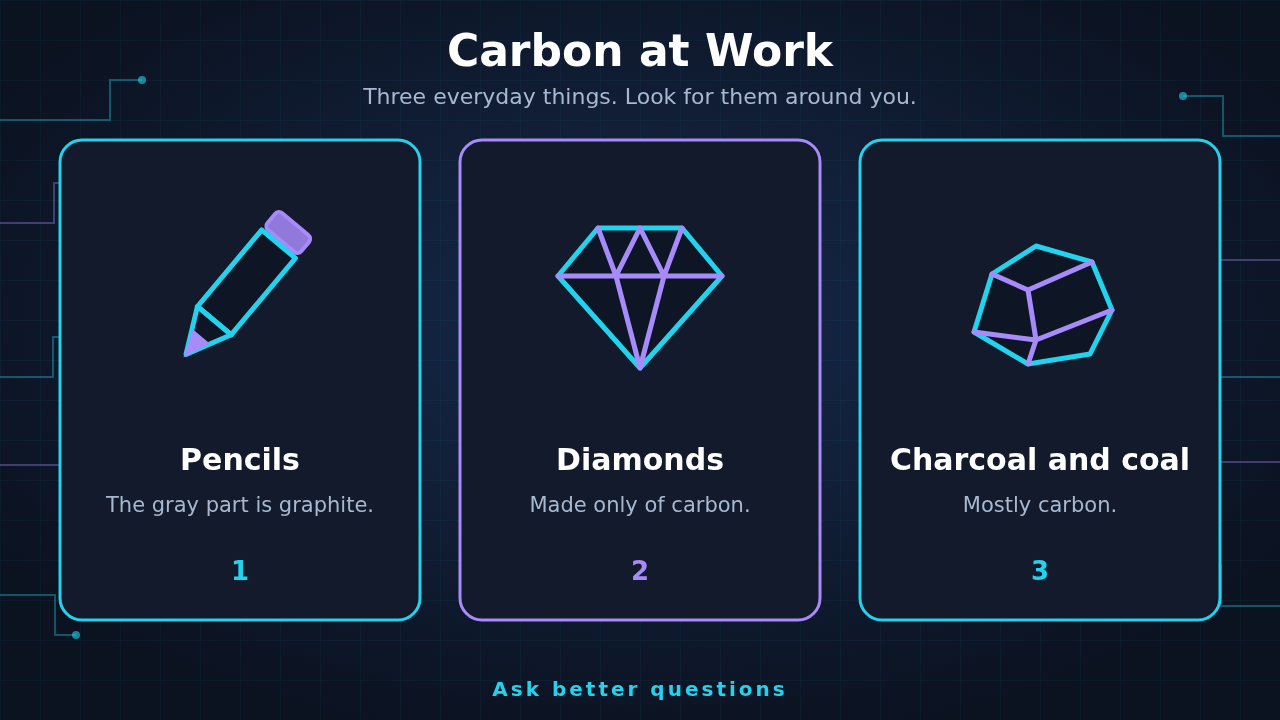
Three everyday things that use carbon.
Fun fact: Diamond and graphite are both pure carbon, but they look and feel very different.

Goal: Learn carbon’s atom by drawing, finding and comparing. You need paper, a pencil and crayons.
- Draw it. Draw a dot in the middle.
- Draw 2 circles around it. Put 2 dots on the inner circle and 4 on the outer circle.
- Pencil clue. Look at a pencil. The gray middle is graphite, a form of carbon.
- Draw a line. You left some carbon on the paper!
- Find it. Find 5 things that were once alive.
- Try wood, paper, cotton, a leaf and a fruit. All have carbon.
- Compare it. Open Carbon in Periodic Table X.
- Then open Oxygen. Which atom has more outer electrons?
Check your thinking: Your atom has 2 dots inside and 4 outside. Pencils leave graphite, which is carbon.
Things that were alive have carbon. Oxygen has 6 outer electrons and carbon has 4.
Talk about it: A diamond and a pencil tip are both carbon. Why do you think they look so different?

You meet carbon every day in pencils, paper, wood and food.
You also let out carbon dioxide every time you breathe out. Carbon dioxide is carbon joined with oxygen.
Who found it? No one person is credited. The RSC lists carbon’s discovery date as prehistoric.
Britannica says it was well known in the ancient world. People knew it as soot and charcoal. Diamond was the hardest form to identify.
In 1796, a scientist named Smithson Tennant showed that diamond is pure carbon.
The name comes from carbo, the Latin word for charcoal.
What next? Pick a neighbor and ask the same questions. Each lesson asks, explores and applies.
Keep exploring
Series: Periodic Table. Previous: Boron (coming soon) Next: Nitrogen (coming soon)
Neighbors in period 2: What Is Oxygen?.
Open Carbon in Periodic Table X
Related elements:
- Oxygen (O): joins with carbon to make carbon dioxide.
- Lithium (Li): another element in period 2.
- Silicon (coming soon): the next element down in carbon’s group.
Family: nonmetals (a family page is coming soon).
More free lessons: Free STEM samples and the Practice Zone.
For advanced learners
Ready for more? These are deeper facts from the sources we used. Read them with a grown-up.
Think deeper:
- The RSC lists carbon’s discovery date as prehistoric. What does that tell you about who found it?
- The RSC lists the density of diamond as 3.513 and graphite as 2.2. Which form of carbon is denser?
Numbers. Atomic mass 12.011 (natural range 12.0096 to 12.0116). Electron configuration 1s2 2s2 2p2.
Our data lists 3823 K and 4098 K (about 3550 C and 3825 C), for graphite. Sources differ: the RSC says carbon sublimes (turns straight to gas) at 3825 C (4098 K) and lists no separate melting point; Britannica lists 3550 C for melting and 4827 C for boiling.
Density of graphite: 2.267 g/cm3 (our data), 2.25 (Britannica), 2.2 (RSC). Density of diamond: 3.513 (RSC), 3.52 (Britannica).
Forms and isotopes. Graphite and diamond are two forms of carbon. Graphene and fullerenes are others.
Carbon-14 is a radioactive isotope used to date old plant and animal remains.
Discovery. The RSC lists the discovery date as prehistoric and gives no discoverer. Britannica says carbon was in effect discovered by the first person to pick up charcoal from a fire.
Giuseppe Averani and Cipriano Targioni heated a diamond with sunlight in 1694 and it disappeared. In 1796 Smithson Tennant showed that burning a diamond made only carbon dioxide.
Safety. This lesson is for reading and imagining, not for experiments.
Supplemental. This free lesson is a STEM aid for home or summer learning. It does not replace a school curriculum.
Word bank
- Element — A pure kind of matter, made of one kind of atom.
- Atom — A tiny building block of matter.
- Carbon — Element 6, found in every living thing.
- Nonmetal — An element that is not a metal. Most sit on the right of the table.
- Proton — A tiny part in the center of an atom with a positive charge.
- Electron — A tiny part that moves around the center with a negative charge.
- Shell — A layer where electrons move around the center.
- Period — A row on the periodic table.
- Group — A column on the periodic table. Elements in a group act alike.
- Graphite — A soft, gray-black form of pure carbon. Pencils use it.
- Diamond — A clear, very hard form of pure carbon.
- Carbon dioxide — A gas made of 1 carbon atom and 2 oxygen atoms.
Element data: National Library of Medicine, PubChem Periodic Table. Atomic weights: © IUPAC/CIAAW, Standard Atomic Weights 2021 (abridged). Cross-checked with NIST. Discoverers: Wikidata (CC0). Text and pictures are original.
Sources: RSC Periodic Table: Carbon; Britannica: carbon. Element data and atomic weights are credited above: NLM PubChem Periodic Table and IUPAC periodic table page (weights from CIAAW).