


Helium (He) is element 2 on the periodic table, a light gas that floats balloons and does not burn. Facts for kids and grown-ups.
Beginner · STEM · Curiosity Questions
Materials: Paper, a pencil, and 2 or more crayons. Optional: the free Periodic Table X app.
Tips: Read the What and How parts aloud together. Ask “What do you notice?” before you explain. Draw the atom together.
Safety: This lesson is for reading and imagining, not for experiments.
New to the periodic table? Start with What Is the Periodic Table?.

Before we explain, wonder together:
- Have you ever seen a balloon float up into the sky? What do you think is inside?
- Where do you think helium was first found: on Earth, or somewhere else?
There are no wrong guesses. Notice first, then explore.
Ask → Explore → Apply: We ask those questions. We explore helium’s atom and neighbors. Then we apply it with a find-it hunt.
Meet Helium
Helium at a glance
Atomic number: 2 (that many protons)
Symbol: He
Atomic mass: 4.0026
Group and period: group 18 (a column), period 1 (a row)
Family: Noble gas
State at room temperature: Gas (in a normal room)
Electron shells (layers): 1 shell, holding 2 electrons
Helium is element 2, a noble gas. It is a light gas that does not burn.

An element is a pure kind of matter. It is made of only one kind of atom.
Helium is element 2. It is the second square on the periodic table.
Helium is a gas. A gas is matter that spreads out to fill its space.
You cannot see helium gas or smell it. It is the second lightest element, after hydrogen.
Look inside a helium atom. It has 2 protons in the center. A proton is a tiny part with a positive charge.
It has 2 electrons moving around the center. An electron is a tiny part with a negative charge.

Look at the atom picture. Helium has 2 electrons on 1 shell. A shell is a layer where electrons move.
The first shell holds only 2 electrons. So helium’s shell is full.
A full shell makes an atom steady. That is why helium hardly ever joins with other atoms.
One shell means helium is in period 1. A period is a row on the table.
Helium is in group 18, at the far right of the table. A group is a column on the table.
Group 18 holds the noble gases. Noble gases are elements that hardly ever join with others.
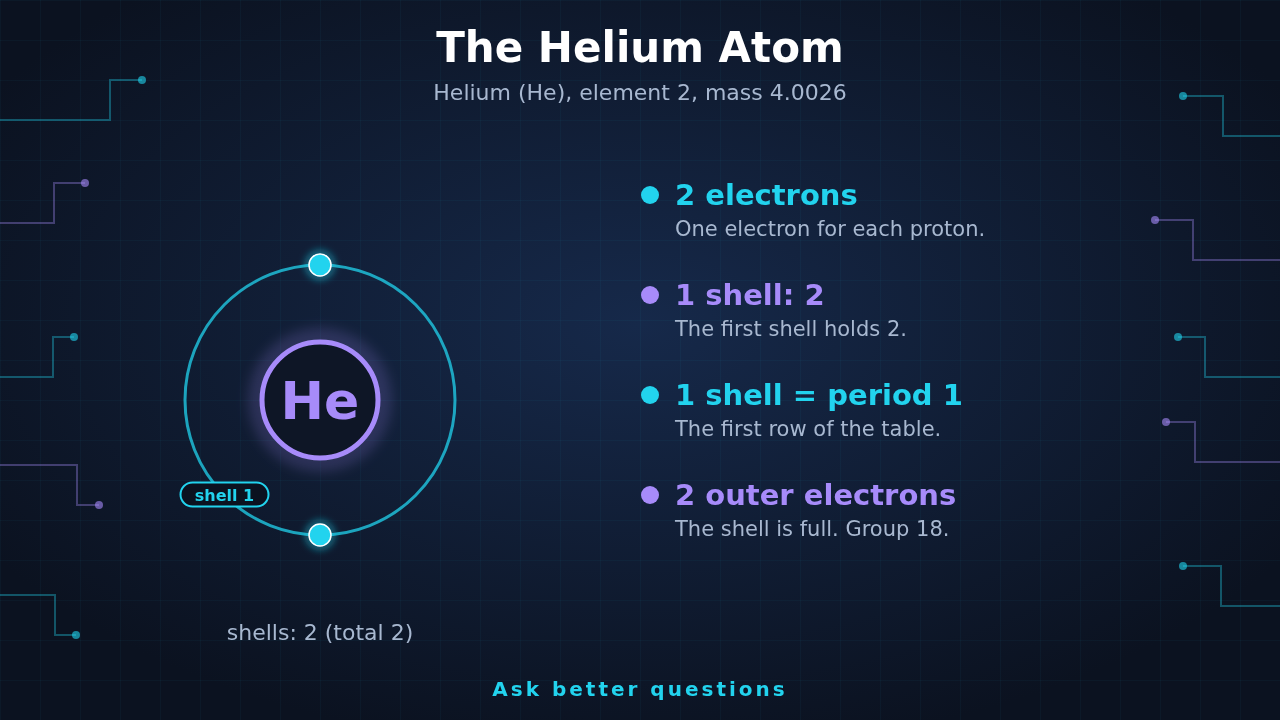
Helium’s atom: 2 electrons on 1 shell.
Helium does not burn. It is lighter than air, so a helium balloon floats up.
Helium stays a gas until it is extremely cold. At about -269 degrees C it turns into a liquid. A liquid flows and takes the shape of its container.
Helium comes out of the ground with natural gas. The RSC says about a quarter of the Sun’s mass is helium.
Look at the neighbors picture. Elements go in order. After helium comes lithium.
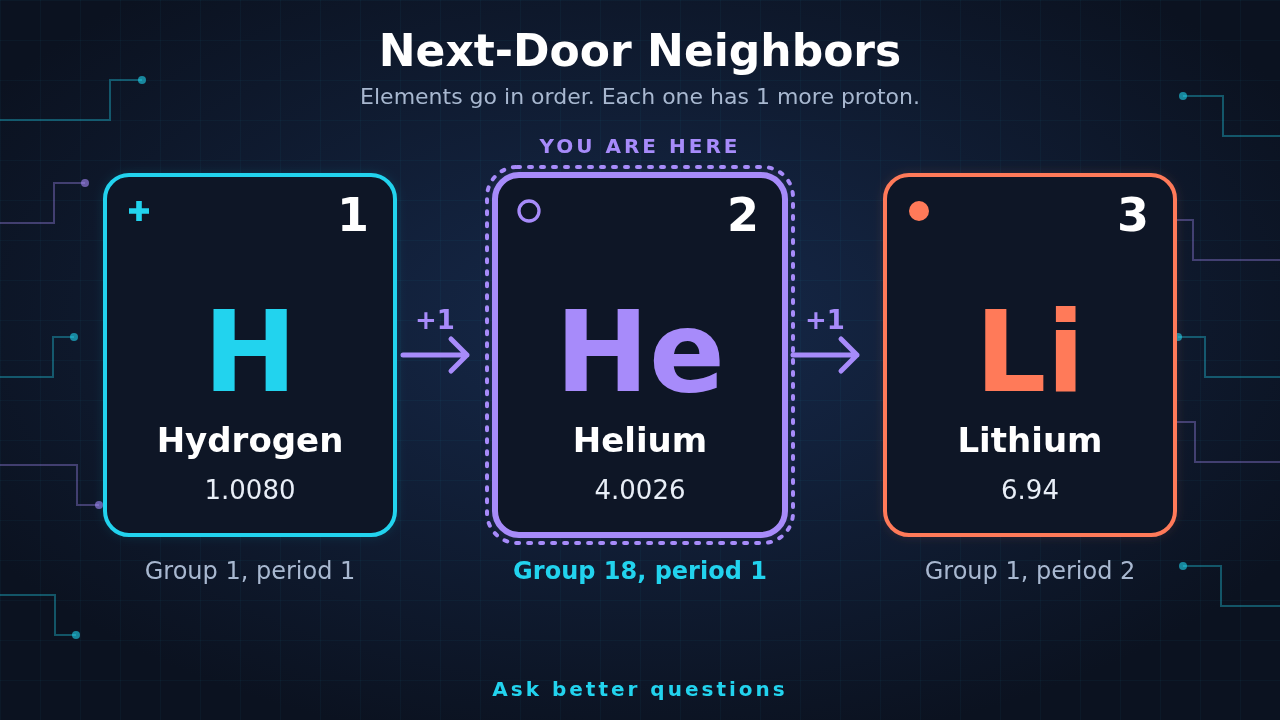
Element 2 sits between its next-door neighbors.

Why does helium matter? Here are three everyday uses.
- Balloons. Helium fills party balloons and weather balloons. It is lighter than air.
- Cold machines. Scientists use liquid helium to keep very cold machines cold.
- Deep-sea divers. Helium is mixed with oxygen for some deep-sea divers.
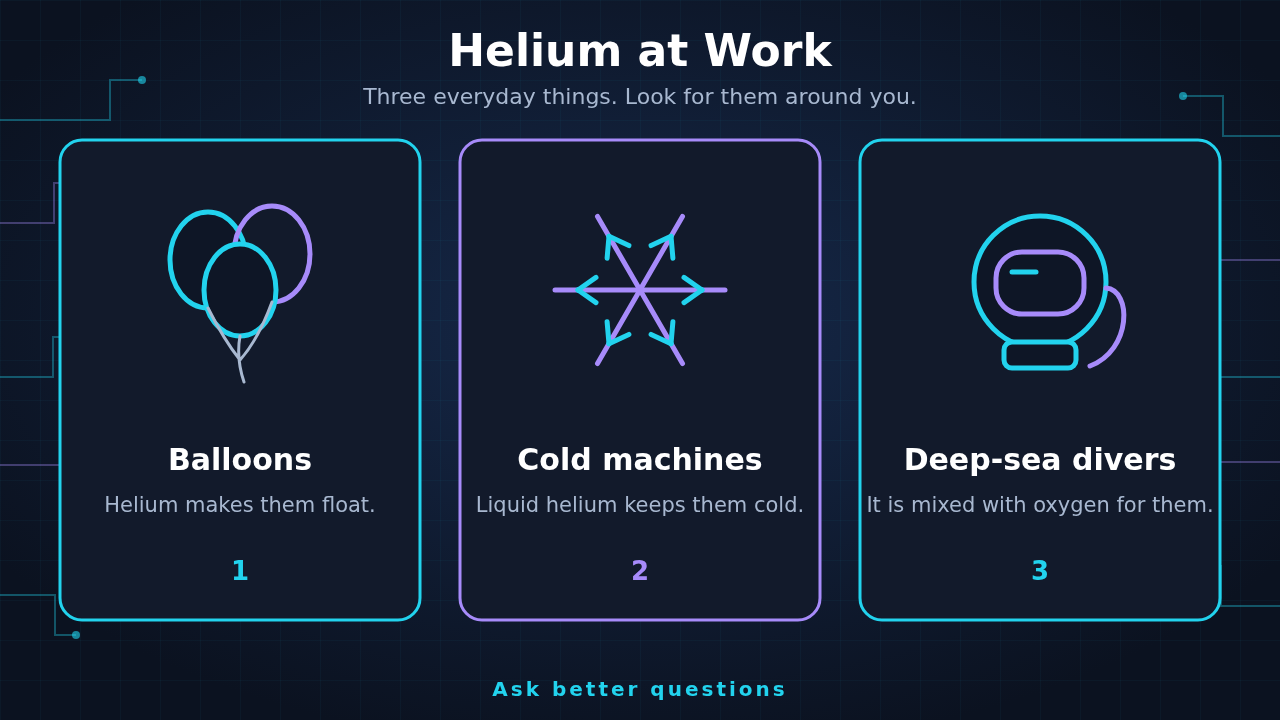
Three everyday things that use helium.
Fun fact: Helium was found in the Sun’s light before anyone found it on Earth.

Goal: Learn helium’s atom by drawing, looking and comparing. You need paper and crayons.
- Draw it. Draw a dot in the middle.
- Draw 1 circle around it. Put 2 dots on the circle.
- Look for it. Look for balloons in a party shop or in pictures. Which ones float up?
- Compare it. Open Helium in Periodic Table X.
- Then open Hydrogen. Which atom has more electrons?
- Find a neighbor. Find helium on a periodic table. Which element is right below it?
Check your thinking: Your atom has 1 circle with 2 dots. Balloons that float up are filled with a light gas, often helium.
Helium has 2 electrons and hydrogen has 1. Neon (Ne) is right below helium.
Talk about it: Hydrogen is lighter than helium. So why do party balloons use helium? (Hint: one of them burns.)

You can meet helium in party balloons. It is also in weather balloons high in the sky.
Who found it? In 1868, scientists saw a new yellow line of light from the Sun.
Pierre Janssen saw it in India during an eclipse. Norman Lockyer saw it in England.
Lockyer named the new element helium. It comes from helios, the Greek word for Sun.
In 1895, helium was found on Earth. William Ramsay found it in London. Per Cleve and Nils Langlet found it in Sweden, on their own.
Which one is the discovery? Sources disagree.
The RSC lists 1895. Britannica credits Janssen for the Sun (1868) and Ramsay for Earth (1895).
What next? Pick a neighbor and ask the same questions. Each lesson asks, explores and applies.
Keep exploring
Series: Periodic Table. Previous: What Is Hydrogen? Next: What Is Lithium?
Open Helium in Periodic Table X
Related elements:
- Hydrogen (H): the only element lighter than helium.
- Lithium (Li): the next element, a soft and light metal.
- Neon (coming soon): the next noble gas, right below helium.
Family: noble gases (a family page is coming soon).
More free lessons: Free STEM samples and the Practice Zone.
For advanced learners
Ready for more? These are deeper facts from the sources we used. Read them with a grown-up.
Think deeper:
- Britannica says helium cannot be frozen solid by cooling alone at normal pressure. What else does it need?
- Eric Scerri (RSC Education, 2012) says some chemists would put helium above beryllium. How many outer electrons do both of them have?
- The RSC lists 1895 for helium’s discovery. Britannica credits Janssen for the Sun in 1868. Why might sources pick different years?
Numbers. Atomic mass 4.0026. Electron configuration 1s2.
Freezes only under high pressure: our data lists 0.95 K, the RSC lists no melting point, and Britannica says 25 atmospheres at 1 K. Boils at 4.22 K (RSC 4.222 K, Britannica 4.21 K), about -269 C.
Density 0.1785 g/L as a gas at 0 C (Britannica); the RSC lists 0.164 g/L at 20 C.
Liquid helium. Britannica says helium is the only element that cannot be frozen solid by cooling alone at normal pressure. It needs 25 atmospheres at 1 K.
Placement. Helium has 2 outer electrons, while the other noble gases have 8. Its full first shell gives it the same steadiness, so tables put it in group 18.
Some chemists favor the left-step table of Charles Janet, which puts helium above beryllium because both have 2 outer electrons (Eric Scerri, RSC Education, 2012). Scerri notes the drawback: chemically, helium is the most unreactive element.
Discovery. Sources differ on which event is the discovery. RSC table: discovered 1895 by William Ramsay in London and, independently, by Per Teodor Cleve and Nils Abraham Langlet in Uppsala, Sweden.
RSC history text: in 1868 Pierre Janssen (India, eclipse) and Norman Lockyer (England) saw a new yellow line in sunlight, and Lockyer named it; Cleve and “Langer” (the RSC’s other spelling) confirmed it in 1895. Britannica: Janssen discovered helium in the Sun in 1868 (he first took the line for sodium), Lockyer and Edward Frankland named it, and Ramsay discovered it on Earth in 1895.
Our data file lists 1868 (Janssen and Lockyer).
Supply. Helium comes out of the ground with natural gas, which can hold up to 7 percent helium (RSC) or up to 7.6 percent in some US fields (Britannica). Earth keeps little helium because it is light enough to escape.
Safety. This lesson is for reading and imagining, not for experiments.
Supplemental. This free lesson is a STEM aid for home or summer learning. It does not replace a school curriculum.
Word bank
- Element — A pure kind of matter, made of one kind of atom.
- Atom — A tiny building block of matter.
- Helium — Element 2, a light gas that does not burn.
- Gas — Matter that spreads out to fill its space.
- Proton — A tiny part in the center of an atom with a positive charge.
- Electron — A tiny part that moves around the center with a negative charge.
- Shell — A layer where electrons move around the center.
- Period — A row on the periodic table.
- Group — A column on the periodic table. Elements in a group act alike.
- Noble gases — Elements in group 18 that hardly ever join with others.
- Liquid — Matter that flows and takes the shape of its container.
Element data: National Library of Medicine, PubChem Periodic Table. Atomic weights: © IUPAC/CIAAW, Standard Atomic Weights 2021 (abridged). Cross-checked with NIST. Discoverers: Wikidata (CC0). Text and pictures are original.
Sources: RSC Periodic Table: Helium; Britannica: helium; Scerri, RSC Education 2012. Element data and atomic weights are credited above: NLM PubChem Periodic Table and IUPAC periodic table page (weights from CIAAW).