


Hydrogen (H) is element 1 on the periodic table, a light gas and the most common element in the universe. Facts for kids and grown-ups.
Beginner · STEM · Curiosity Questions
Materials: Paper, a pencil, and 2 or more crayons. Optional: the free Periodic Table X app.
Tips: Read the What and How parts aloud together. Ask “What do you notice?” before you explain. Draw the atom together.
Safety: This lesson is for reading and imagining, not for experiments.
New to the periodic table? Start with What Is the Periodic Table?.

Before we explain, wonder together:
- What do you think is the lightest kind of stuff in the whole universe?
- Water is made from two kinds of tiny building blocks. Can you guess one?
There are no wrong guesses. Notice first, then explore.
Ask → Explore → Apply: We ask those questions. We explore hydrogen’s atom and neighbors. Then we apply it with a find-it hunt.
Meet Hydrogen
Hydrogen at a glance
Atomic number: 1 (that many protons)
Symbol: H
Atomic mass: 1.0080
Group and period: group 1 (a column), period 1 (a row)
Family: Nonmetal
State at room temperature: Gas (in a normal room)
Electron shells (layers): 1 shell, holding 1 electron
Look, don’t touch. This is for reading and imagining, not for handling. If you ever see something that might contain it, tell a grown-up.
Hydrogen is element 1. It is the lightest element, a gas with no color or smell.

An element is a pure kind of matter. It is made of only one kind of atom.
Hydrogen is element 1. It is the very first square on the periodic table.
Hydrogen is a gas. A gas is matter that spreads out to fill its space.
You cannot see hydrogen gas or smell it. It is the lightest element of all.
It is also the most common element in the universe. NASA says about three quarters of ordinary matter, by weight, is hydrogen.
Look inside a hydrogen atom. It has 1 proton in the center. A proton is a tiny part with a positive charge.
It has 1 electron moving around the center. An electron is a tiny part with a negative charge.

Look at the atom picture. Hydrogen has 1 electron on 1 shell. A shell is a layer where electrons move.
One shell means hydrogen is in period 1. A period is a row on the table.
Hydrogen is also in group 1. A group is a column on the table.
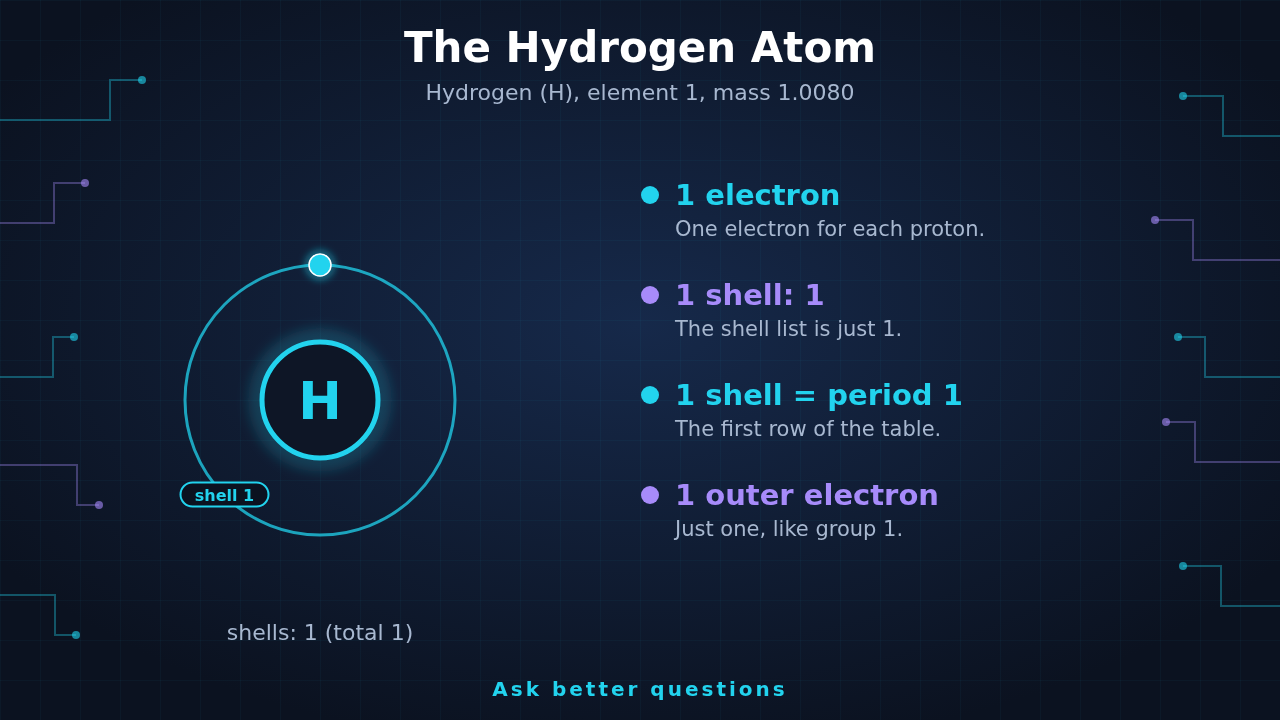
Hydrogen’s atom: 1 electron on 1 shell.
Here is a surprise. Hydrogen is in group 1, but it is a nonmetal. A nonmetal is an element that is not a metal.
Most nonmetals sit on the right side of the table. Hydrogen is the odd one out.
Hydrogen is lighter than air, so it rises. Hydrogen gas also burns very easily. That is why this lesson is for reading and imagining only.
Hydrogen is almost never alone in nature. It likes to join with other atoms. Water is hydrogen joined with oxygen.
Look at the neighbors picture. Elements go in order. After hydrogen comes helium.
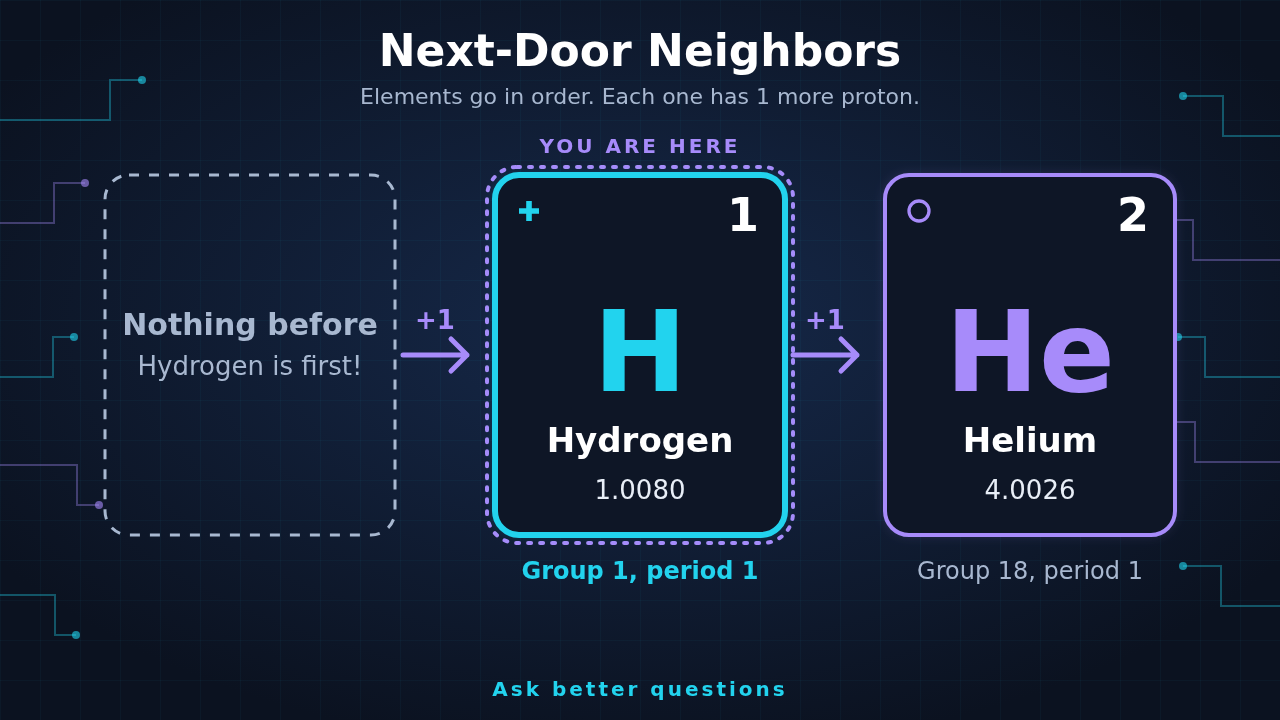
Element 1 is first. Helium, element 2, is next.

Why does hydrogen matter? Here are three everyday uses.
- Rocket fuel. Some rockets burn hydrogen. A fuel is something used to make energy.
- Fertilizer. Factories use hydrogen to make fertilizer and other chemicals. Fertilizer helps plants grow.
- Fuel-cell cars. Some cars can run on hydrogen.
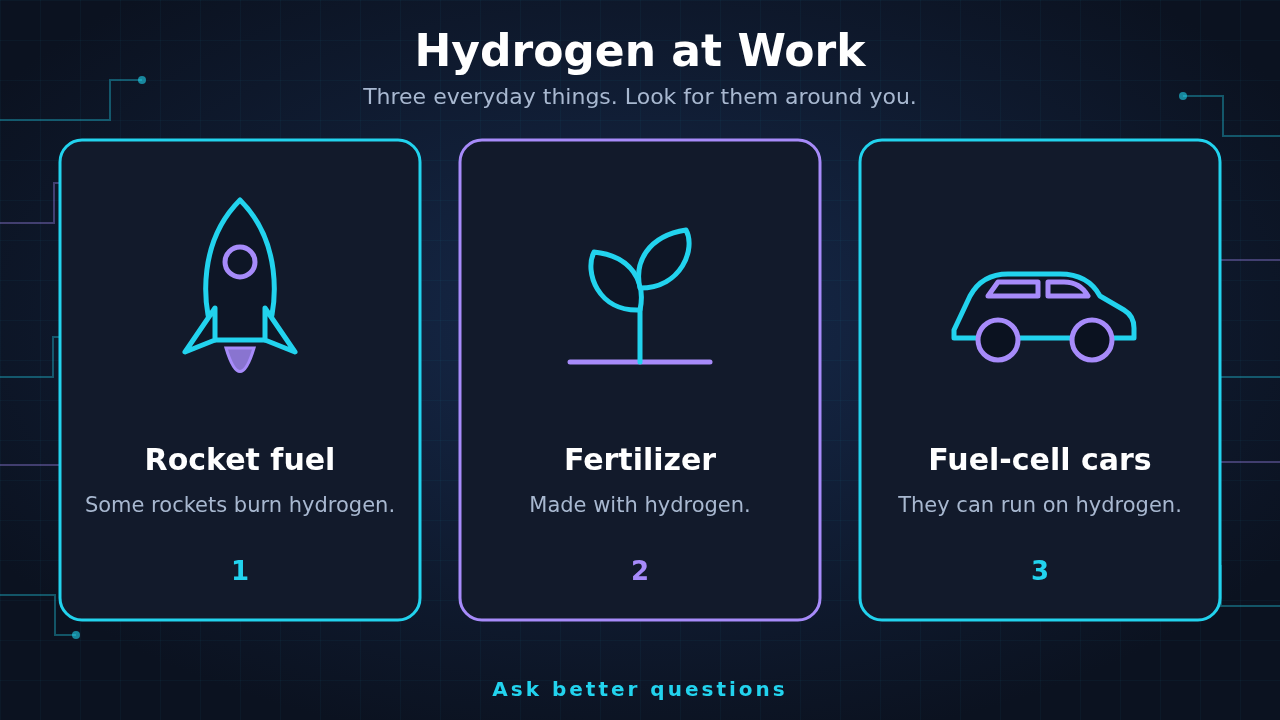
Three everyday things that use hydrogen.
Fun fact: Stars like our Sun are mostly hydrogen.

Goal: Learn hydrogen’s atom and its square by drawing and finding. You need paper and crayons.
- Draw it. Draw a dot in the middle.
- Draw 1 circle around it. Put 1 dot on the circle.
- Find it. Find 3 places in your home or yard where you see water. Water has hydrogen in it.
- Look it up. Open Hydrogen in Periodic Table X.
- Tap the next element. Which one is it?
- Count it. Look at a periodic table. How many squares are in row 1?
Check your thinking: Your atom has 1 dot on 1 circle. Water is in sinks, rain and puddles.
The next element is helium (He). Row 1 has 2 squares: H and He.
Talk about it: Hydrogen is in group 1, but it is not a metal. What do you think makes it special?

You meet hydrogen whenever you see water. Water is hydrogen and oxygen joined together.
Our Sun shines by turning hydrogen into helium.
Who found it? A scientist named Henry Cavendish collected hydrogen gas in 1766. He showed it was different from other gases.
He also showed that burning hydrogen makes water. Others had seen the gas before, but Cavendish gets the credit.
Later, Antoine Lavoisier gave it the name hydrogen. The name means “water maker.”
What next? Pick a neighbor and ask the same questions. Each lesson asks, explores and applies.
Keep exploring
Series: Periodic Table. Previous: What Is the Periodic Table? Next: What Is Helium?
Open Hydrogen in Periodic Table X
Related elements:
- Oxygen (O): joins with hydrogen to make water.
- Helium (He): the next element, also very light.
- Lithium (Li): another element in group 1.
Family: nonmetals (a family page is coming soon).
More free lessons: Free STEM samples and the Practice Zone.
For advanced learners
Ready for more? These are deeper facts from the sources we used. Read them with a grown-up.
Think deeper:
- The RSC says the Sun is about 75 percent hydrogen and 24 percent helium by mass. Which gas makes up more of the Sun?
- Eric Scerri (RSC Education, 2012) says hydrogen can sit in group 1 or in group 17, and that some have even suggested the carbon group. Why might it be hard to pick one spot?
- The RSC says the name hydrogen is Greek for “water-forming.” Which element joins with hydrogen to make water?
Numbers. Atomic mass 1.0080 (natural range 1.00784 to 1.00811). Electron configuration 1s1.
Melts at about 14 K and boils at about 20 K (about -259 C and -253 C). The decimals differ by source: our data lists 13.81 K and 20.28 K, the RSC lists 13.99 K and 20.271 K, and Britannica lists -259.20 C and -252.77 C.
Density 0.08988 g/L as a gas near 0 C; the RSC lists 0.000082 g/cm3 (0.082 g/L) at 20 C.
Isotopes. Most hydrogen atoms have no neutrons. Deuterium has 1 neutron and tritium has 2.
Tritium is radioactive.
Placement. Hydrogen sits in group 1 because it has one outer electron, but it is a nonmetal gas. The RSC lists it in group 1.
Eric Scerri (RSC Education, 2012) says it is usually placed in group 1 but can sit with the halogens in group 17, or even at the head of the carbon group, and calls the question open. Kaesz and Atkins (Chemistry International, 2003) proposed one central spot in period 1, in no group.
Discovery. Paracelsus (early 1500s) and Robert Boyle (1671) saw the flammable gas from iron and acid but did not follow up. Henry Cavendish (1766) is credited.
Antoine Lavoisier named it (Greek for “water-forming”, per the RSC).
Stars. Stars fuse hydrogen into helium. The RSC (helium page) says the Sun is about 75 percent hydrogen and 24 percent helium by mass.
Abundance. The RSC calls hydrogen the most abundant element in the universe, with 75 percent of its detectable content. Britannica says it is three times as abundant as helium, the next most common.
NASA says about three quarters hydrogen by weight. Counting atoms instead of weight gives hydrogen an even bigger share.
Safety. Look, don’t touch. This is for reading and imagining, not for handling.
If you ever see something that might contain it, tell a grown-up.
Supplemental. This free lesson is a STEM aid for home or summer learning. It does not replace a school curriculum.
Word bank
- Element — A pure kind of matter, made of one kind of atom.
- Atom — A tiny building block of matter.
- Hydrogen — Element 1, the lightest element. A gas.
- Gas — Matter that spreads out to fill its space.
- Proton — A tiny part in the center of an atom with a positive charge.
- Electron — A tiny part that moves around the center with a negative charge.
- Shell — A layer where electrons move around the center.
- Period — A row on the periodic table.
- Group — A column on the periodic table. Elements in a group act alike.
- Nonmetal — An element that is not a metal. Most sit on the right of the table.
- Fuel — Something used to make energy.
Element data: National Library of Medicine, PubChem Periodic Table. Atomic weights: © IUPAC/CIAAW, Standard Atomic Weights 2021 (abridged). Cross-checked with NIST. Discoverers: Wikidata (CC0). Text and pictures are original.
Sources: RSC Periodic Table: Hydrogen; Britannica: hydrogen; NASA Ask an Astrophysicist (archived); Scerri, RSC Education 2012; Kaesz and Atkins, Chemistry International 2003; RSC Periodic Table: Helium (Sun figures). Element data and atomic weights are credited above: NLM PubChem Periodic Table and IUPAC periodic table page (weights from CIAAW).