

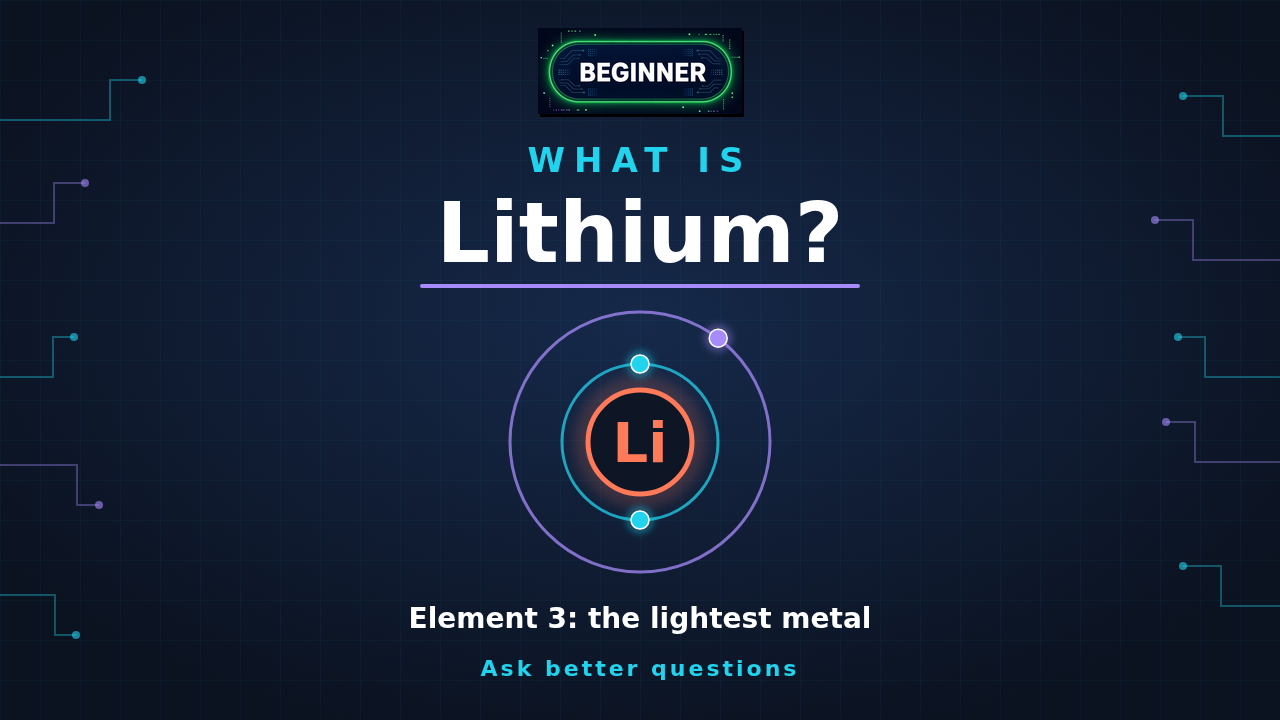
Lithium (Li) is element 3 on the periodic table, the lightest metal and a key part of rechargeable batteries. Facts for kids and grown-ups.
Beginner · STEM · Curiosity Questions
Materials: Paper, a pencil, and 2 or more crayons. Optional: the free Periodic Table X app.
Tips: Read the What and How parts aloud together. Ask “What do you notice?” before you explain. Draw the atom together.
Safety: This lesson is for reading and imagining, not for experiments.
New to the periodic table? Start with What Is the Periodic Table?.
Before we explain, wonder together:
- What is inside your phone that lets you charge it again and again?
- Do you think a metal can be lighter than water?
There are no wrong guesses. Notice first, then explore.
Ask → Explore → Apply: We ask those questions. We explore lithium’s atom and neighbors. Then we apply it with a find-it hunt.
Meet Lithium
Lithium at a glance
Atomic number: 3 (that many protons)
Symbol: Li
Atomic mass: 6.94
Group and period: group 1 (a column), period 2 (a row)
Family: Alkali metal
State at room temperature: Solid (in a normal room)
Electron shells (layers): 2 shells, holding 2 and 1 electrons
Look, don’t touch. This is for reading and imagining, not for handling. If you ever see something that might contain it, tell a grown-up.
Lithium is element 3, an alkali metal. It is the lightest metal, and it is soft.

An element is a pure kind of matter. It is made of only one kind of atom.
Lithium is element 3. It is a metal. A metal is a shiny element that carries electricity.
Lithium is the lightest metal of all. The RSC says no other metal is lighter for its size. It is also soft.
Lithium is in group 1, with the alkali metals. Alkali metals are soft, shiny metals that join easily with other things.
Look inside a lithium atom. It has 3 protons in the center. A proton is a tiny part with a positive charge.
It has 3 electrons moving around the center. An electron is a tiny part with a negative charge.

Look at the atom picture. Lithium has 3 electrons on 2 shells. A shell is a layer where electrons move.
Shell 1 holds 2 electrons. Shell 2 holds just 1.
Two shells means lithium is in period 2. A period is a row on the table.
The lonely outer electron puts lithium in group 1. A group is a column on the table.
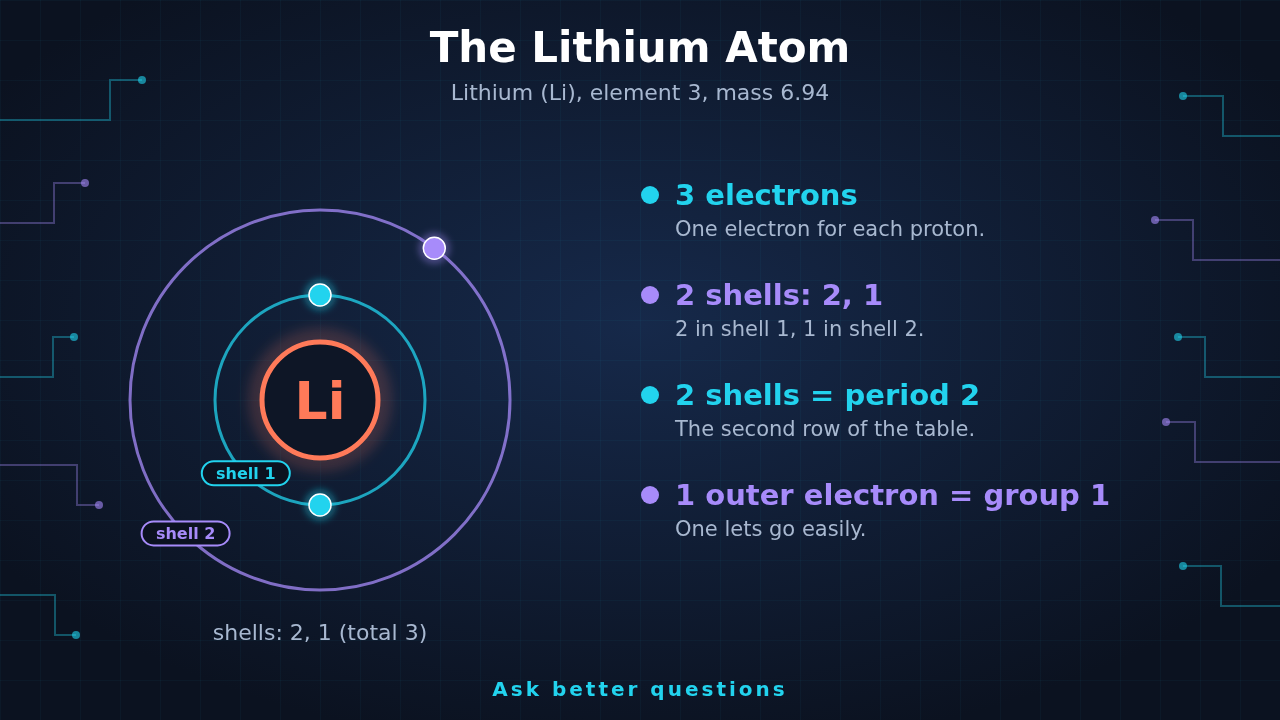
Lithium’s atom: 3 electrons on 2 shells.
An atom with 1 outer electron lets it go easily. That makes alkali metals ready to join with other things.
That is why this lesson is for reading and imagining only.
Dense means heavy for its size. Lithium is less dense than water. A lump of lithium weighs less than water of the same size.
Lithium is not found alone in nature. It is in some rocks and in the water of some mineral springs.
Look at the neighbors picture. Elements go in order. After lithium comes beryllium.
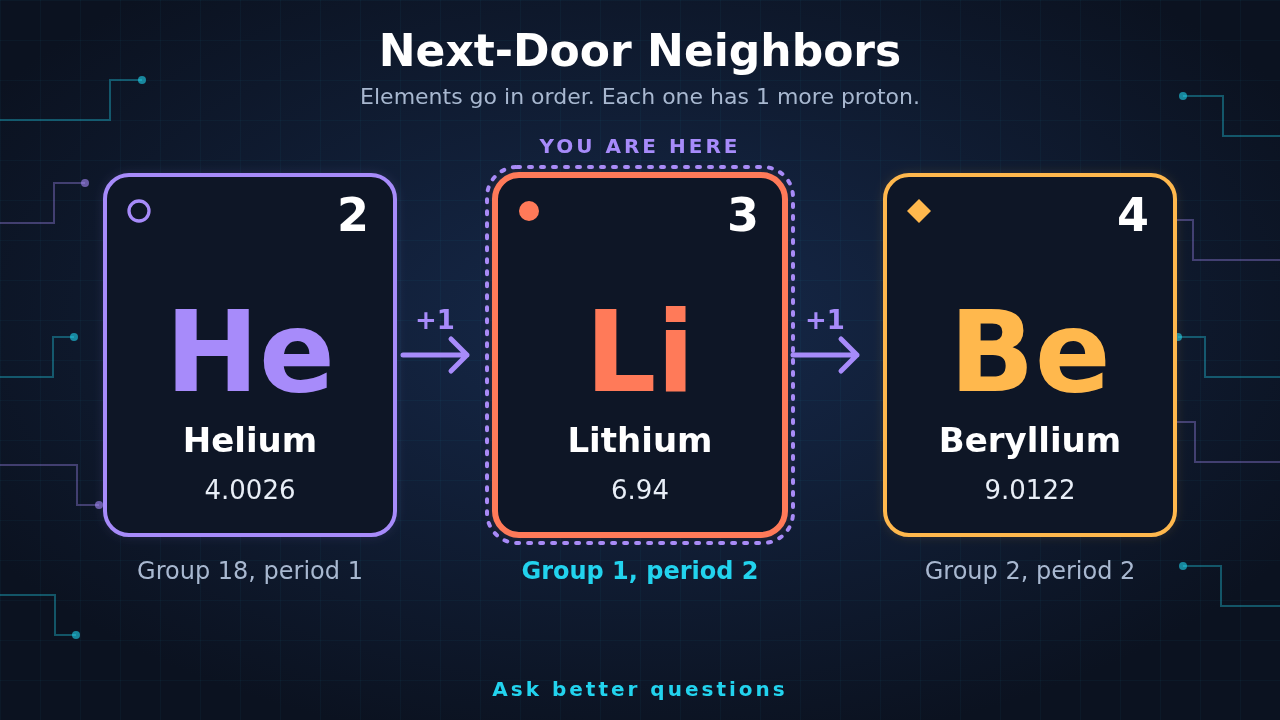
Element 3 sits between its next-door neighbors.
Why does lithium matter? Here are three everyday uses.
- Rechargeable batteries. Phones, laptops and electric cars use them. A rechargeable battery is one you can fill with energy again.
- Glass and ceramics. Some kinds have lithium in them.
- Aircraft. Light metal mixes with lithium are used in aircraft.
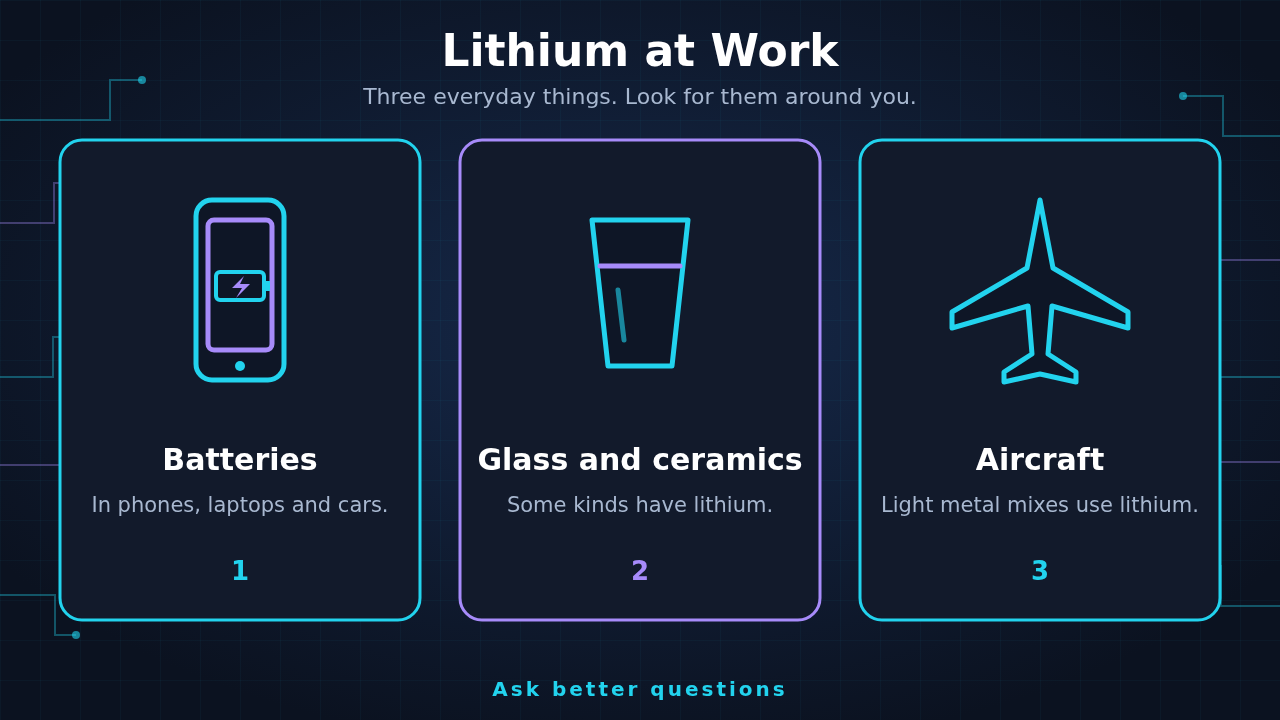
Three everyday things that use lithium.
Fun fact: Lithium gets its name from lithos, the Greek word for stone.

Goal: Learn lithium’s atom by drawing, looking and comparing. You need paper and crayons.
- Draw it. Draw a dot in the middle.
- Draw 2 circles around it. Put 2 dots on the inner circle and 1 on the outer circle.
- Look for it. Look at the label on a phone or tablet. Can you spot the word lithium or the letters Li-ion?
- Just look. Do not take anything apart.
- Compare it. Open Lithium in Periodic Table X.
- Then open Sodium (Na). How many outer electrons does each have?
- Find a pattern. Look at the first column of a periodic table. Name the first three elements.
Check your thinking: Your atom has 2 inner dots and 1 outer dot. Lithium and sodium each have 1 outer electron. The first column starts with hydrogen (H), lithium (Li) and sodium (Na).
Talk about it: Lithium is a very light metal. Why might that help in an aircraft?

You may meet lithium every day. It is in the rechargeable batteries of phones and laptops.
Who found it? In 1817, Johan August Arfwedson (also spelled Arfvedson) studied petalite, a stone. He worked in Stockholm, Sweden.
He worked out that it held a new metal. He named it lithium, from the Greek word for stone. He could not separate the pure metal.
What next? Pick a neighbor and ask the same questions. Each lesson asks, explores and applies.
Keep exploring
Series: Periodic Table. Previous: What Is Helium? Next: Beryllium (coming soon)
Also in period 2: What Is Carbon? and What Is Oxygen?.
Open Lithium in Periodic Table X
Related elements:
- Hydrogen (H): the other element in group 1, but it is a nonmetal.
- Helium (He): element 2, the lightest noble gas.
- Sodium (coming soon): the next alkali metal down the column.
Family: alkali metals (a family page is coming soon).
More free lessons: Free STEM samples and the Practice Zone.
For advanced learners
Ready for more? These are deeper facts from the sources we used. Read them with a grown-up.
Think deeper:
- Britannica spells the discoverer’s name Arfwedson. The RSC spells it Arfvedson. Which letter is different?
- The RSC says lithium is made in Chile from brines. What is a brine?
Numbers. Atomic mass 6.94. Natural lithium is a mix of lithium-6 and lithium-7, so its mass varies slightly by source (range 6.938 to 6.997).
Electron configuration 1s2 2s1. Melts at 453.65 K and boils at 1615 K (about 180 C and 1342 C).
Density 0.534 g/cm3.
Discovery. The mineral petalite was found on the Swedish island of Utö in the 1790s. Johan August Arfwedson analyzed it in 1817 and deduced the new metal.
Britannica spells his name Arfwedson; the RSC spells it Arfvedson. Pure metal in bulk first came in 1855 from Robert Bunsen and Augustus Matthiessen.
Where found. The RSC says lithium is found in nearly all igneous rocks and in the waters of many mineral springs, and that most lithium is now made in Chile from brines (salty water from underground). Britannica lists brine deposits, mineral springs and pegmatite ores such as spodumene.
Group 1. Lithium is the lightest alkali metal. Hydrogen also sits in group 1, but it is not an alkali metal.
Safety. Look, don’t touch. This is for reading and imagining, not for handling.
If you ever see something that might contain it, tell a grown-up.
Supplemental. This free lesson is a STEM aid for home or summer learning. It does not replace a school curriculum.
Word bank
- Element — A pure kind of matter, made of one kind of atom.
- Atom — A tiny building block of matter.
- Lithium — Element 3, the lightest metal.
- Metal — A shiny element that carries electricity.
- Alkali metals — Soft, shiny metals in group 1 that join easily with other things.
- Proton — A tiny part in the center of an atom with a positive charge.
- Electron — A tiny part that moves around the center with a negative charge.
- Shell — A layer where electrons move around the center.
- Period — A row on the periodic table.
- Group — A column on the periodic table. Elements in a group act alike.
- Dense — Heavy for its size.
- Rechargeable battery — A battery you can fill with energy again.
Element data: National Library of Medicine, PubChem Periodic Table. Atomic weights: © IUPAC/CIAAW, Standard Atomic Weights 2021 (abridged). Cross-checked with NIST. Discoverers: Wikidata (CC0). Text and pictures are original.
Sources: RSC Periodic Table: Lithium; Britannica: lithium. Element data and atomic weights are credited above: NLM PubChem Periodic Table and IUPAC periodic table page (weights from CIAAW).