


Oxygen (O) is element 8 on the periodic table, the gas in the air that we breathe. Facts for kids and grown-ups.
Beginner · STEM · Curiosity Questions
Materials: Paper, a pencil, and 2 or more crayons. Optional: the free Periodic Table X app.
Tips: Read the What and How parts aloud together. Ask “What do you notice?” before you explain. Draw the atom together.
Safety: This lesson is for reading and imagining, not for experiments.
New to the periodic table? Start with What Is the Periodic Table?.

Before we explain, wonder together:
- What invisible gas do you breathe in all day long?
- Where do you think the oxygen in the air comes from?
There are no wrong guesses. Notice first, then explore.
Ask → Explore → Apply: We ask those questions. We explore oxygen’s atom and neighbors. Then we apply it with a find-it hunt.
Meet Oxygen
Oxygen at a glance
Atomic number: 8 (that many protons)
Symbol: O
Atomic mass: 15.999
Group and period: group 16 (a column), period 2 (a row)
Family: Nonmetal
State at room temperature: Gas (in a normal room)
Electron shells (layers): 2 shells, holding 2 and 6 electrons
Oxygen is element 8, a nonmetal. It is a gas that most living things need to breathe.

An element is a pure kind of matter. It is made of only one kind of atom.
Oxygen is element 8. It is a nonmetal and a gas.
A nonmetal is an element that is not a metal. A gas is matter that spreads out to fill its space.
Oxygen has no color and no smell. Air is a mix of gases, and oxygen is one of them.
People and animals need oxygen to breathe.
Plants and algae make oxygen too. They do it when they use sunlight to make food. This is called photosynthesis.
Look inside an oxygen atom. It has 8 protons in the center. A proton is a tiny part with a positive charge.
It has 8 electrons moving around the center. An electron is a tiny part with a negative charge.

Look at the atom picture. Oxygen has 8 electrons on 2 shells. A shell is a layer where electrons move.
Shell 1 holds 2 electrons. Shell 2 holds 6.
Two shells means oxygen is in period 2. A period is a row on the table.
Oxygen has 6 outer electrons. That puts it in group 16. A group is a column on the table.
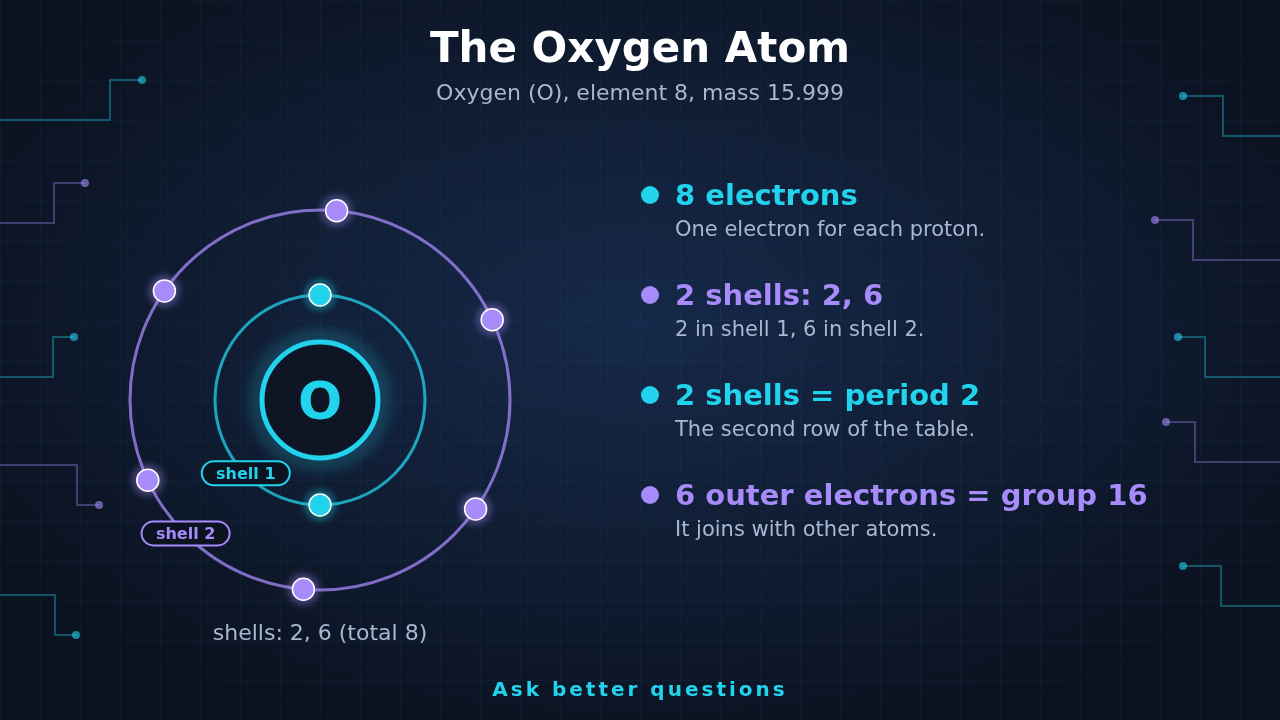
Oxygen’s atom: 8 electrons on 2 shells.
Oxygen likes to join with other atoms. It joins with hydrogen to make water. It joins with carbon to make carbon dioxide.
Oxygen is not only in air. It is in water and in most rocks.
Britannica says oxygen is about 46 percent of Earth’s crust by weight. The crust is Earth’s rocky outer layer.
Look at the neighbors picture. Elements go in order. Nitrogen comes before oxygen, and fluorine comes after.
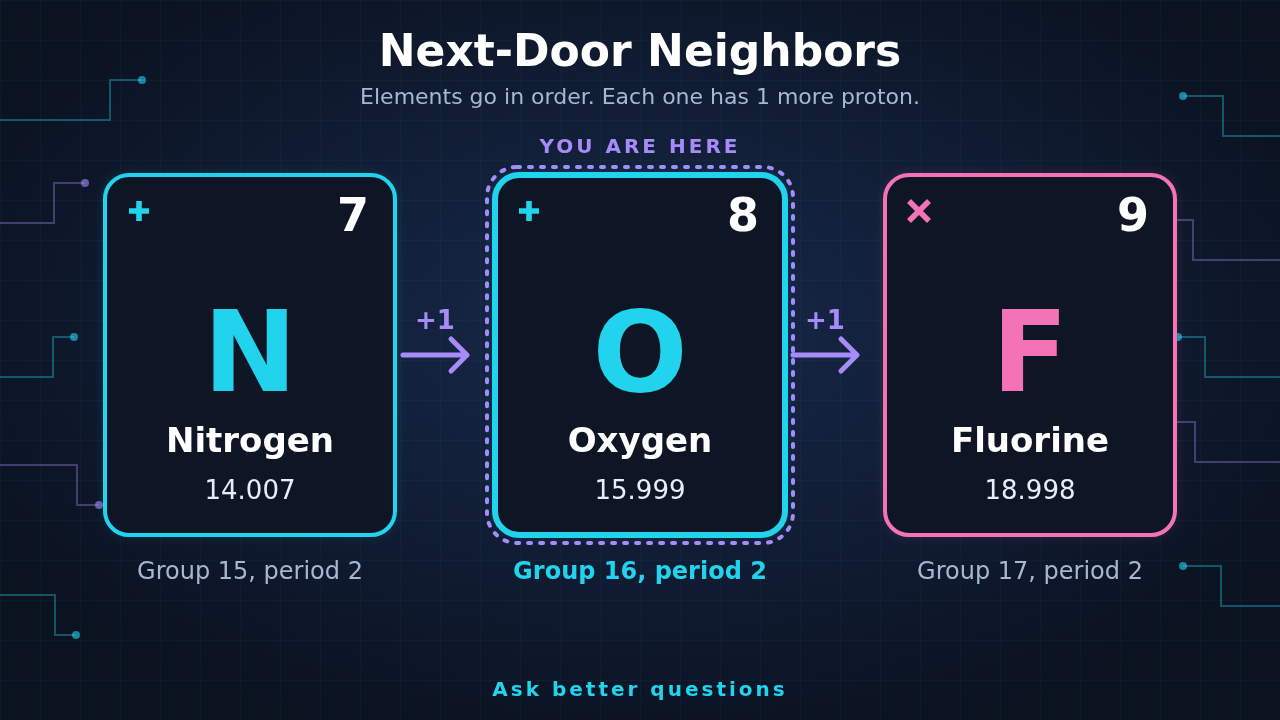
Element 8 sits between its next-door neighbors.

Why does oxygen matter? Here are three everyday uses.
- Breathing. People and animals use it to breathe.
- Fire. Fires need oxygen to burn.
- Steel making. Steel factories and welding torches use oxygen.
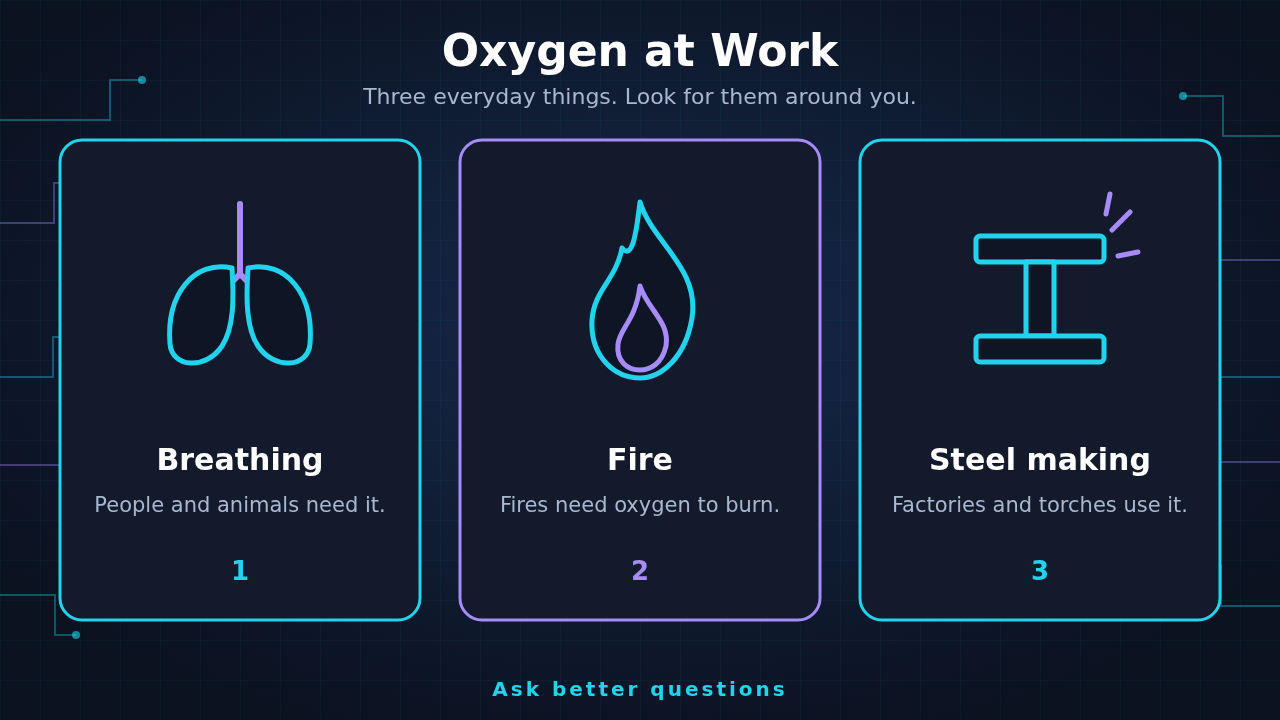
Three everyday things that use oxygen.
Fun fact: About 21 out of every 100 parts of air are oxygen.

Goal: Learn oxygen’s atom by drawing, finding and comparing. You need paper and crayons.
- Draw it. Draw a dot in the middle.
- Draw 2 circles around it. Put 2 dots on the inner circle and 6 on the outer circle.
- Find it. Find 3 plants: a tree, a flower and some grass. They help put oxygen into the air.
- Look it up. Open Oxygen in Periodic Table X. Which element comes just before oxygen?
- Compare it. Count the dots on oxygen’s outer circle.
- Then count carbon’s. Which has more?
Check your thinking: Your atom has 2 dots inside and 6 outside. Trees, flowers and grass all make oxygen.
Nitrogen (N) comes just before oxygen. Oxygen has 6 outer dots and carbon has 4.
Talk about it: Water has hydrogen and oxygen in it. Can you find H and O on a periodic table?

You use oxygen every time you breathe. Water has oxygen too, joined with hydrogen.
Oxygen joins with carbon to make carbon dioxide.
Who found it? Three scientists share the story of oxygen.
Carl Scheele in Sweden made oxygen gas in 1771, says the RSC. Britannica says about 1772. Joseph Priestley in England made it in 1774.
Priestley told the world about it first. Scheele’s book came out in 1777. Antoine Lavoisier gave it the name oxygen.
The RSC says credit is shared by all three. Britannica credits Scheele first.
What next? Pick a neighbor and ask the same questions. Each lesson asks, explores and applies.
Keep exploring
Series: Periodic Table. Previous: Nitrogen (coming soon) Next: Fluorine (coming soon)
Neighbors in period 2: What Is Carbon?.
Open Oxygen in Periodic Table X
Related elements:
- Hydrogen (H): joins with oxygen to make water.
- Carbon (C): joins with oxygen to make carbon dioxide.
- Sulfur (coming soon): right below oxygen in group 16.
Family: nonmetals (a family page is coming soon).
More free lessons: Free STEM samples and the Practice Zone.
For advanced learners
Ready for more? These are deeper facts from the sources we used. Read them with a grown-up.
Think deeper:
- The RSC and Britannica say about 21 percent of air is oxygen by volume. Is that more or less than half of the air?
- Britannica says Scheele discovered oxygen about 1772 and Priestley in 1774. Who published first? Read the Discovery notes below.
Numbers. Atomic mass 15.999 (natural range 15.999 to 15.9998). Electron configuration 1s2 2s2 2p4.
Melts at 54.36 K and boils at 90.2 K (about -219 C and -183 C; Britannica lists -218.4 C and -183.0 C). Density 1.429 g/L as a gas at 0 C (Britannica); the RSC lists 1.308 g/L at 20 C.
Oxygen in air is O2, two atoms joined. Ozone is a form of oxygen with three atoms.
Abundance. About 21 percent of air is oxygen by volume (RSC, Britannica); by mass it is about 23 percent (RSC). Oxygen is the most common element in Earth’s crust by mass.
The crust figure differs by source: Britannica 46 percent; USGS Circular 285 lists 46.60 percent (Mason, 1952), with other estimates in that table up to 49.5; the RSC says about 46 percent by weight in its podcast text, 49.2 percent by mass for the element and its compounds in its main text, and 461,000 ppm in its data table. So “about 46 percent” is a fair summary.
Discovery. Sources differ. RSC table: discovered 1774 by Joseph Priestley in England and, independently, by Carl Wilhelm Scheele in Sweden.
RSC history: credit is shared by three chemists; Priestley was first to publish (he made it in 1774), Scheele made it in June 1771 but his account was not published until 1777, and Antoine Lavoisier also claimed it and proposed the name oxy-gene (“acid-forming”). Britannica: Scheele discovered it about 1772, Priestley independently in 1774 and published three years before Scheele, and Lavoisier (1775-80) explained its role in breathing and burning and named it.
RSC podcast: Scheele probably came first, and Lavoisier was first to identify it as an element. Our data file lists 1774 (Scheele and Priestley).
Safety. This lesson is for reading and imagining, not for experiments.
Supplemental. This free lesson is a STEM aid for home or summer learning. It does not replace a school curriculum.
Word bank
- Element — A pure kind of matter, made of one kind of atom.
- Atom — A tiny building block of matter.
- Oxygen — Element 8, the gas in the air that we breathe.
- Gas — Matter that spreads out to fill its space.
- Nonmetal — An element that is not a metal. Most sit on the right of the table.
- Photosynthesis — How plants use sunlight to make food and oxygen.
- Proton — A tiny part in the center of an atom with a positive charge.
- Electron — A tiny part that moves around the center with a negative charge.
- Shell — A layer where electrons move around the center.
- Period — A row on the periodic table.
- Group — A column on the periodic table. Elements in a group act alike.
Element data: National Library of Medicine, PubChem Periodic Table. Atomic weights: © IUPAC/CIAAW, Standard Atomic Weights 2021 (abridged). Cross-checked with NIST. Discoverers: Wikidata (CC0). Text and pictures are original.
Sources: RSC Periodic Table: Oxygen; Britannica: oxygen; USGS Circular 285 (1953). Element data and atomic weights are credited above: NLM PubChem Periodic Table and IUPAC periodic table page (weights from CIAAW).