

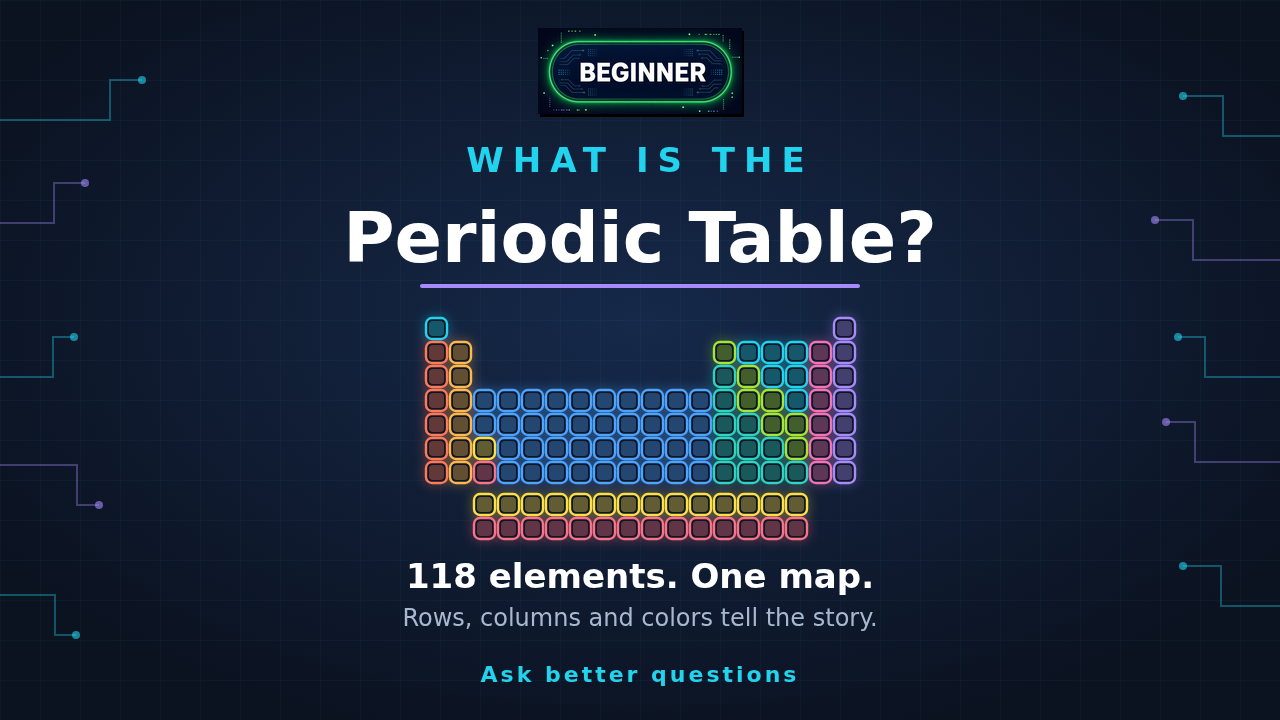
The periodic table is a chart that sorts all 118 known elements, the basic ingredients of everything around you. This free lesson shows kids what it is, how to read it, and why scientists use it.
Beginner · STEM · Curiosity Questions
Materials: Paper, a pencil, and 3 or more crayons or colored pencils. Optional: a printed periodic table, or the free Periodic Table X app.
Tips: Read the What and How parts aloud together. Ask “What do you notice?” before you explain. Let the learner point to the squares on the map.
Safety: This lesson is for reading and imagining, not for experiments.
Before we explain, wonder together:
- Everything around you is built from tiny kinds of stuff. How many different kinds do you think there are?
- If you had 118 different things, how could you sort them so they are easy to find?
There are no wrong guesses. Notice first, then explore.
Ask → Explore → Apply: We ask those questions, explore the map and the colors, then apply with a treasure hunt you can do at home.

Matter is anything that takes up space, like water, air and rocks. An element is a pure kind of matter. It is made of only one kind of atom.
An atom is a tiny building block of matter. It is far too small to see.
Gold is an element. Oxygen is an element. So is carbon, the stuff in a pencil.
Scientists know 118 elements. About 90 are found in nature. Scientists made the rest in labs.
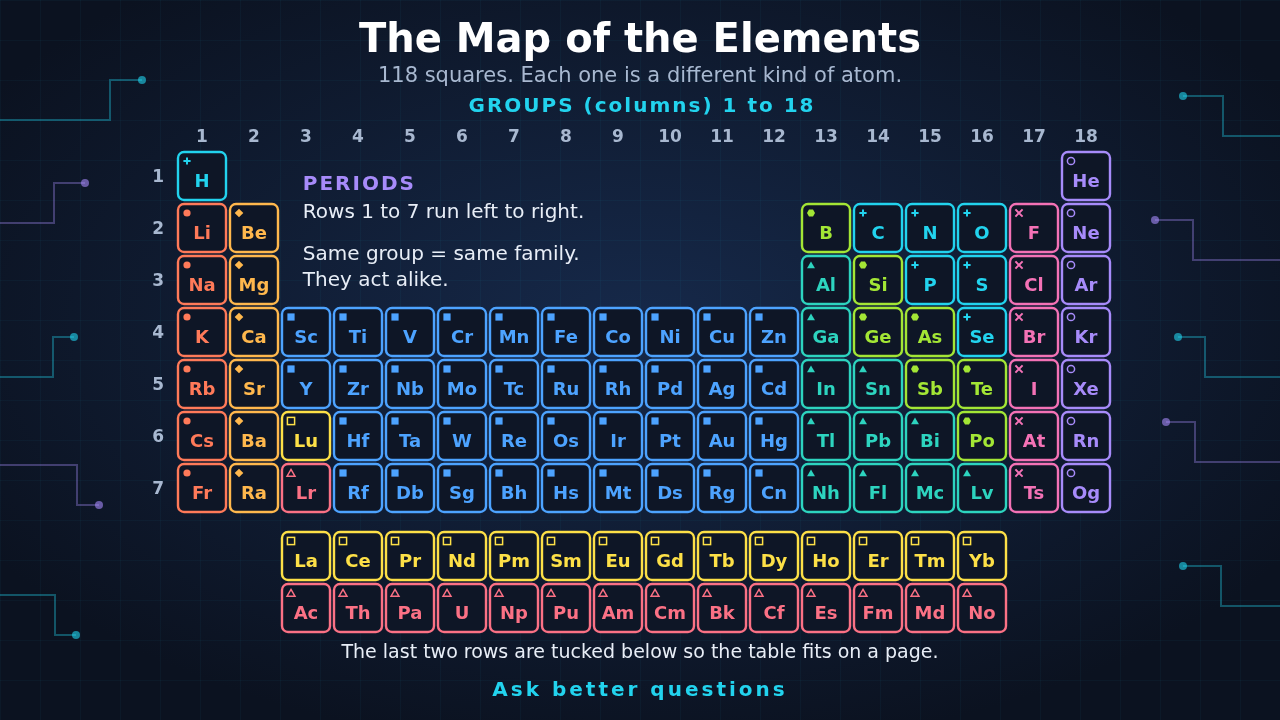
The periodic table is a chart that puts every element in its own square. It works like a map, so you can find any element fast.
In 1869, a chemist named Dmitri Mendeleev sorted the elements he knew into rows and columns. He left gaps for elements nobody had found yet.
Later, people found them. That is why his chart became so famous.
In one sentence: The periodic table is a map that sorts every element by its number and its family.

You can read the table in three steps: one square, then the rows and columns, then the colors.
1. Read one square. Every square tells you four things.
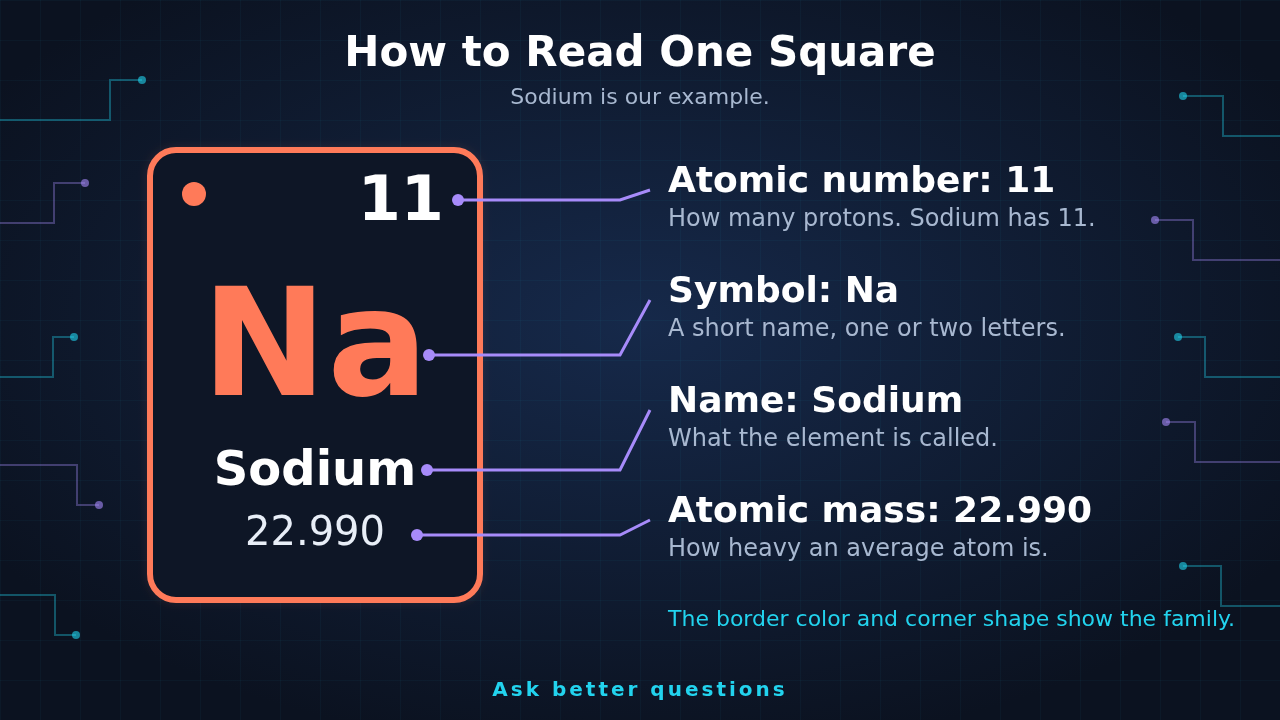
- The atomic number counts the protons in the center of the atom. Protons are tiny parts with a positive charge. The squares go in order of this number.
- The symbol is a short name. Some come from old Latin names: Au is gold and Fe is iron.
- The name is what we call the element.
- The atomic mass tells how heavy an average atom of that element is.
2. Read the rows and columns. A row is called a period.
There are 7 periods. A column is called a group. There are 18 groups.
Elements in the same group are like a family. They act in alike ways.
Helium, neon and argon sit in group 18. They hardly ever join with other elements.
3. Read the colors.
Each color shows one family of elements. Each family also has its own corner shape, so you can tell families apart even without color.
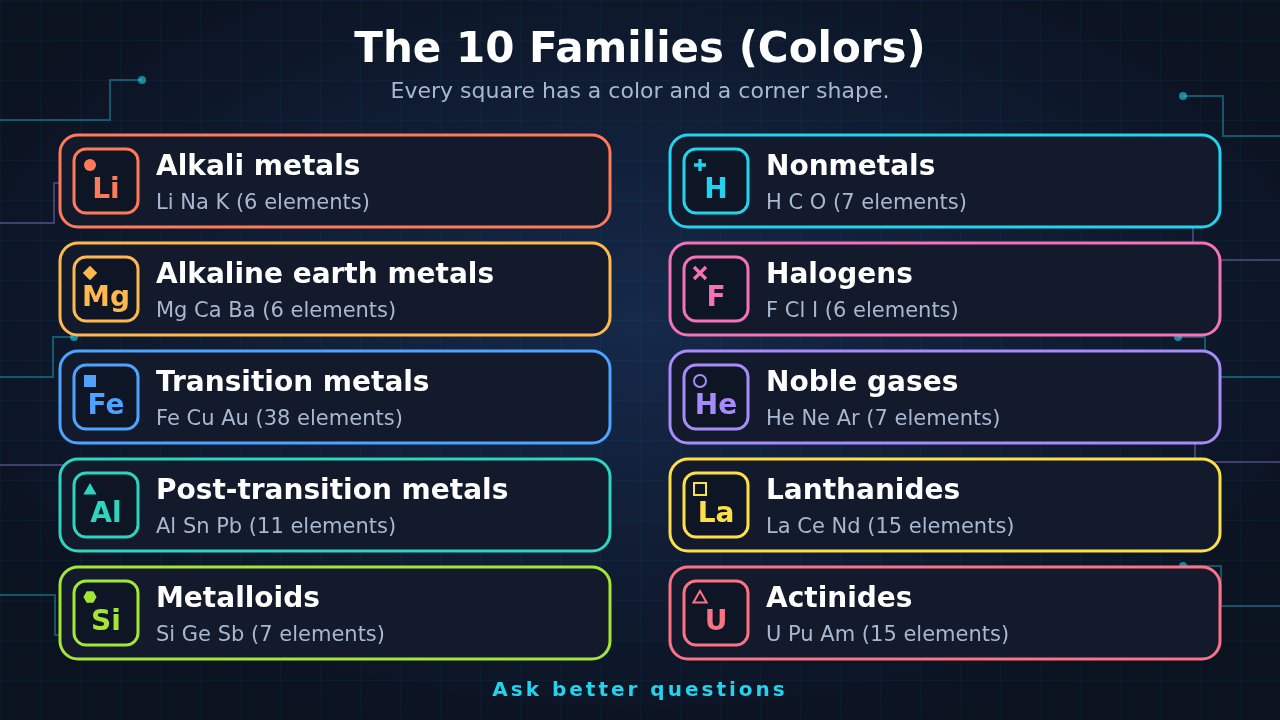
Most elements are metals. They are on the left and in the middle. Nonmetals are on the right.
Metalloids sit along a staircase between them. Hydrogen is the odd one: it sits at the top left but is a nonmetal.
Why do rows matter? Look inside an atom. Its electrons move around the center in layers called shells.
Electrons are tiny parts with a negative charge. Sodium has 3 shells, so it is in period 3.
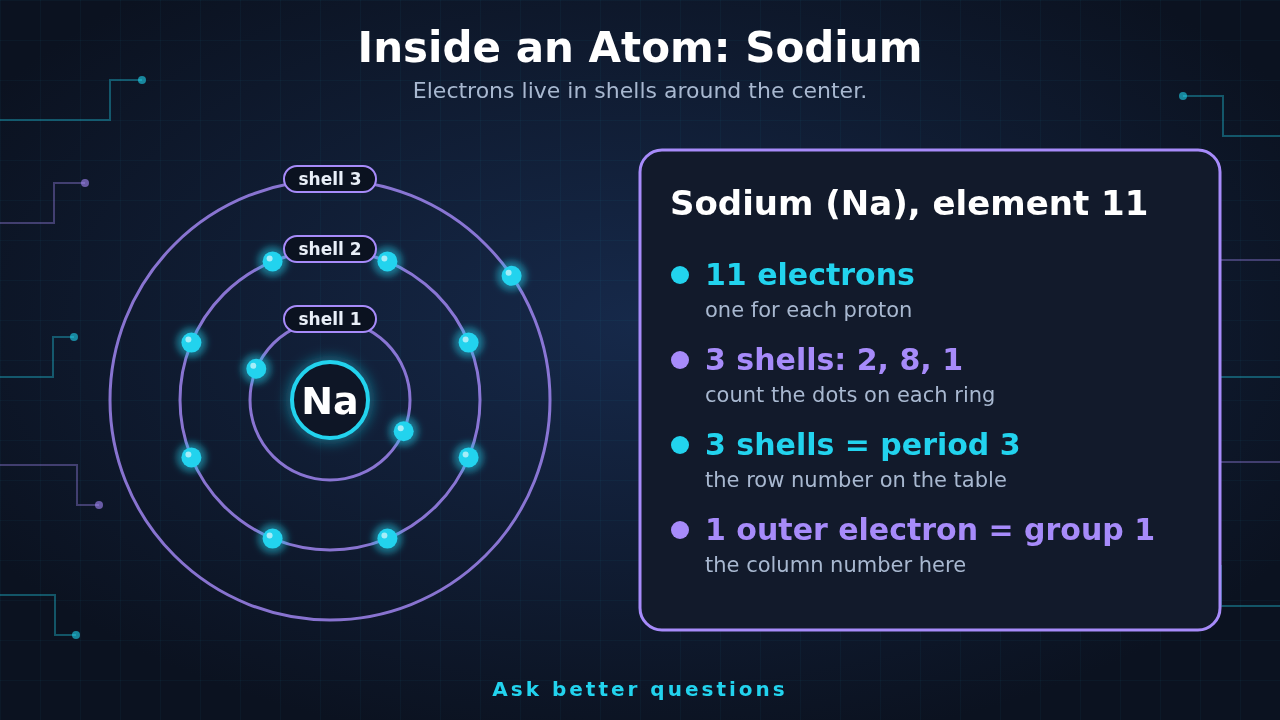
Sodium has just 1 electron in its outer shell. That puts it in group 1.
This is a simple picture of an atom. It is a handy way to see the pattern.

Goal: Find elements on the map and read their squares. Use the map above, a printed table, or the free Periodic Table X app.
- Find H. It is the very first square.
- What is its name? What is its atomic number?
- Count the squares in period 1. How many are there?
- Count the squares in period 2. How many are there?
- Find Fe and Au. Say their names.
- Find He and Ne. What do you notice about where they sit?
- Name spelling game: write your name using element symbols. Sam = S + Am. Cody = Co + Dy.
- Some names will not work. That is okay!
Check your thinking: H is hydrogen, number 1. Period 1 has 2 squares (H and He). Period 2 has 8 squares.
Fe is iron and Au is gold. He and Ne are both in group 18, the far right column.
Talk about it: Why do you think elements in the same column act alike? (Hint: look at the outer electrons.)

A good map saves time. The periodic table does the same for elements.
- It organizes. You can find any element by its row and column.
- It shows patterns. Elements in the same group act in alike ways.
- It helps us predict. Mendeleev’s gaps pointed to elements that were found later.
- It helps us build. Chemists and engineers use it to pick materials for batteries, phone chips and more.

You meet elements every day.
- Water is hydrogen (H) and oxygen (O).
- Table salt is sodium (Na) and chlorine (Cl) joined together.
- Pencil “lead” is really carbon (C).
- Phone chips are made from silicon (Si).
- Party balloons may be filled with helium (He).
Use the table when you read a label, visit a museum, or see a neon sign and wonder: what is that made of?
What next? Next we meet the elements one by one, starting with the very first. Each lesson asks a question, explores, and applies it.
Keep exploring
Series: Periodic Table. Previous: this is the first lesson. Next: What Is Hydrogen?
Tap any element, see its atom, and learn what it is used for.
More free lessons: Free STEM samples and the Practice Zone.
For advanced learners
Ready for more? These are deeper facts from the sources we used. Read them with a grown-up.
Think deeper:
- A 2021 IUPAC provisional report called the group 3 choice a convention. Why might two tables show different elements in group 3?
- Our family names follow the PubChem periodic table, but the colors and corner shapes are our own. Why do we use shapes as well as colors?
What an element is. An element is defined by its atomic number, the number of protons. Atoms of one element can differ in neutrons (isotopes).
Table masses are averages over natural isotopes. Elements with no stable form show a mass number in [brackets] instead.
For the heaviest elements, tables do not always pick the same number.
Order. Mendeleev (1869) sorted by atomic weight and chemical behavior. Since Moseley (1913), tables run in order of atomic number.
Rows and columns. Periods usually match the number of occupied electron shells, and the group tracks the outer electrons. Palladium is a known exception: its 46 electrons fill only 4 shells, yet it sits in period 5.
The shell picture is a simplified (Bohr-style) model.
Group 3. Tables differ on group 3. This series shows Sc, Y, Lu and Lr in group 3, with La to Yb and Ac to No in the two rows below.
A 2021 IUPAC provisional report called the choice a convention and suggested this layout as a compromise. IUPAC has not endorsed a single official table form.
Colors. Family names follow the PubChem periodic table. The colors and corner shapes are our own.
Shapes are the second cue, for color-blind readers.
Safety. Look, don’t touch. This is for reading and imagining, not for handling.
If you ever see something that might contain one of these elements, tell a grown-up.
Supplemental. This free lesson is a STEM aid for home or summer learning. It does not replace a school curriculum.
Word bank
- Element — A pure kind of matter, made of one kind of atom.
- Atom — A tiny building block of matter.
- Periodic table — A chart that puts every element in its own square.
- Atomic number — The number of protons in an atom. It sets the order of the table.
- Symbol — A short name for an element, like Na or Fe.
- Period — A row on the table.
- Group — A column on the table. Elements in a group act alike.
- Proton — A tiny part in the center of an atom with a positive charge.
- Electron — A tiny part that moves around the center with a negative charge.
- Shell — A layer where electrons move around the center.
- Metal, nonmetal, metalloid — Three big kinds of elements. A metalloid acts a bit like both.
- Noble gas — An element in group 18 that hardly joins with others.
Element data: National Library of Medicine, PubChem Periodic Table. Atomic weights: © IUPAC/CIAAW, Standard Atomic Weights 2021 (abridged). Cross-checked with NIST. Discoverers: Wikidata (CC0). Text and pictures are original.