


The solar system is the Sun and everything that travels around it. Learn the order, distances and sizes with a paper strip model. Free STEM lesson.
Beginner · STEM · Curiosity Questions
Materials: A strip of paper or string about 31 inches (79 centimeters) long. A ruler, a pencil and a grown-up to help.
Tips: Read the What and How parts aloud together. Ask “What do you notice?” before you explain.
Read the top bar of each picture first. It tells you what is true and what is not. Then build the paper strip.
Safety: Never look straight at the Sun. Not even with sunglasses.
This is the first lesson in our Solar System series.

Before we explain, wonder together:
- How many planets circle the Sun, and which one is our home?
- If the planets sat on a paper strip, where would each one go?
- Are the space pictures in books the right size and the right distance apart?
There are no wrong guesses. Notice first, then explore.
Ask → Explore → Apply: We ask those questions. We explore the order, the distances and the sizes. Then we apply it with a paper strip model.
The solar system
The solar system at a glance
The center: The Sun, our only star
Planets: 8, from Mercury to Neptune
Dwarf planets: 5 officially recognized (NASA)
Moons: Hundreds, including our Moon
Neptune’s distance: More than 30 times Earth’s distance from the Sun
Sunlight to Earth: About 8 minutes
The planets are very far apart. We need three pictures to show it honestly.

The solar system is the Sun and everything that travels around it.
The Sun is a star. A star is a ball of hot gas that makes its own light.
The Sun is in the center. NASA says it is our solar system’s only star.
The Sun’s gravity holds everything together. Gravity is a pull between things. Bigger things pull harder.
A planet is a large world that circles the Sun. The path it takes is called an orbit.
NASA says there are eight planets. Here they are, in order.
Mercury, Venus, Earth, Mars, Jupiter, Saturn, Uranus and Neptune.
The first four planets from the Sun have solid surfaces. Jupiter and Saturn are giant balls of gas.
We live on Earth. NASA says it is the only place we know of with living things.
A moon is a smaller world that circles a planet. NASA says there are hundreds of moons in our solar system.
A dwarf planet is a small, round world that circles the Sun. It has not cleared the space around its path.
NASA says five dwarf planets are officially recognized, and there may be more. One of them is Pluto.
Asteroids are rocky leftovers from when the planets formed. Comets are snowballs of ice, rock and dust.

It is hard to show the whole solar system in one picture. So we use three pictures.
The first picture shows the order. Read the top bar. It says that sizes and distances are not to scale.
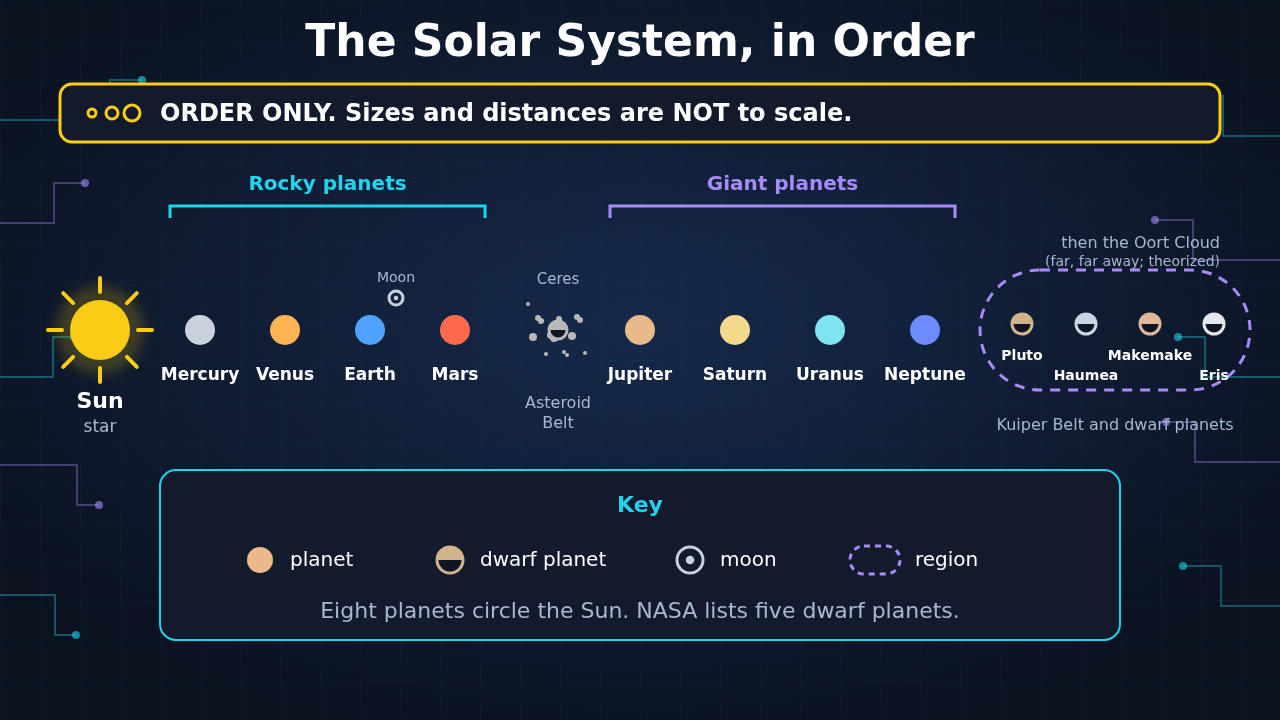
The order is true. The sizes and distances are not to scale.
Now we need a way to measure the big gaps. Scientists use the astronomical unit (AU).
One AU is the distance from the Sun to Earth. That is about 93 million miles (150 million kilometers).
NASA says Jupiter is 5.2 AU from the Sun. Neptune is more than 30 AU away.
Now look at the distance picture. Every dot is in its true place along the line.
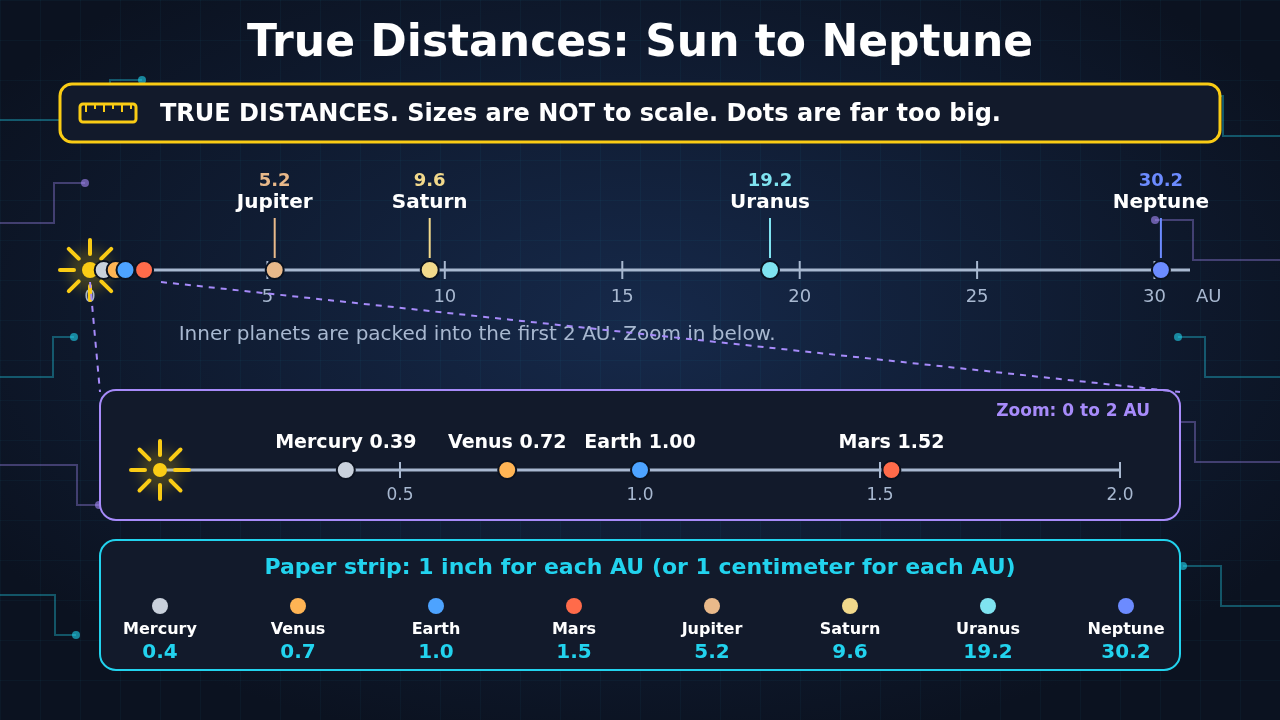
The spots are in the true places. The dots are far too big.
But the dots are far bigger than the real planets. Real planets would be too tiny to see.
The planets are not spread out evenly. The inner planets are close together. The outer planets are far apart.
Sunlight takes about eight minutes to reach Earth. NASA says it takes 43 minutes to reach Jupiter.
Now look at the size picture. Here the sizes are true, but the gaps are not.
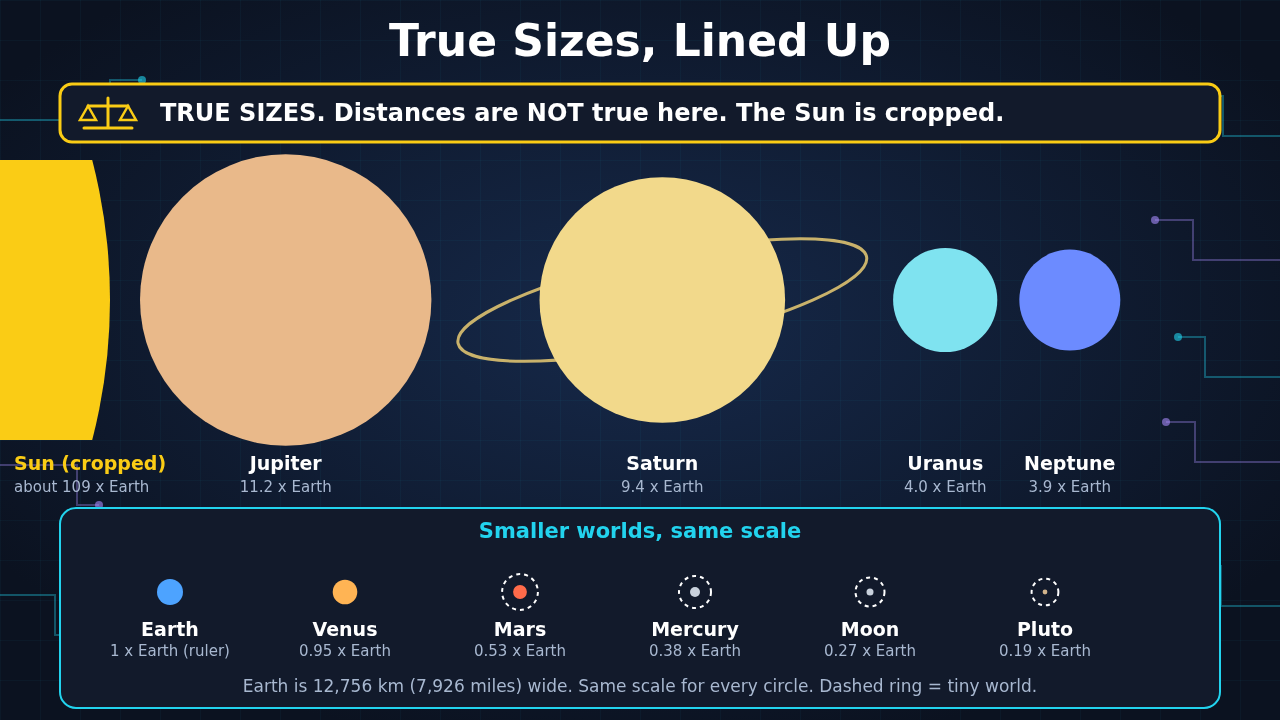
The sizes are true. The gaps between worlds are not.
Jupiter is the biggest planet. NASA says it is 11 times wider than Earth.
The Sun is much bigger. NASA says it is about 100 times wider than Earth.
That is why the picture shows only the edge of the Sun. The whole Sun will not fit on the page.
Each picture tells one thing true and leaves another thing out. Every picture says which.

Why use three pictures? Because one picture can fool us.
To fit them all, a picture must shrink the gaps or the planets.
So ask two questions about any space picture. Is the size true? Is the distance true?
People also sort space objects into groups. Groups help us talk about them.
In 2006, the International Astronomical Union (IAU) voted on what to call a planet.
Pluto was found in 1930. For many years it was called the ninth planet.
NASA says Pluto was reclassified as a dwarf planet in 2006.
Not every astronomer voted the same way. The IAU posted the vote counts. Those counts are for two Pluto votes.
The IAU says the planet rule passed with a great majority. It gave no count.
Fun fact: Mercury goes around the Sun in 88 Earth days. NASA says Neptune takes 165 Earth years.

Goal: Make a scale model of the solar system on a paper strip. A scale model is a small copy that keeps the right proportions.
- Cut the strip. Make it 31 inches (79 centimeters) long. String works too.
- Mark the Sun. Put a dot at the left end.
- Use 1 inch for each AU. Or use 1 centimeter for each AU.
- Mark Earth. Make a mark 1 inch from the Sun. That is 1 AU.
- Mark the inner planets. Mercury: 0.4 inch.
- Venus: 0.7 inch. Mars: 1.5 inches.
- Mark the giants. Jupiter: 5.2. Saturn: 9.6.
- Uranus: 19.2. Neptune: 30.2 inches.
- Compare. Earth is 1 inch out.
- Jupiter is 5.2 inches out. So Jupiter is about five times farther.
The real Sun would be a speck on this strip. It would be smaller than a pencil dot.
Check your thinking: Earth is at 1 inch. Neptune is at about 30 inches.
So Neptune is about 30 times farther from the Sun than Earth. NASA says the same.
Talk about it: Which surprised you more: close inner planets or faraway Neptune?

You can use this idea any time you see a picture of space.
First ask what the picture shows. Is it the order, the size or the distance?
Then ask what it leaves out. Look for the words “not to scale.”
What next? The Moon is our closest neighbor. Find out how far away it is in How Far Is the Moon?.
Keep exploring
Next lesson: How Far Is the Moon?. Zoom in on the Moon and build a string model. Then try How Long Does It Take to Get to the Moon?.
Explore the solar system in Solar System X. It is a free interactive map with 35 objects, including 16 moons.
Try Earth, Saturn or Uranus. Open the true sizes view to compare the planets.
Related lessons:
- How Far Is the Moon?: how far away the Moon is.
- How Long Does It Take to Get to the Moon?: how long a trip to the Moon takes.
- Why Is the Sky Blue?: why sunlight makes a blue sky.
More free lessons: All lessons, Free STEM samples and the Practice Zone.
For advanced learners
Ready for more? These are deeper facts from the sources we used. Read them with a grown-up.
Think deeper:
- NASA’s Planets page says there are eight planets and five officially recognized dwarf planets. How many is that in all?
- The IAU’s 2006 definition of a planet has three tests. Which test does Pluto not pass?
- NASA’s Earth page says sunlight takes about eight minutes to reach Earth. NASA’s Jupiter page says 43 minutes. Which planet is farther from the Sun?
Counts and dates. NASA’s Planets page says eight planets and five officially recognized dwarf planets: Ceres, Pluto, Haumea, Makemake and Eris. NASA’s Dwarf Planets page adds that the IAU says there may be more.
Moon counts change. NASA’s Saturn Facts page says 274 confirmed moons as of March 2025.
NASA’s Saturn Moons page says 293 as of August 2026. We say “hundreds” (NASA’s word) and show each count with its source and date on the Saturn page in Solar System X.
Why did Pluto change? The IAU’s 2006 definition of a planet has three tests: it orbits the Sun, it is nearly round, and it has cleared the neighborhood around its orbit. Pluto passes the first two but not the third.
The IAU vote page says Resolution 6A, on Pluto-class objects, passed with 237 votes in favor, 157 against and 17 abstentions. Resolution 6B, on “Plutonian Objects,” got 183 in favor and 186 against.
NASA’s Pluto page says other objects might cross Pluto’s orbit.
Distance picture: where the numbers come from. Each position is the average distance from the Sun (semi-major axis) on the NASA NSSDC fact sheet for that planet, divided by Earth’s 149.598 million km, which NSSDC defines as 1 AU. That gives Mercury 0.39, Venus 0.72, Earth 1.00, Mars 1.52, Jupiter 5.20, Saturn 9.57, Uranus 19.16 and Neptune 30.18 AU.
We round to one decimal on the strip. NASA’s Jupiter page says 5.2 AU and its Neptune page says “more than 30 times” Earth’s distance.
Sources differ a little for the two farthest giants. The NSSDC table gives Saturn 9.57 and Neptune 30.18 AU.
NASA’s JPL table of approximate planet positions (Table 1) gives Saturn 9.54 and Neptune 30.07 AU. That is about 0.03 AU less for Saturn and about 0.11 AU less for Neptune, or about 0.03 inch and 0.11 inch on the strip.
NASA’s Saturn page says 9.5 AU and its Neptune page says 30 AU, with fewer digits. We use the NSSDC numbers and do not say which source is better.
Size picture: the math. Each circle is the NSSDC equatorial diameter divided by Earth’s 12,756 km. For the giant planets, that is measured at the 1 bar pressure level.
Jupiter is 11.2 times Earth’s width (NASA’s Jupiter page rounds to 11). The Sun is 1,391,400 km wide, which is 109.1 times Earth’s width.
NASA’s Sun page says “about 100 times” wider. Both are rounded in different ways, so we show NASA’s wording in the text and the 109 in the picture note.
Scale model. At 1 inch per AU the Sun’s width is 1,391,400 ÷ 149,598,000 = 0.0093 inch, which is smaller than a pencil dot. Neptune sits at 30.18 inches, so a 31 inch (79 centimeter) strip is enough.
These are our calculations from the NASA numbers above.
Light time. NASA’s Earth page says it takes about eight minutes for light from the Sun to reach Earth and lists 8.350022 minutes one way. NASA’s Jupiter page says 43 minutes.
Our check: Jupiter at 5.20 AU times 499.0 seconds per AU is about 43 minutes.
Year lengths. NASA says Mercury circles the Sun every 88 Earth days. NASA’s Neptune page says in 2011 Neptune completed its first 165-year orbit since its discovery in 1846.
A planet’s year can be measured against the stars or against the seasons. We use NASA’s own numbers.
Not to scale. The order picture is a diagram. It does not show distances, sizes or orbit shapes.
The Kuiper Belt dwarf planets are drawn as a group, not in order of distance. NASA has no direct images of the Oort Cloud, so we only mention it.
Supplemental. This free lesson is a STEM aid for home or summer learning. It does not replace a school curriculum.
Word bank
- Solar system — The Sun and everything that travels around it.
- Sun — The star at the center of our solar system.
- Star — A ball of hot gas that makes its own light.
- Gravity — A pull between things. Bigger things pull harder.
- Planet — A large world that circles the Sun.
- Orbit — The path one thing takes around another.
- Moon — A smaller world that circles a planet.
- Dwarf planet — A small, round world that circles the Sun.
- Asteroids — Rocky leftovers from when the planets formed.
- Comets — Snowballs of ice, rock and dust.
- Astronomical unit (AU) — The distance from the Sun to Earth.
- Scale model — A small copy that keeps the right proportions.
Sources: NASA Science: Planets; NASA Science: Sun Facts; NASA Science: Earth Facts; NASA Science: Jupiter Facts; NASA Science: Neptune Facts; NASA Science: Pluto Facts; NASA Science: Dwarf Planets; NASA Science: Moons of Our Solar System; NASA NSSDC: Planetary Fact Sheet; NASA JPL Solar System Dynamics: Approximate Positions of the Planets; IAU: Result of the 2006 resolution votes; IAU Resolutions B5 and B6 (2006); NASA Science: Comets; NASA Science: Asteroid Facts; NASA Science: Mercury Facts; NASA Science: Saturn Facts; NASA Science: Saturn Moons.
Made by K12 Summer Workbooks. Text and pictures are original.